
TL;DR
A dining table defines how a room breathes, who gathers, and what conversations unfold across its surface. The seven styles explored here go beyond aesthetics into structural decisions that shape daily life. Understanding the subtle interplay between material weight, leg geometry, and spatial proportion lets you choose a table that does not just fill a room but commands it quietly for decades.
Introduction
Walk into any well-loved home and the dining table tells you everything before a single word is exchanged. It betrays whether the owners favour long, unhurried meals or quick breakfasts before the school run. It reveals their tolerance for maintenance, their appetite for visual drama, and their unspoken rules about how people should sit together. Most furniture purchases are utilitarian.
A dining table is autobiographical. The seven styles that follow are not ranked by trendiness or price bracket. They are arranged by the distinct architectural conversation each one starts with the room around it, and the honest truth is that getting this decision right saves you from the quiet regret of living with a piece that never quite belonged.
1. The Solid Wood Farmhouse Table With Turned Legs
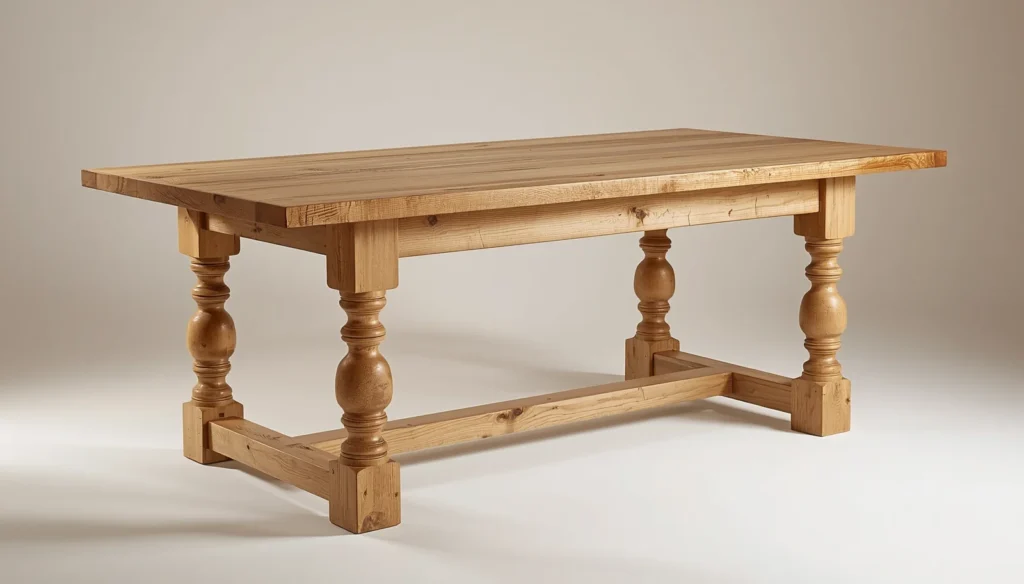
The solid wood farmhouse table is the oldest story in domestic furniture, and it remains the hardest to fake convincingly. Mass-market reproductions mimic the silhouette with veneered particleboard and hollow legs, but genuine versions carry a density that transfers through the floorboards.
You feel it when you lean an elbow on the edge. The turned legs, typically lathe-shaped from a single block of oak or pine, provide more than ornamental value. Their bulbous lower sections add mass low in the structure, which prevents the lateral wobble that plagues lighter tables after years of use.
Why Turned Legs Survived Industrialisation
Turned legs predate flat-pack logic by centuries. The technique originated when woodworkers realised that rotating a timber blank against a fixed cutting tool produced symmetrical curves far stronger than hand-carved equivalents. This matters today because the continuous grain running through those curves resists splitting along the length of the leg.
Factory-made tables with straight, glued-up legs often fail at the joint where horizontal stress concentrates. A properly turned leg distributes weight down its curved profile, which is why antique farmhouse tables still stand level on uneven stone floors while newer pieces develop a drunken lean.
The Finish That Ages Honestly
Farmhouse tables invite abuse in ways that polished surfaces never will. Hot dishes leave ghostly white rings on lacquered tops but sink into oil-finished wood and gradually darken into the patina. That word, patina, has become marketing fluff for anything distressed with sandpaper at the factory.
Real patina is the accumulated evidence of meals eaten, wine spilled, and candles dripped, and it cannot be replicated by a machine. Choosing a raw or lightly oiled surface means accepting that the table will look worse before it looks better. The first six months are awkward. Then the surface deepens into something no showroom piece ever achieves.
2. The Mid-Century Modern Walnut Table With Tapered Legs
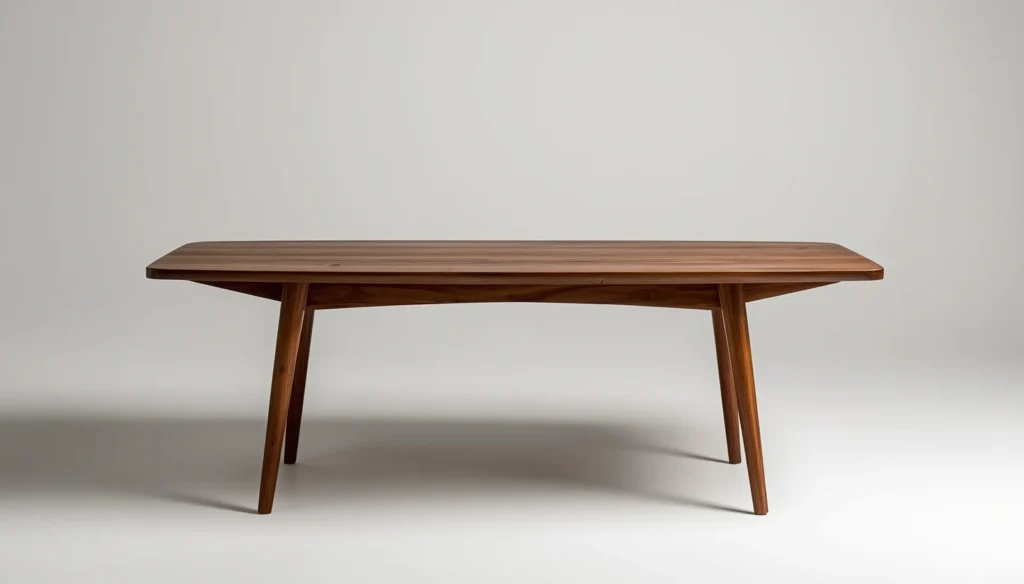
Mid-century modern dining tables operate on a principle of visual subtraction. Every element that does not perform a structural job gets eliminated, and what remains is pared down to its most elegant proportion. Walnut became the timber of choice during this period because its naturally dark, straight grain provided drama without needing ornate carving. The tapered leg, thinner at the floor than at the apron, reverses the visual logic of the farmhouse table. Where turned legs anchor downward, tapered legs create a sense of lift that makes even a six-seater appear to float.
The Engineering Inside the Angle
That taper is not arbitrary. Reducing the leg diameter by roughly one-third from top to bottom shifts the visual centre of mass upward, which tricks the eye into perceiving less floor obstruction. This optical effect enlarges small dining rooms more effectively than glass tops, which reflect light but also reflect every fingerprint and crumb.
The engineering risk is lateral racking. A slender leg anchored only at the apron corner can twist under load if the joinery is not reinforced. Quality mid-century pieces use a triangular corner block screwed into both apron sides, hidden from view but critical for decades of stability.
Living With Walnut’s Sensitivity
Walnut is photochromic, meaning it lightens considerably when exposed to direct sun over years. A table placed near south-facing windows will develop a noticeable gradient unless rotated seasonally. This is not a flaw so much as a behavioural trait you either accommodate or resent. Covering the table with a cloth for half the year defeats the purpose of owning timber with such depth. The alternative is embracing the slow shift as part of the table’s life in your specific home. No two walnut tables age identically because no two dining rooms share the same light.
3. The Round Pedestal Table With a Central Column Base
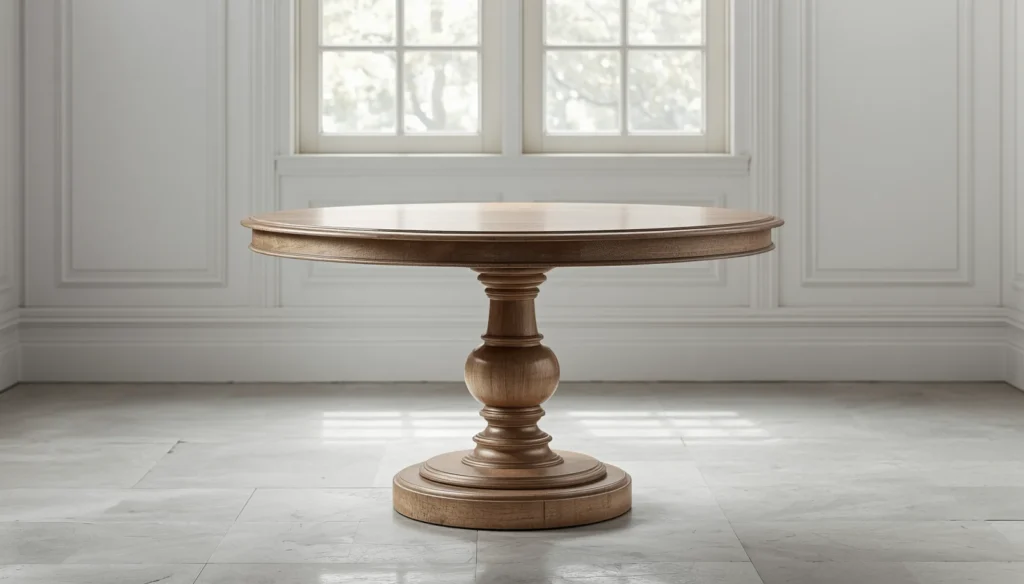
Round tables solve a spatial problem that rectangular ones cannot. In square rooms, they centre the dining zone without dictating a head-of-table hierarchy that some families find stiff or needlessly formal. The pedestal base, a single central column supporting the entire weight, also eliminates the awkward corner legs that trap chairs and bruise shins.
Where four-leg tables demand that chairs align with the leg spacing, a pedestal allows any number of chairs to slide under at any angle. This flexibility sounds trivial until you host a dinner where the guest count shifts from six to nine at the last minute.
The Cantilever Challenge No One Discusses
A pedestal base must resist a force that four-leg tables never face: the lever effect of a heavy elbow pressing down on the table edge far from the centre support. The base’s footprint becomes the fulcrum point, and if it is too narrow, the entire table can tip.
Quality manufacturers counter this with a heavy cast-iron plate inside the base or a cross-shaped foot that extends close to the table’s perimeter without becoming a tripping hazard. Testing this in a showroom is simple. Sit at the edge, place both elbows on the surface, and lean in with your full weight. If the far side lifts even slightly, the engineering has been compromised for aesthetics.
Material Choices for the Central Column
Pedestal bases appear in turned wood, cast metal, or sculptural fibreglass, and each material changes the acoustic quality of the room. A hollow metal column rings slightly when struck, which amplifies the clatter of cutlery. Solid wood absorbs sound and feels acoustically warmer during meals. This is the sort of detail no salesperson volunteers because buyers rarely ask. Living with a resonant pedestal in a room with hard floors and bare walls can make dinner conversation feel like shouting across a canteen. The fix is a felt pad glued inside the column or a rug beneath, but knowing the issue exists before purchase is half the solution.
4. The Extendable Dining Table With Butterfly or Drop-Leaf Mechanisms
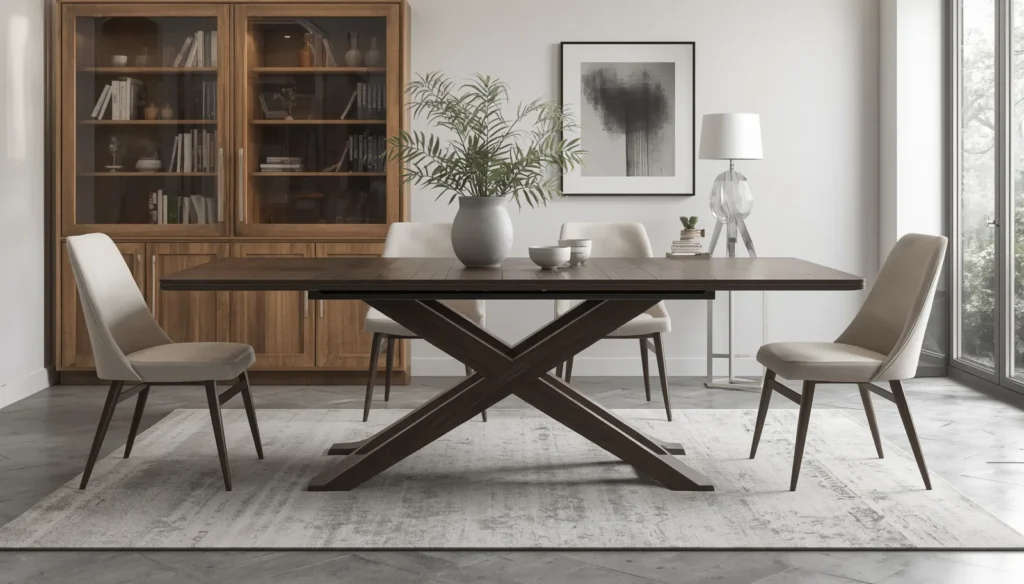
Extendable tables serve a dual life that fixed-top tables cannot. They stay compact for daily meals and expand for gatherings, which makes them the pragmatic choice for homes where square footage is finite. The mechanism inside determines whether the table becomes a treasured heirloom or a source of muttered frustration. Butterfly leaves, which fold and store within the table itself, eliminate the problem of where to stash loose panels. Drop-leaf sides, hinged along the table’s length, let the surface nearly double when raised and propped on swing-out supports.
Mechanism Quality Is Everything
A cheap extension mechanism announces itself with a graunching sound and a wobble that suggests misaligned gears. Smooth extension depends on hardwood runners, preferably waxed, sliding within precisely routed channels. Metal gear systems exist and can be excellent, but the teeth must be cut rather than stamped. Stamped gears wear unevenly and eventually slip, leaving one side of the table slightly higher than the other. Testing this in person means extending and collapsing the table three times in succession. The motion should feel consistent, not looser on the third attempt than the first.
The Gap That Betrays Its Age
Every extendable table develops a slight gap where the two halves meet when closed. This is normal. What separates quality from compromise is the gap’s width and uniformity. A hairline crack that runs dead straight signals precise joinery and stable wood. A gap that widens toward one end suggests the timber has cupped or the mechanism is torquing unevenly. This is repairable but expensive. Running a fingertip along the centre seam tells you more about the table’s structural health than any brochure copy ever could.
5. The Glass-Top Dining Table With a Sculptural Metal Base
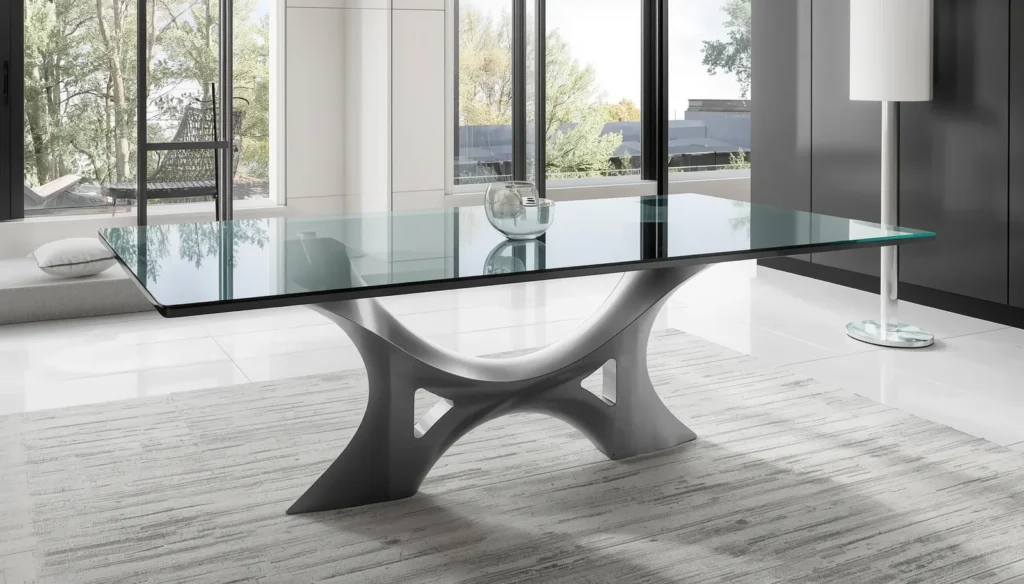
Glass-top tables carry a reputation for being high-maintenance, but the truth depends entirely on the base material and the glass’s thickness. Tempered glass at least twelve millimetres thick resists chips and distributes impact better than thinner panels.
The base becomes the visual anchor, often in brushed brass, blackened steel, or powder-coated aluminium shaped into intersecting geometric planes. Because glass removes visual mass from the room’s centre, these tables excel in apartments where every square metre must feel airier than it physically is.
The Fingerprint Equation
Clear glass reveals everything. Water spots, oil smears, dust settling in real time. This transparency forces a daily discipline that some owners find meditative and others find maddening. Frosted or smoked glass masks fingerprints but also mutes the reflective quality that makes glass appealing in the first place. The compromise is a low-iron glass with a subtle grey tint that reads as cooler and hides marks marginally better than standard green-tinted float glass. There is no fully maintenance-free option, only a spectrum of tolerable upkeep.
What the Base Must Withstand
A glass top resting on a metal frame relies on small silicone or rubber pads at each contact point to prevent the glass from sliding and to absorb vibration. These pads degrade over five to seven years, hardening and losing grip. The first sign is a faint rattle when someone sets down a heavy platter.
Replacing them is simple and costs little, but ignoring them risks a stress fracture where the pad has thinned. Glass under tension can fail suddenly, and a dining table collapse is not a quiet event. Checking those pads annually is the sort of preventive habit that separates long-term owners from regretful ones.
6. The Live-Edge Slab Table With Epoxy Resin Inlays
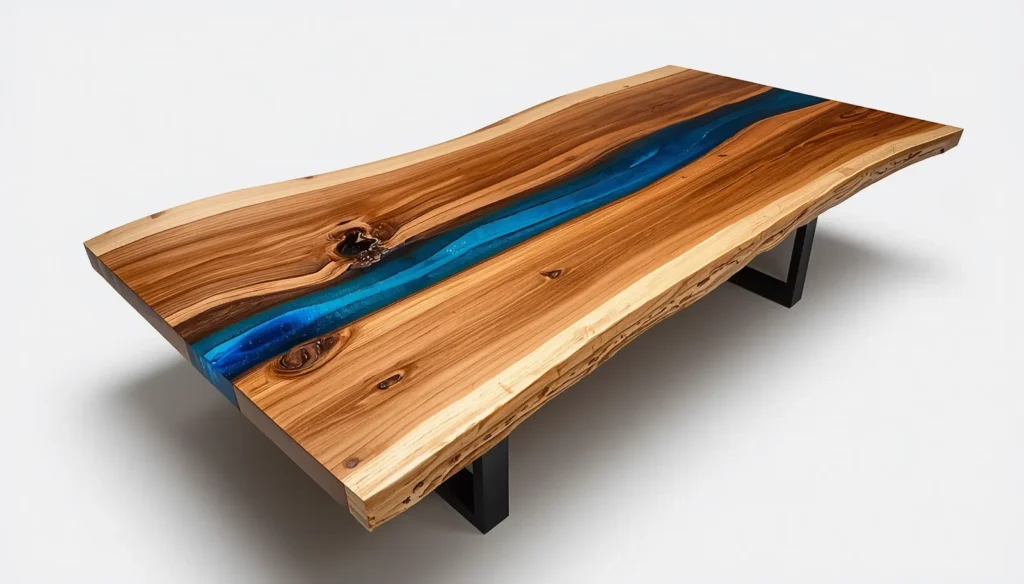
Live-edge tables preserve the natural contour of the tree’s outer edge, bark stripped away but the wavy silhouette kept intact. Each slab is unique because no two trees grow identically. The trend toward filling voids and fissures with tinted epoxy resin has created a subcategory that walks the line between furniture and art. A deep blue or black resin river running through a golden acacia slab can anchor an otherwise neutral room with startling effectiveness. But epoxy introduces a material mismatch that carries long-term consequences worth understanding.
Wood Moves, Epoxy Does Not
Timber expands and contracts with seasonal humidity changes. Epoxy, once cured, is dimensionally stable. Where the two materials meet, the wood will try to pull away or press against the resin, and over enough cycles, hairline separations can form along the bond line.
A quality build mitigates this with bowtie inlays or steel C-channels routed into the underside to stabilise the slab, but no technique eliminates the differential entirely. Homes with stable humidity levels fare better, which means a live-edge table in a coastal cottage without climate control will show stress faster than one in a sealed city apartment.
The Weight Consideration
A single live-edge slab two inches thick and seven feet long can weigh over two hundred pounds before the base is attached. Moving it requires planning, professional help, and floors that can bear concentrated weight without indentations. The payoff is a table that feels immovable in the best sense, a piece that anchors not just the room but the entire floor plan.
The tradeoff is that rearranging furniture stops being a spontaneous Sunday afternoon impulse and becomes a logistical operation. Knowing your tolerance for that permanence separates informed enthusiasm from impulsive acquisition.
7. The Marble-Topped Table With a Brass or Brushed Steel Base
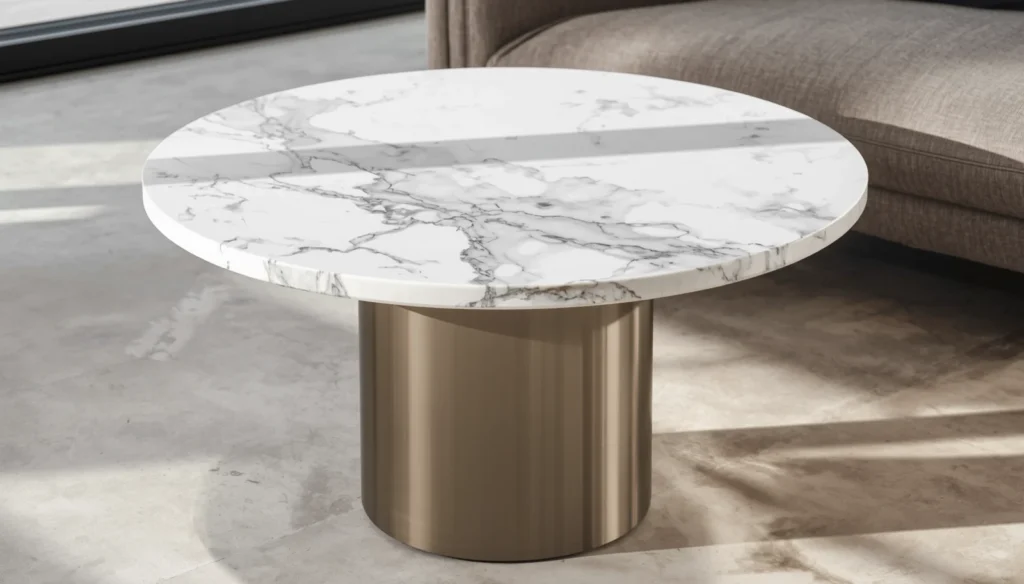
Marble dining tables occupy the top tier of formal dining presence. The veining patterns, whether bold and dramatic in Calacatta or fine and feathery in Carrara, ensure every surface is a one-off. The coolness of the stone under your palm signals a permanence that wood and glass cannot match. Marble also brings two practical considerations that affect daily life more than most buyers anticipate. It stains and it etches, and these two processes are not the same thing.
The Distinction Between Staining and Etching
Staining occurs when a coloured liquid like red wine or beet juice penetrates the stone’s porous surface and leaves pigment behind. Sealing reduces porosity but does not eliminate it, and sealants wear away with cleaning. Etching is a chemical reaction. Acidic substances including lemon juice, vinegar, and tomato sauce dissolve the calcium carbonate in marble, leaving dull spots that look like stains but are actually microscopic surface erosion.
No sealant prevents etching because the acid attacks the stone itself, not just what has soaked into it. This means a marble table will develop a lived-in patina of marks that tell the story of every meal served upon it. Some owners treasure this as wabi-sabi authenticity. Others find it unbearable. Identifying which camp you belong to before purchasing saves thousands in buyer’s remorse.
The Base That Carries the Weight
Marble tops need bases engineered for immense static load. A brass or brushed steel frame with a full perimeter lip rather than isolated contact points distributes the stone’s weight evenly and reduces the risk of a stress crack developing from a dropped pot.
The junction between metal and stone should include a thin cork or felt gasket that prevents the harder metal from abrading the marble’s underside during temperature-driven expansion and contraction. Skipping this gasket is a cost-cutting measure common in budget imports, and it leads to a fine marble dust accumulating on the floor beneath the table over time, the stone slowly grinding itself down against its own support.
Wrap Up
A dining table is the slowest piece of furniture you will ever buy. It does not wear out like a sofa or date itself like a lamp. The seven styles here map to seven ways of living, not seven trends to chase. The solid farmhouse table asks for patience with its finish but rewards with generational sturdiness.
The live-edge slab demands climate awareness but delivers singularity no factory run can replicate. Whichever path you choose, the table will outlast your current home, your current tastes, and quite possibly your current decade. Choose the one whose compromises you can live with happily, because every table has them, and the best ones wear them as character.
FAQs
What shape dining table works best in a rectangular room?
A rectangular or oval table usually mirrors the room’s proportions and allows the most comfortable traffic flow around all sides. Round tables in long narrow rooms often leave awkward dead zones at each end.
How do I protect a wood dining table from heat marks without using tablecloths?
Place felt-bottomed trivets or thick cork mats under hot dishes, and avoid silicone mats that can trap moisture against the wood finish. Re-oiling the surface every six months also helps the wood resist heat penetration.
Is a marble dining table worth the maintenance for a family with young children?
It depends on your tolerance for visible wear. Marble will etch and stain over time despite diligent sealing. Families who see those marks as part of the table’s evolving story often find the stone’s beauty worth the upkeep, while those who prefer pristine surfaces may regret the choice.
Disclaimer:
The content shared by Fall Rugs is solely for research and informational purposes. Fall Rugs is not a professional interior design or home renovation consultancy, and the information provided should not be considered professional advice for home improvement or decor. All ideas and suggestions are based on current trends and general knowledge in the home decor industry.