
TL;DR
A breakfast nook does not have to sacrifice space to gain charm. These eight design ideas fold storage directly into seating, cabinetry, and architecture so nothing goes to waste. Each concept suits tight kitchens where every square foot carries double duty.
Introduction
What do you do when the kitchen is too small for a proper dining table but too important to leave without a gathering spot? Most people buy a tiny table, push it against the wall, and call it done. The ones who live there longest, the ones who stop noticing the cramped square footage, built a breakfast nook instead.
Not the decorator-catalog kind that photographs beautifully and stores nothing, but a working nook where the bench seat lifts, the banquette wraps around a base full of baskets, and the wall above earns its place. These eight ideas come from that second category: spaces where the storage is part of the furniture and the furniture is part of the room.
1. Lift-Top Bench Seating with Hinged Compartments
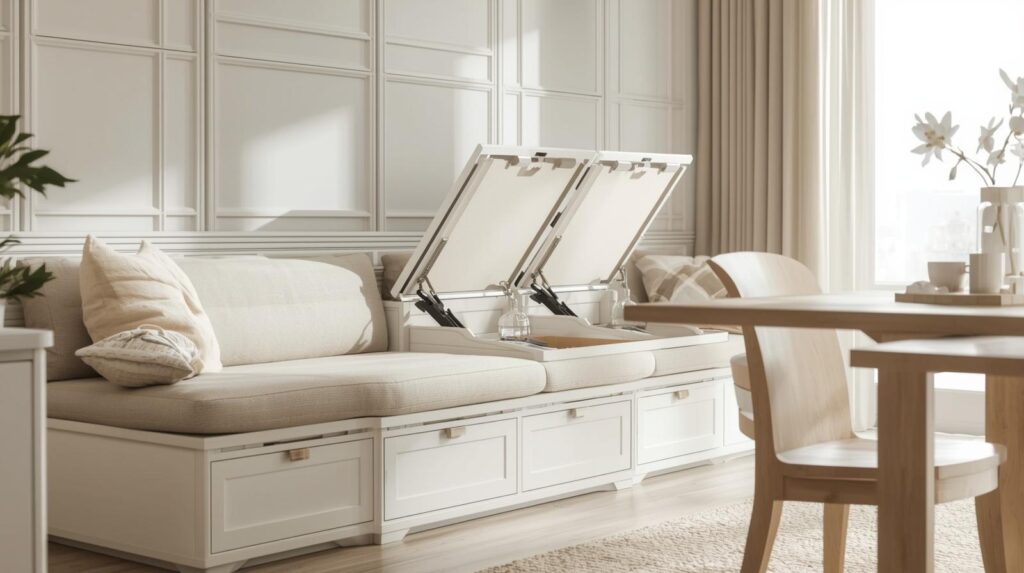
The oldest trick in built-in furniture design is still the most useful. Bench seating with a hinged top turns the entire underside of a nook seat into a cabinet without adding a centimeter to the room’s footprint. The bench base becomes a chest for seasonal table linens, extra throw pillows, children’s art supplies, or anything that needs a home but not daily access.
The hinge mechanism matters more than most buyers realize. A soft-close pneumatic hinge holds the lid open while you reach inside without requiring a hand to prop it. Older piano-hinge designs let the lid fall unexpectedly and usually win an argument with whoever is seated closest. When specifying this build, ask for 18-gauge steel hinges rated for repeated daily use rather than the decorative hardware that ships with flat-pack alternatives.
A family in a 1940s bungalow in central Ohio redid their breakfast corner using two runs of hinged bench seating on perpendicular walls. The combined interior storage came to roughly eleven cubic feet, which absorbed every board game they owned, the dog’s winter accessories, and two sets of seasonal placemats. The kitchen table disappeared and the nook became the only eating surface in the house. Nobody missed it.
2. Drawer Bases Instead of Solid Plinths
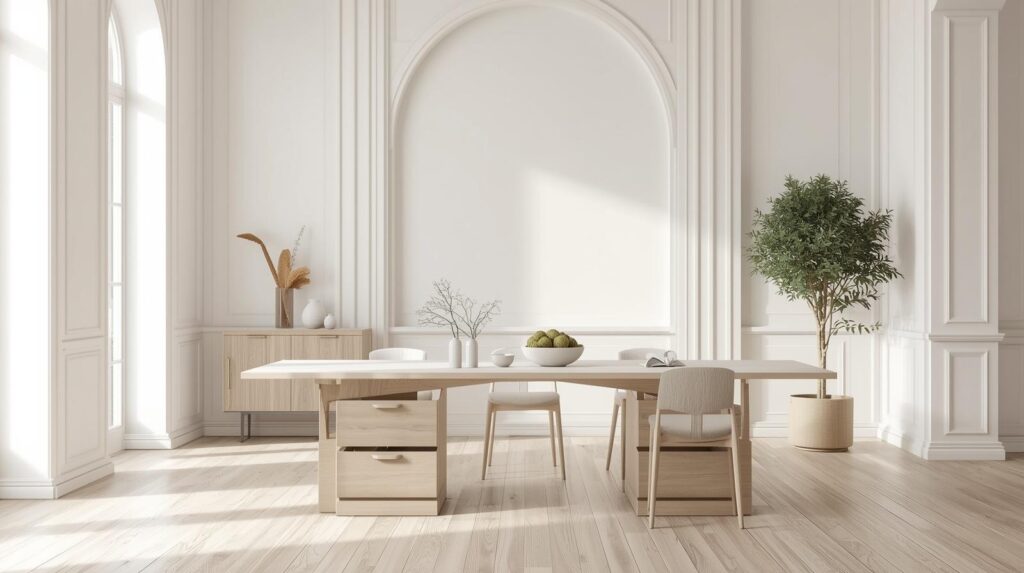
Where a hinged lid feels disruptive to daily use, pull-out drawers solve the access problem cleanly. A banquette with drawer bases lets someone retrieve a napkin or a set of coasters without asking the person seated to stand up. The drawers run perpendicular to the bench face, typically four to six inches deep depending on seat height.
Drawer construction quality creates the difference between furniture that feels built-in and furniture that feels like a workaround. Dovetail-jointed solid wood drawers on full-extension runners outlast MDF boxes on partial-extension slides by a decade or more. The added cost is real, but the tactile satisfaction of a well-running drawer in a fitted space compounds over years of daily use.
The proportions matter visually too. A row of three equal-width drawers across the bench front reads as furniture. A single wide drawer panel with a flush finger pull reads as architecture. The second approach suits formal or minimalist kitchens where visible hardware breaks the room’s rhythm.
3. Built-In Banquette with Under-Seat Baskets
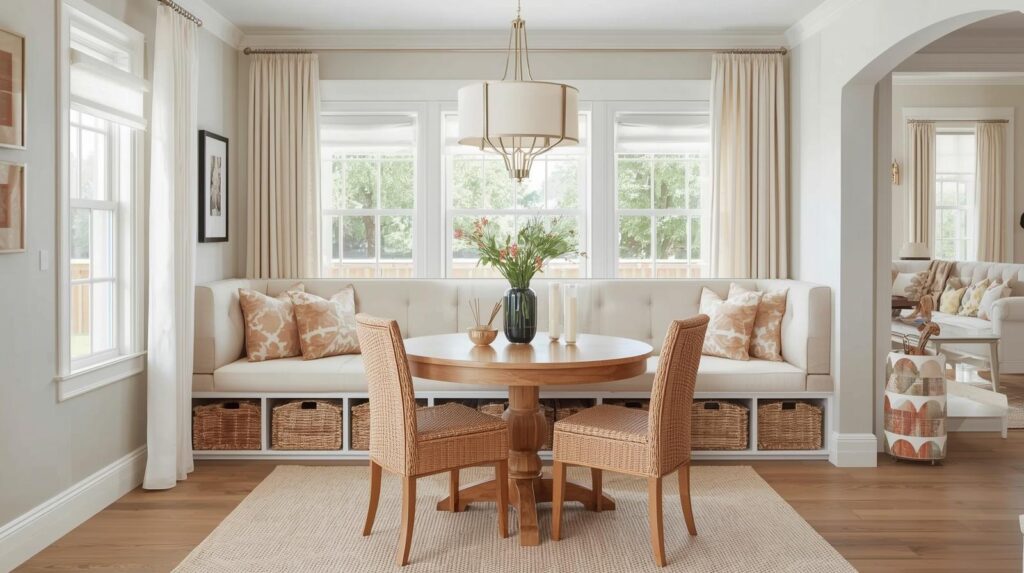
Not every storage idea requires a carpenter. Open-base banquettes with basket inserts solve the storage problem at a fraction of the cost of custom cabinetry and offer the added benefit of easy reconfiguration. The bench frame sits on legs raised four to six inches off the floor, and woven or wire baskets slide underneath like a card catalog.
Rattan baskets suit warm, natural kitchens. Wire mesh baskets with powder-coated frames read more industrial. Fabric-covered bins work in softer color schemes. The point is not the material but the organizing logic: each basket holds a category, and pulling one out is faster than opening a cabinet door.
A food blogger who documents weekday cooking shared that she keeps her most-used aprons, pot holders, and folded dish towels in the two baskets directly under her corner bench seat. She estimated she had been walking to the linen drawer across the kitchen roughly forty times a week before the nook was built. Proximity storage is underrated in kitchen design.
4. Window Seat Nook with Deep Window-Sill Shelving
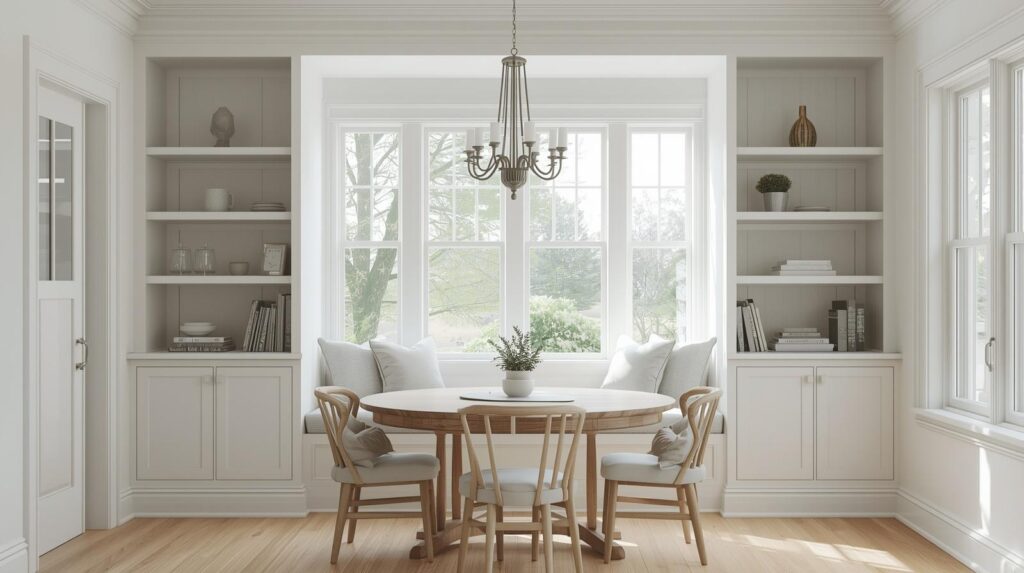
A breakfast nook positioned under a window gets the obvious benefit of natural light and the less obvious benefit of a deep architectural ledge. Window sills in older homes often run eight to twelve inches deep, deep enough for a continuous shelf that holds cookbooks, potted herbs, or a small collection of ceramic pieces.
The seat itself in this configuration typically sits at the standard bench height of 18 inches while the window sill begins four to six inches above the seat back. That gap is dead space in most window seat designs. A fitted backrest cushion that stops short of the sill, combined with a row of small baskets or purpose-cut cubbies at the sill level, makes that zone functional without crowding the view.
Lighting changes the character of the whole nook. A single pendant hung just above the window frame, rather than at center-ceiling, keeps the reading and eating light directed at the table rather than bouncing off the glass. It also makes the nook feel like a distinct room within the room, a design effect worth intentionally pursuing in an open-plan kitchen.
5. Corner Booth Design with Wrap-Around Cabinet Base
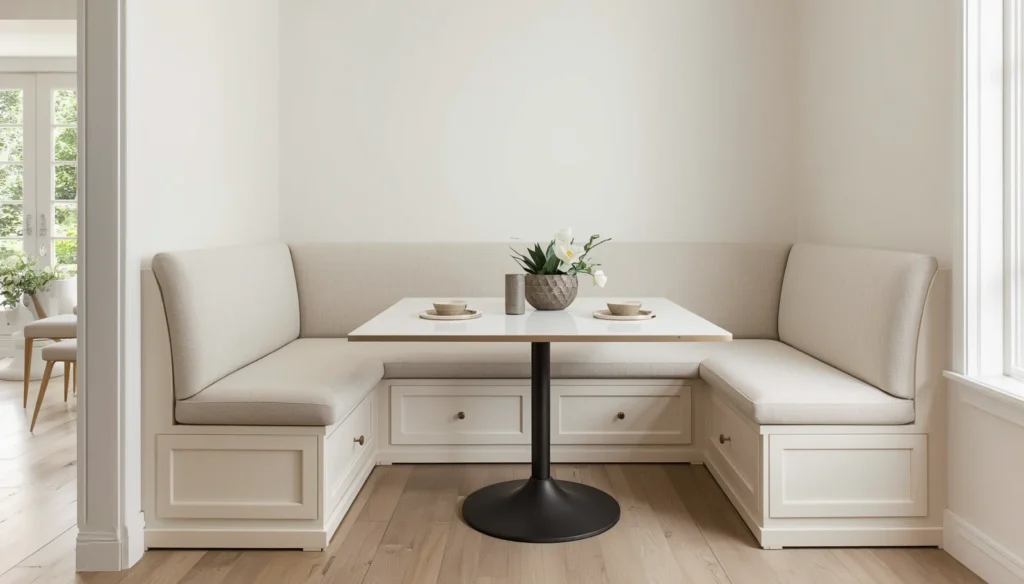
A corner breakfast booth is the most spatially efficient nook configuration because it uses two walls simultaneously and anchors naturally into what would otherwise be dead corner space. The L-shaped or U-shaped bench meets at the corner, and the cabinet base beneath can run continuously along both walls, creating a wraparound storage zone that matches the seating perimeter.
Corner cabinets present the usual interior-access challenge: the back corner of any L-shaped cabinet is hard to reach. Lazy Susan inserts, pull-out shelves, or corner drawers with diagonal faces solve this in kitchen cabinetry and they solve it equally well under nook seating. A lazy Susan base inside the corner bench section turns the least accessible point into genuinely useful daily storage.
The table in a corner booth is typically pedestal-based rather than four-legged, which matters for both seating access and cleaning underneath. A cast-iron pedestal with a round or oval top suits a farmhouse aesthetic. A chrome tulip base suits a mid-century or Scandinavian room. The pedestal style is not merely decorative; it allows two people to slide into the inner corners without a table leg in the way of every entry.
6. Floating Shelf Wall Above the Table
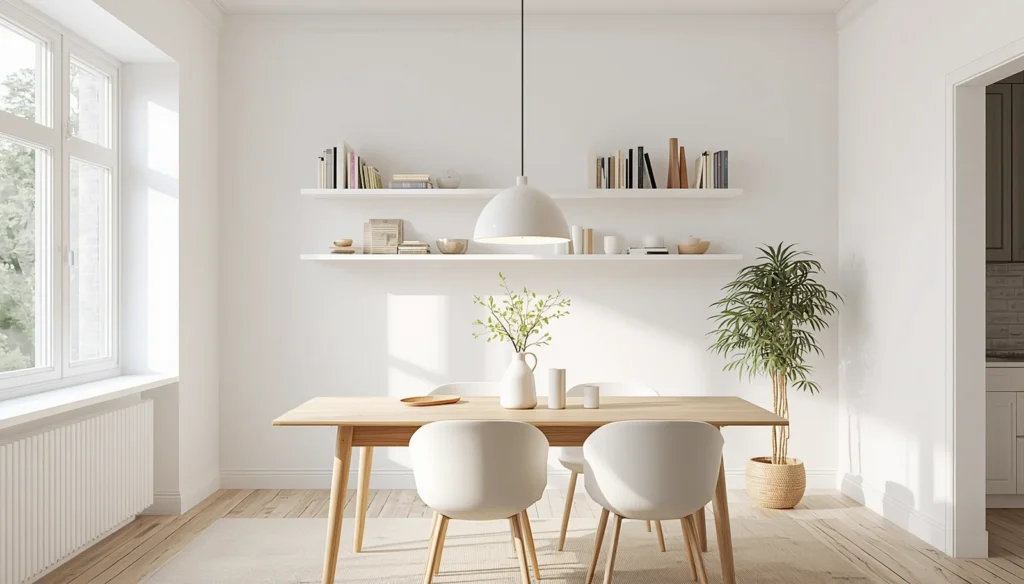
Bench storage handles what goes below the table. A gallery-style floating shelf wall handles everything above it. The zone between the table surface and the ceiling in a breakfast nook is often treated as decoration space, but it can carry real organizational weight with the right shelf placement.
One practical configuration uses two shelf depths: a deeper lower shelf at roughly 56 inches from the floor, which holds cookbooks, a small speaker, or a charging dock, and a shallower upper shelf at about 72 inches that holds displayed objects or seasonal decor. The depth difference creates visual layering and prevents the wall from reading as a storage unit rather than an intentional composition.
Shelf material consistency with the nook seating ties the whole corner together. If the bench base is painted white oak, the shelves should repeat either the white paint or the oak tone. Mixing both is fine; mixing three or four different materials in a tight zone reads as unresolved. Color discipline in small spaces is not timidity, it is the thing that makes compact design feel intentional.
7. Nook with Built-In Cabinet Columns on Each Side
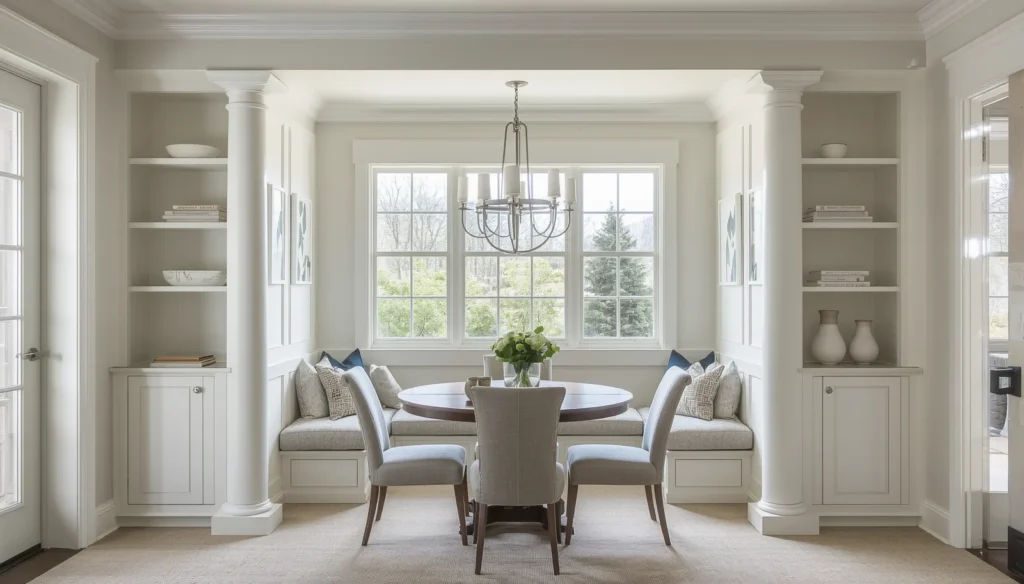
Where the breakfast nook sits between two walls rather than in a corner, the flanking walls become opportunities for tall cabinet columns that frame the seating like a built-in booth at a restaurant. These columns can run floor to ceiling, turning what are often blank wall sections into organized, closed storage.
The upper portion of a flanking column typically holds items accessed weekly rather than daily: extra sets of china, serving platters, seasonal napkin collections. The lower portion, at bench height and below, holds items needed at the table: condiment jars, napkin rings, place mat storage. The organizational logic mirrors the physical access logic.
In a Brooklyn apartment renovation shared by an interior detailing firm, a 7-foot-wide breakfast alcove gained fourteen linear feet of cabinetry across two flanking columns without reducing the seating area by a single inch. The family had previously been storing the overflow on the kitchen counter, a habit that made the counter perpetually feel smaller than it was. Moving that category of items into the nook columns freed the counter and changed how the kitchen felt to work in.
8. Built-In Bench with Toe-Kick Drawers
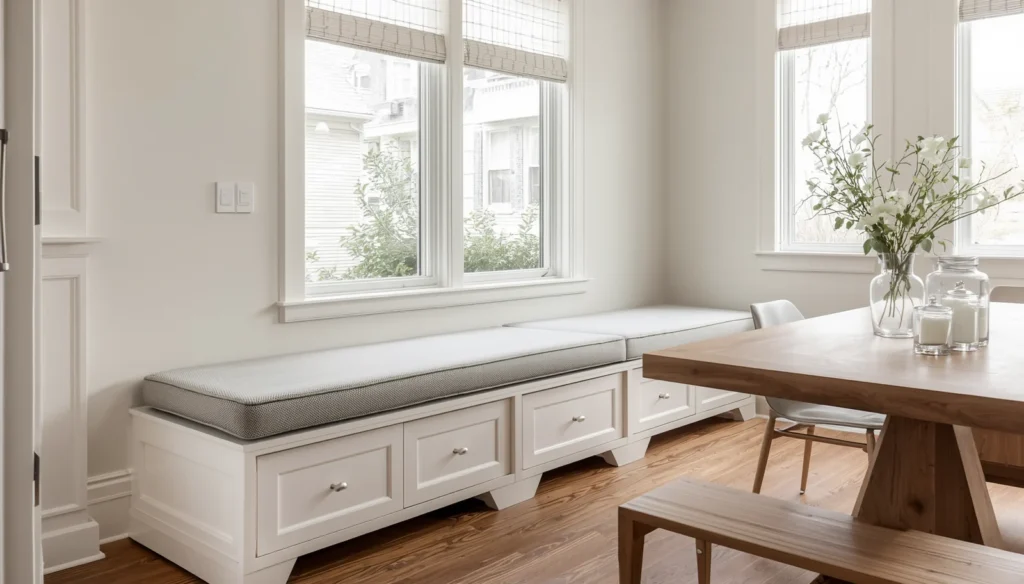
The least expected storage location in a built-in bench is also the most overlooked: the toe-kick zone, the four-to-five-inch gap between the bottom of the cabinet base and the floor. Standard cabinetry treats this as wasted space covered by a recessed toe-kick board. Built-in bench seating can convert it into a shallow drawer accessible at floor level.
Toe-kick drawers suit flat, stackable items almost perfectly: trays, cutting boards, baking sheets, floor maps, pet placemats, or anything that stores horizontally without height. Because the drawer pulls open at ankle height rather than waist height, the visual clutter it would otherwise introduce stays completely hidden when closed. From a standing position, the bench reads as solid furniture. Only a deliberate reach toward the baseboard reveals the drawer beneath.
The hardware for a toe-kick drawer typically runs along the full width of the drawer face, a continuous recessed aluminum pull that doubles as a finger groove. Flush with the toe-kick face when closed, it disappears entirely. This detail is popular in Scandinavian kitchen design and translates well to any nook where storage has been exhausted everywhere else and a final inch of usable depth still waits to be claimed.
Wrap Up
A breakfast nook earns its place in a small kitchen when it contributes more than seating. The eight configurations here treat storage as part of the original design rather than an afterthought, whether through hinged bench tops, toe-kick drawers, flanking cabinet columns, or the often-ignored ledge above a window seat.
The strongest nooks borrow from all categories, not just one, because the more that storage is distributed across the architecture, the less visible and the more generous it feels. Start with the seating footprint you have, then ask what every surface within arm’s reach could be doing that it isn’t.
FAQs
What is the best type of storage for a small breakfast nook?
Built-in bench seating with hinged lids or pull-out drawers gives the most storage without adding any furniture footprint. It converts the seat base into a cabinet, which is the most space-efficient option in a tight kitchen.
How deep should breakfast nook bench storage be?
Most bench builds run 18 to 22 inches deep to match comfortable seating depth. The interior storage depth is typically 14 to 17 inches after accounting for the seat frame and structural walls, which is sufficient for folded linens, board games, and seasonal items.
Can I add hidden storage to an existing breakfast nook bench?
Yes, though it depends on how the original bench was constructed. A solid-plinth bench can sometimes be retrofitted with toe-kick drawers or a hinged lid, but a structural rebuild is often more cost-effective if the goal is full-height interior access.
Disclaimer:
The content shared by Fall Rugs is solely for research and informational purposes. Fall Rugs is not a professional interior design or home renovation consultancy, and the information provided should not be considered professional advice for home improvement or decor. All ideas and suggestions are based on current trends and general knowledge in the home decor industry.