
TL;DR
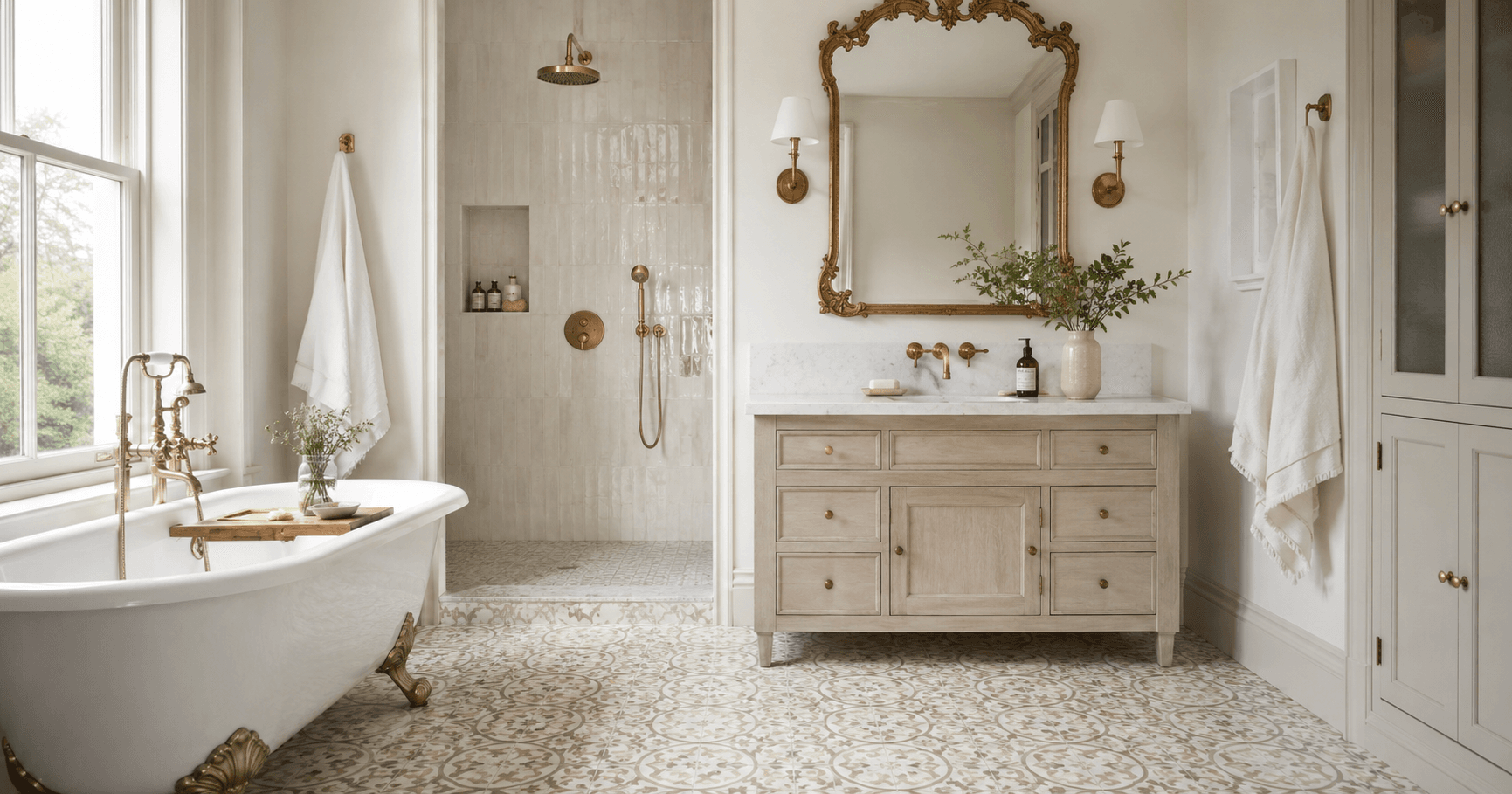
Statement tiles with vintage motifs are the defining bathroom design move of 2026, pulling from Moorish geometry, Victorian encaustic patterns, and Mediterranean colour traditions. The trend is less about decoration and more about architectural intention, treating the tile as the room’s primary design statement rather than its background.
Introduction
What does it say about a bathroom when the floor is the first thing a visitor photographs? Increasingly, it says the designer knew exactly what they were doing. Across renovation projects completed in the past 18 months, one pattern has emerged with unusual consistency: homeowners are abandoning the safe, all-white subway tile and reaching instead for something that carries history, weight, and visual personality.
The vintage motif tile revival is not nostalgia for its own sake. It’s a calculated design decision that treats the bathroom as a room worthy of the same creative investment as a living room or kitchen. This piece covers what’s fueling the shift, which patterns and palettes are leading in 2026, where the mistakes tend to happen, and how a few real-world choices played out.
Why Minimalism’s Reign in the Bathroom Finally Hit a Wall
For roughly a decade, the dominant bathroom aesthetic ran on a narrow set of rules: white or pale grey, large-format porcelain, grout that disappears, fixtures that recede. The logic was defensible. Bathrooms are small, resale matters, and safe choices don’t photograph badly. What that logic ignored was the creeping sense that a bathroom finished entirely in 60x120cm white slab porcelain has no soul whatsoever.
The reaction, when it came, didn’t arrive gradually. It arrived in a wave of Moroccan zellige, Spanish hydraulic cement tiles, and Victorian encaustic revivals that interior designers had been quietly accumulating on their project boards for years. When those projects finally got photographed and shared publicly, the response was visceral. People wanted in.
There’s also a practical element that rarely gets discussed. Large-format neutral tile ages in a specific way: grout discolors, surface scratches become visible across the expanse, and the absence of pattern means every imperfection reads clearly. A busy encaustic floor, by contrast, hides wear beautifully. The visual complexity that seems like a risk at purchase actually provides long-term forgiveness that blank surfaces don’t.
The Vintage Motifs Leading the 2026 Tile Revival
Encaustic Cement: The Pattern That Refuses to Date
Encaustic cement tiles originated in southern France and spread through Mediterranean Europe and North Africa during the 19th century. They’re made without firing, with pigmented cement pressed into molds under high pressure, which gives them a matte, slightly porous surface that no modern porcelain quite replicates. That texture is the point.
In 2026, encaustic patterns dominate bathroom floors in two distinct reads: the high-contrast geometric (think eight-pointed stars in black and cream, or interlocking diamonds in terracotta and sage) and the more restrained single-color relief pattern, where the motif shows through texture rather than color contrast. Both read as intentionally historical without being costumey, which is exactly the balance designers are chasing.
A project completed in Porto in late 2024 illustrates the tipping point well. A narrow, windowless bathroom in a converted 1920s apartment used a reclaimed-style encaustic tile in indigo, white, and aged brass tones across the floor. The walls stayed plain limewash plaster. The result photographed like a boutique hotel and required no other decorative layer. The tile did everything.
Moorish and Islamic Geometric Patterns
The geometry of classical Islamic tilework, with its interlocking stars, hexagons, and radial symmetry, has been cycling through interior design in various forms for 20 years. What’s different in 2026 is the scale and confidence of its application. Rather than a single accent panel behind a vanity, designers are now using full Moorish geometric tile across entire shower enclosures or wrapping it continuously from floor to ceiling on one wall.
The color palettes have also matured. Earlier interpretations leaned heavily on the cobalt-and-white combination associated with Moroccan riad interiors. The current wave is working with deeper, more complex tones: ochre and forest green, terracotta with dusty rose, charcoal with bronze. These palettes age better than high-contrast versions and read as more considered.
Where this pattern fails: scale miscalculation. A Moorish geometric tile that works beautifully at 20x20cm becomes overwhelming and visually exhausting at 40x40cm in a small bathroom. The pattern’s density needs to be calibrated against room size with more care than most homeowners expect.
Victorian Encaustic Revivals and Edwardian Floor Layouts
The original Victorian-era bathroom floor, with its small geometric tiles arranged in complex border-and-field layouts, has returned with considerable force. Reproduction manufacturers have become genuinely skilled at capturing the slight irregularity and color variation of the originals, and the results now have a period authenticity that earlier revivals couldn’t achieve.
The distinctive feature of this pattern family is the border system: a central field tile surrounded by a contrasting border tile and corner medallion, creating a framed composition on the floor. It’s labor-intensive to lay correctly, requiring a skilled tile setter who understands the layout before a single tile is placed. When it goes wrong, it usually goes wrong at the border, with misaligned corners or inconsistent spacing that breaks the pattern’s coherence.
Zellige: Handmade Imperfection as Luxury Signal
Zellige tile, hand-cut from slabs of fired terracotta and glazed using traditional Moroccan techniques, has become one of the clearest luxury signals in contemporary bathroom design. No two tiles are identical. The glaze surface is deliberately uneven, catching light at different angles across a wall surface. In the right setting, a zellige-tiled shower wall is one of the most visually rich surfaces achievable in residential construction.
The production reality matters here. Authentic zellige comes primarily from Fes, where workshops have operated continuously for centuries. Lead times are long, wastage rates are higher than standard tile (factor 20 to 25% extra), and installation requires an experienced setter who understands the tile’s behavior. Cheaper imitations exist in abundance and the visual difference is immediately apparent: genuine zellige has movement and depth; the imitations look flat.
Colour Strategy: Where the 2026 Vintage Tile Palette Is Sitting
The color story of 2026’s statement tile moment is built around warmth and historical pigment logic. Synthetic dye colors, the cool blues and artificial greens that dominated tile production in the 2000s, are largely absent from the current wave. What’s leading is a palette derived from mineral and earth pigments: iron oxide reds, copper-derived greens, manganese purples, and raw umber neutrals.
This palette choice has a practical consequence. Warm-toned tiles are significantly more forgiving of warm artificial lighting, which is the reality in most interior bathrooms without natural light. A cobalt blue tile under warm LED lighting shifts toward green in unpredictable ways. A terracotta encaustic under the same light simply deepens.
Designers working on bathroom renovations in 2025 and 2026 have increasingly shifted from specifying tile and lighting independently to treating them as a single decision. Sara Villanueva, a Barcelona-based interior designer whose residential portfolio spans converted farmhouses and urban apartments, has spoken about requiring lighting mock-ups before finalizing any patterned tile specification. It’s a step that adds a few days to the process and prevents the single most common disappointment in tile-heavy bathrooms.
Installation Realities That Don’t Make It Into Trend Coverage
The gap between a statement tile as it looks on a design board and as it lands in a real bathroom is almost entirely explained by installation quality. This is not a comfortable thing to write because it implies that the beautiful outcome requires expensive skilled labour, which it does.
Patterned tile, particularly geometric formats, requires precise layout planning before installation begins. A layout that centers the pattern on the room’s visual axis (usually the wall facing the door, or the shower floor centered on the drain) looks intentional and resolved. A layout that starts from one wall and runs to the other looks like it was laid by someone who hadn’t thought it through. The tile itself is identical in both cases. The result is not.
Grout selection has an outsized effect on the final read of any patterned tile. Traditional cement-based grout in period-appropriate tones, off-white, buff, grey-beige, or charcoal, allows the pattern to breathe. Bright white epoxy grout on a vintage-motif encaustic makes the whole surface feel sanitized and robs it of period character. This is a detail worth arguing about with a contractor who defaults to convenience over result.
Wrap Up
The 2026 statement tile moment is a genuine design shift rather than a seasonal trend cycle. It reflects a broader revaluation of craft, material history, and visual richness in spaces that were previously considered too functional for that kind of investment. The patterns leading the movement, encaustic cement, Moorish geometric,
Victorian revival layouts, and handmade zellige, all share a relationship to pre-industrial tile production that gives them a depth and authenticity no mass-produced format can replicate. Getting it right means choosing patterns calibrated to room scale, treating lighting and tile as a single decision, and investing in installation quality that matches the material’s ambition.
FAQs
Are statement tiles suitable for small bathrooms?
Yes, but pattern scale matters significantly. Smaller geometric repeats and high-contrast borders can make a compact bathroom feel curated rather than cluttered, while oversized patterns in tight spaces tend to overwhelm the room.
How do vintage motif tiles compare in cost to standard porcelain?
Authentic encaustic cement and zellige tiles typically run two to four times the material cost of standard porcelain, with installation labour costs also higher due to layout complexity and the skill required for patterned work.
Do patterned bathroom tiles affect resale value?
Well-executed statement tile work in a bathroom generally holds resale appeal, particularly when the pattern reads as high-quality and deliberate. Poorly laid or cheap imitations of vintage motifs tend to be viewed as a renovation cost by buyers rather than a feature.
Disclaimer
This content shared by Fall Rugs is solely for research and informational purposes. Fall Rugs is not a professional interior design or home renovation consultancy, and the information provided should not be considered professional advice for home improvement or decor. All ideas and suggestions are based on current trends and general knowledge in the home decor industry.