

TL;DR
Jewel tone bedrooms succeed or fail based on how a room handles natural light, texture contrast, and undertone matching. A single saturated wall often outperforms four painted surfaces. The real luxury lies in material choices, velvet, unlacquered brass, raw silk, that absorb and release color unevenly, creating movement a flat matte wall can never replicate.
Introduction
A bedroom wrapped in sapphire or amethyst sounds like a sensory gamble. Most people back away from deep color because they have been burned before. The emerald accent wall that looked jewel-box exquisite on a Pinterest board turned their own room into a cave by Tuesday afternoon. The problem is rarely the hue. The problem is a misunderstanding of how saturated color behaves across different hours of daylight, how it interacts with textiles, and how it either sharpens or softens the edges of a room. Once you understand those three variables, the palette stops feeling risky and starts feeling inevitable. Here are ten approaches that honor the complexity of jewel tones without letting them dominate the room.
1. Anchor the Room With a Single Emerald Feature Wall
Emerald green carries a peculiar optical weight. It can make a wall feel closer than it actually is, which is useful in a long, narrow bedroom where you want to shorten the visual tunnel. The temptation is to paint all four walls and then panic when the room shrinks by a perceived eighteen inches.
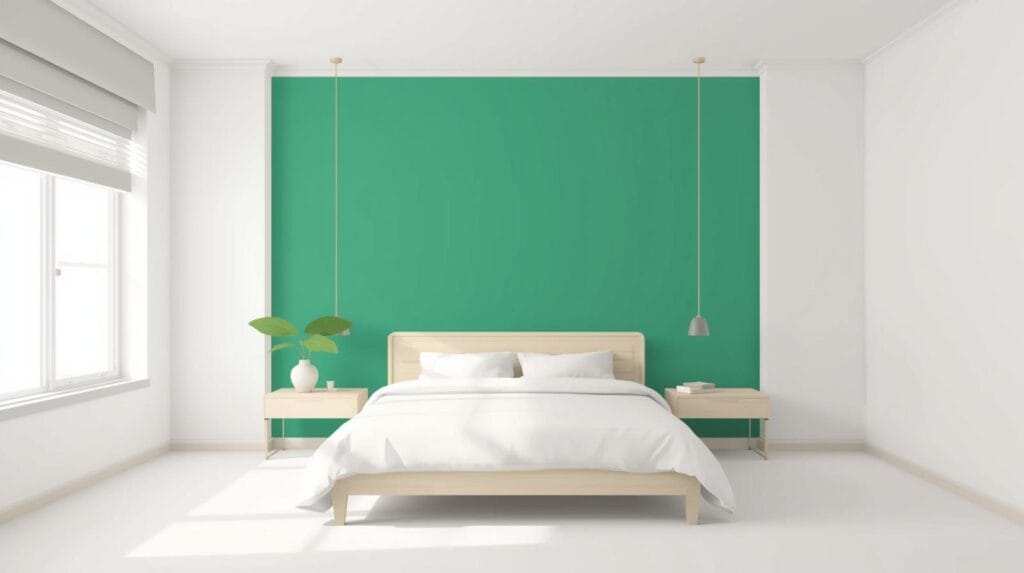
Fight that instinct. Choose the wall behind the bed, the one your eyes land on first. Let it hold the saturation alone while the other three walls stay a muted plaster tone or warm ivory.
Why Emerald Responds Unevenly to Natural Light
East-facing emerald walls look electric at sunrise and somber by dinner. That shift is not a flaw. It is the reason a room feels alive. Artificial light kills the nuance if you choose the wrong temperature bulb. Cool white LEDs turn emerald into a flat, almost surgical green. Warm dimmable bulbs, somewhere around 2700K, pull out the yellow undertones hiding inside the pigment. The wall appears to exhale. If your bedroom has only one small window, consider a lacquered or high-gloss finish. It catches what little light exists and throws it around rather than absorbing it all.
Layering Textiles That Make the Color Move
Matte velvet in a shade slightly lighter than your wall paint, maybe a moss or faded jade, belongs on a reading chair or a generous throw. Linen sheets in oat or flax introduce a dry, nubby counterpoint. Without texture, emerald feels like a jewel box. With it, the room breathes. One mistake people repeat is pairing emerald with stark white trim. It chops the wall into a hard graphic. A better partner is trim painted in a warm griege or even a muted brass tone, which softens the boundary and lets the green recede gently.
2. Sapphire Blue That Deepens After Dark
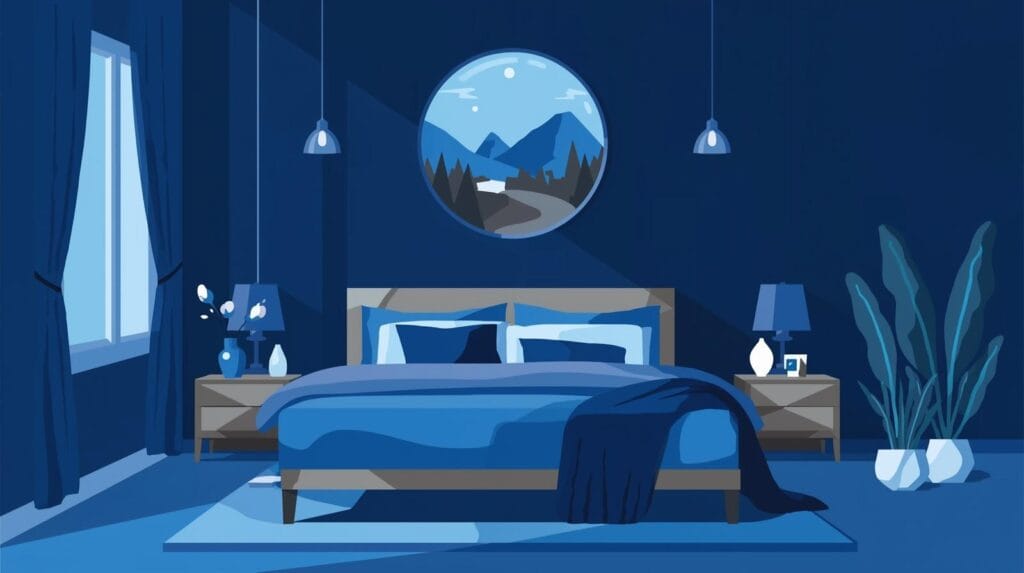
Sapphire blue behaves differently from emerald. It recedes. A room painted in deep blue feels larger at night than it does at midday, the reverse of what happens with warm jewel tones. This makes sapphire ideal for bedrooms where the primary use is sleep and evening retreat. The color does not demand attention. It creates distance, which in a small bedroom can feel generous.
Undertone Selection and the Ceiling Debate
Not all sapphires are equal. Some lean teal, others violet. A teal-leaning sapphire looks chaotic under warm light. The violet-leaning versions hold their composure. Test your paint on two walls, north and south facing, before committing. And here is a specific move few designers discuss: paint the ceiling the same sapphire as the walls. When overhead boundaries dissolve, the room loses its box shape. This works spectacularly in bedrooms with standard eight-foot ceilings. The caveat is that you need at least one substantial light source, a wide window or French doors, to keep the ceiling from pressing down.
Brass and Wood as Warmth Anchors
Unlacquered brass develops a patina that cool blue walls need desperately. A pair of brass sconces flanking the bed introduce a living finish that changes over years. Raw oak or walnut nightstands prevent the room from feeling like a hotel lobby. The wood grain interrupts the smoothness of painted surfaces and brings something imperfect into the composition. A Turkish kilim with faded saffron and rust thrown across the floor ties the cool and warm elements together without a single predictable accent color.
3. Amethyst and Mauve for an Unexpected Softness
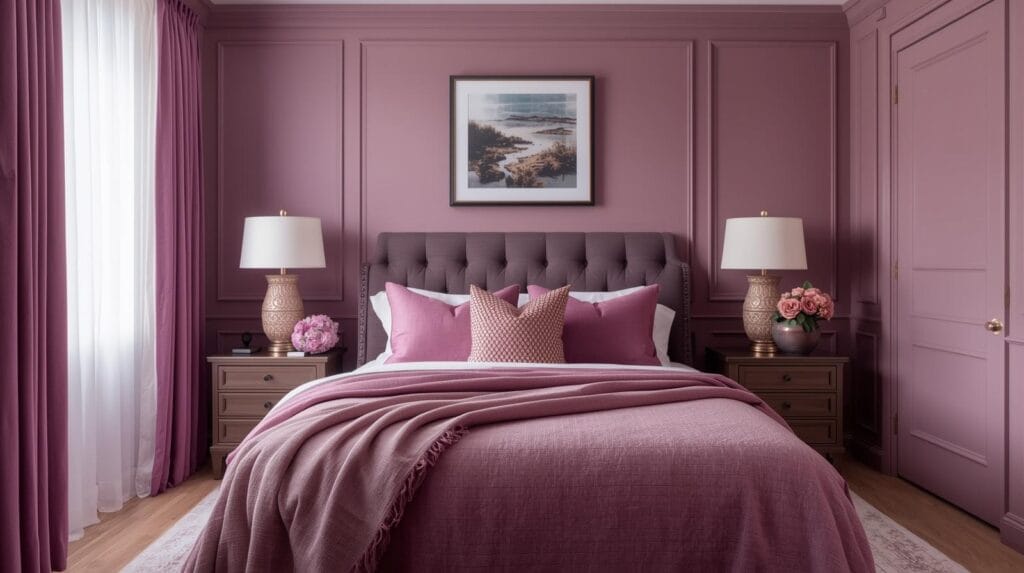
Purple bedrooms went wrong in the 1990s and many people still carry the scar. The culprit was always too much saturation paired with shiny synthetic fabrics. Amethyst today works because the approach has matured. You are not painting a child’s fantasy palace. You are building a room that shifts between gray-lavender at noon and deep plum at dusk.
The Grayed-Out Amethyst That Feels Adult
A purist jewel tone is vivid straight from the tube. That is not what you want here. Look for amethyst shades with a visible gray or brown undertone. These muted versions, often called dusty plum or smoke lavender, read as neutral while still carrying emotional warmth. They let you use bolder art or patterned bedding without visual chaos. A client in a Chicago loft paired smoked-amethyst walls with a rust velvet headboard and olive linen curtains. The combination should not have worked on a color wheel, but in the room it felt like a secret garden after rain.
Preventing a Purple Room From Turning Sugary
Avoid high-gloss purple at all costs unless you are designing a nightclub. Keep the sheen to eggshell or matte. Introduce black in small doses, a matte black picture frame, a black ceramic lamp base, a charcoal wool throw, to ground the sweetness. Natural materials like rattan or seagrass add an earthy counterweight that keeps amethyst from floating into candy territory. A single oversized monstera or fiddle-leaf fig against an amethyst wall becomes a sculptural moment.
4. Ruby Red Restrained by Architecture
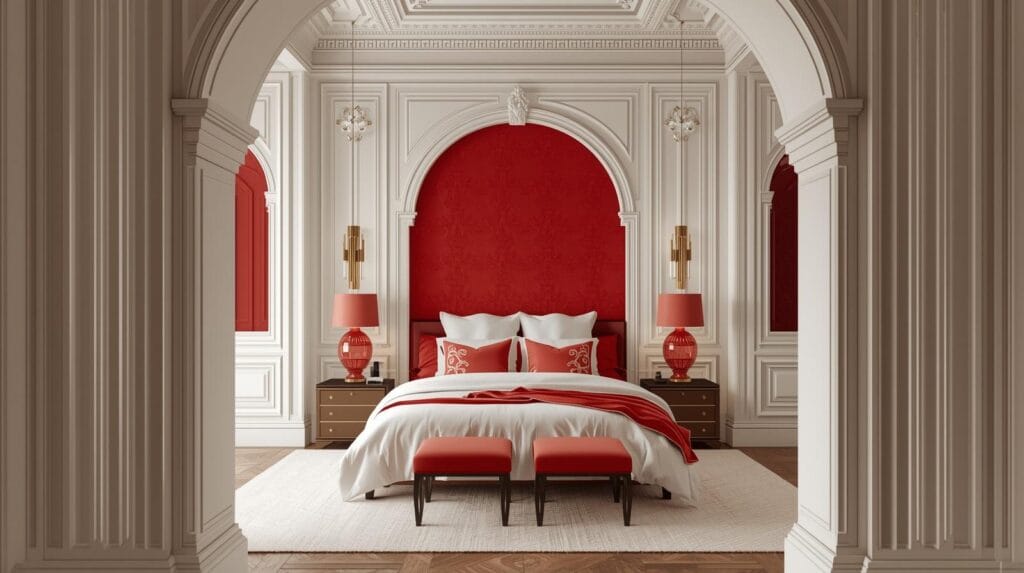
Ruby has a reputation for aggression. In a bedroom, aggression is unwelcome. The solution is not to dilute the color but to shrink its footprint. Ruby performs beautifully as an alcove treatment, a headboard wall recessed between built-in wardrobes, or a ceiling coffered and painted deep red above neutral walls. The color feels intentional rather than overwhelming because its boundaries are architectural, not arbitrary.
How Rubies Shift Under Different Bulbs
Ruby under a cheap LED turns flat and orange-leaning. Under halogen or high-quality warm-dimming LED it deepens toward pomegranate and black cherry. The room temperature shifts perceptibly. Red wavelengths are long and they advance toward the eye. Use this to your advantage if a bedroom feels cavernous and you crave intimacy. A ruby ceiling in a room with twelve-foot height brings the visual plane down. If the room is already small, confine ruby to textiles and let the walls stay quiet.
Velvet, Linen, and the Gloss Balance
Ruby velvet on a slipper chair or an ottoman catches light differently depending on the pile direction. Run your hand across it and the color changes. That tactile shimmer is what separates a designer room from a paint-by-numbers copy. Keep the surrounding surfaces matte. A flat charcoal wall next to ruby bedding creates a tension between absorption and reflection that makes both colors read more vividly. Add one piece of black glass or dark mercury glass for the same reason, light behaves unpredictably around it.
5. Topaz and Amber for Morning Light Worship
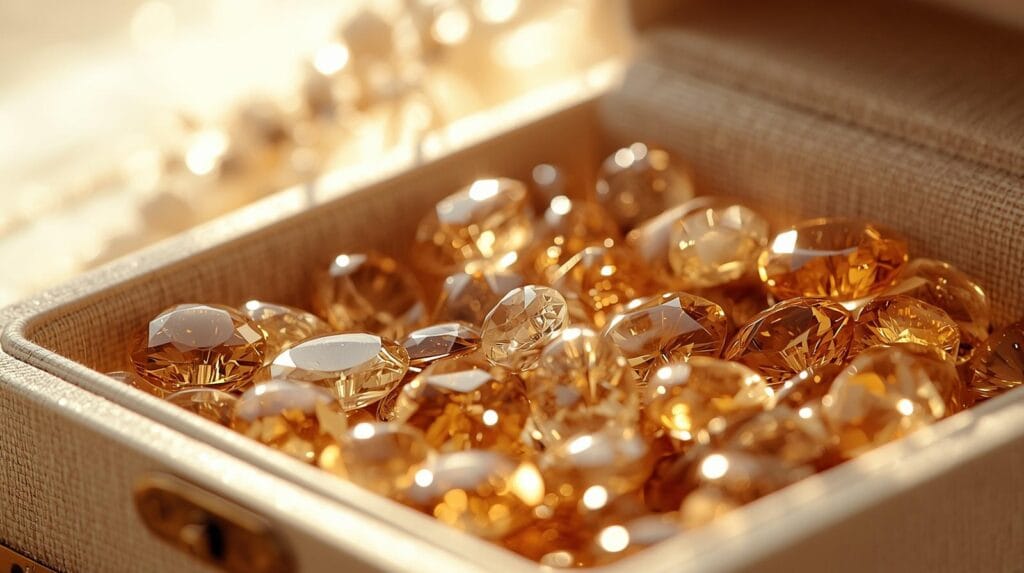
Topaz bedrooms thrive in east and south-facing rooms where dawn floods the space. The yellow-amber spectrum wakes up slowly, moving from honey at sunrise to a deep golden brown by late afternoon. This tonal range makes topaz surprisingly livable. It avoids the flatness of beige while steering clear of orange’s hyperactivity.
When a Room Faces the Wrong Direction
A north-facing topaz room turns muddy and cold by noon. If your heart is set on amber but your window orientation fights you, compensate with layered warm lighting. Wall sconces, floor lamps, and bedside fixtures, all dimmable and all warm-toned, can fake the light the sun refuses to deliver. Mirrors placed opposite windows bounce what little natural light exists back into the golden surfaces. The effect is not identical to true southern exposure, but it approaches a convincing approximation.
Pairing Topaz With Unexpected Neutrals
Forget beige and cream. Topaz comes alive against deep chocolate brown, slate gray, or even a muted navy. A slate linen headboard against a honey-toned wall creates a sophisticated friction. Raw brass and copper accessories do predictable harmony. Matte black metal introduces a graphic edge that stops topaz from feeling nostalgic or fussy. One underused combination pairs topaz walls with a charcoal wool rug threaded with faint gold fibers. The overall read is warm but grounded.
6. Multi-Jewel Layering Without a Circus Effect
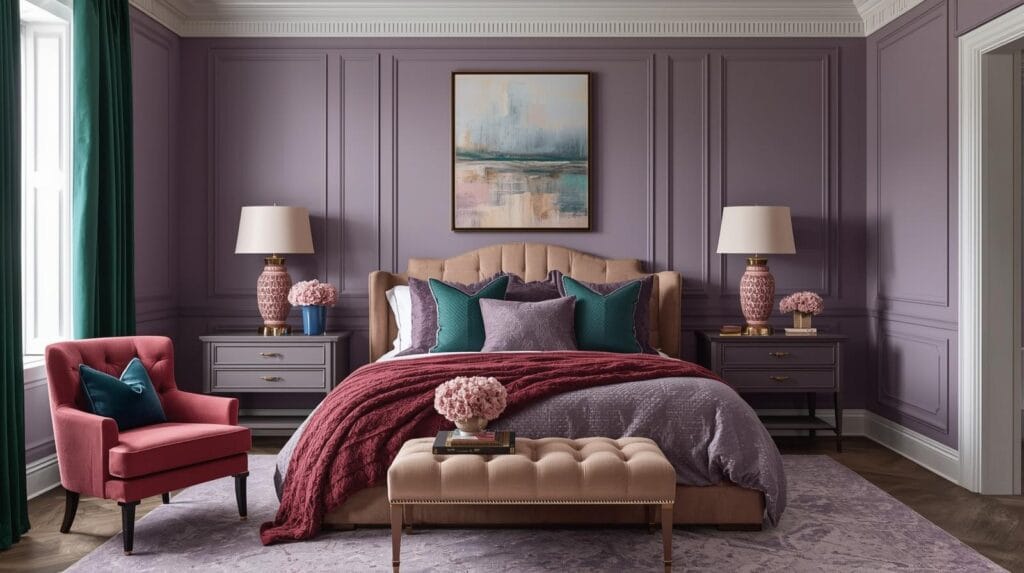
Using more than one jewel tone in a single bedroom sounds like a disaster waiting to happen. It can work, but only if one color dominates and the others appear in controlled, repeated doses. The dominant shade covers the largest surface area, walls. The secondary shades show up in bed linens, a single upholstered chair, or the inner backing of open shelving. They repeat at least three times across the room so the eye registers intention rather than accident.
The Anchor Color Strategy
Choose an anchor, say emerald walls. Then introduce sapphire in the form of a bench cushion, a ceramic lamp, and a narrow stripe in a kilim rug. Add amethyst even more sparingly, perhaps as the spine of a book on the nightstand and the thread in a throw pillow. The brain reads the repetitions as rhythm. Without repetition, the room looks like a color wheel sneezed. The anchor must stay close to seventy percent of the total color footprint. If secondary hues begin competing, one of them has to go.
What Designers Know About Jewel Tone Proportions
A working formula floats around design circles: sixty percent dominant jewel, twenty-five percent secondary jewel, ten percent a soft neutral, five percent black or near-black for visual punctuation. The black matters more than it seems. It stops the composition from becoming saccharine. A thin black picture rail, a single black-framed mirror, or a dark iron curtain rod provides a visual period at the end of the sentence. Without it, the room drifts.
7. The Paint Finish as a Design Tool, Not an Afterthought
Paint color gets all the attention. Paint finish decides whether the color succeeds. A jewel tone in flat matte absorbs so much light that the color can feel heavy and dead by evening. In eggshell or satin, the same color breathes. In high gloss, it becomes dramatic to the point of demanding a very specific room personality. Most bedrooms benefit from an eggshell finish for walls and a matte ceiling to reduce glare from overhead fixtures.
What High Gloss Does to a Small Space
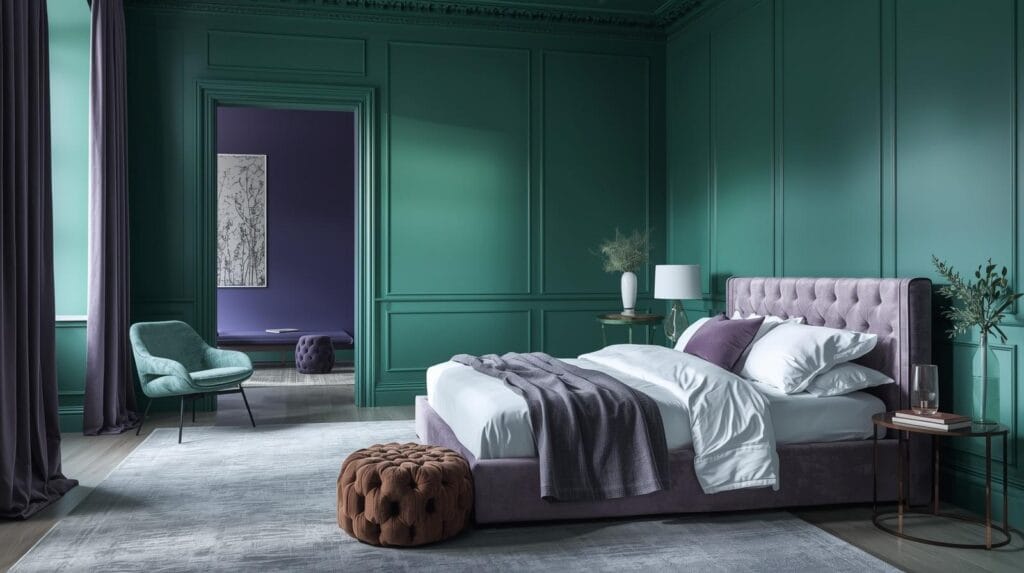
High gloss on jewel-toned walls acts as a mirror. It expands the perception of space but also reveals every imperfection in the drywall. If your walls are textured or older, stay away. If they are smooth and the room has generous natural light, high gloss can turn a jewel-box powder room or a small guest bedroom into something memorable. A colleague once lacquered a tiny Brooklyn bedroom in deep ruby. The room measured barely ten feet by ten feet. Guests described it as stepping into a warm, beating heart. That reaction came from the gloss, not the color alone.
Matching Sheen to Lifestyle
Glossy walls show fingerprints. Eggshell forgives. If you have small children or a dog that shakes off against the wall, keep the finish practical. Satin provides a middle ground, enough reflectivity to keep jewel tones lively, enough durability to handle cleaning, and enough forgiveness on imperfect walls. The slight difference in sheen between wall and trim creates a subtle delineation that catches peripheral vision without shouting.
8. Jewel Tone Headboards as the Low-Commitment Entry Point
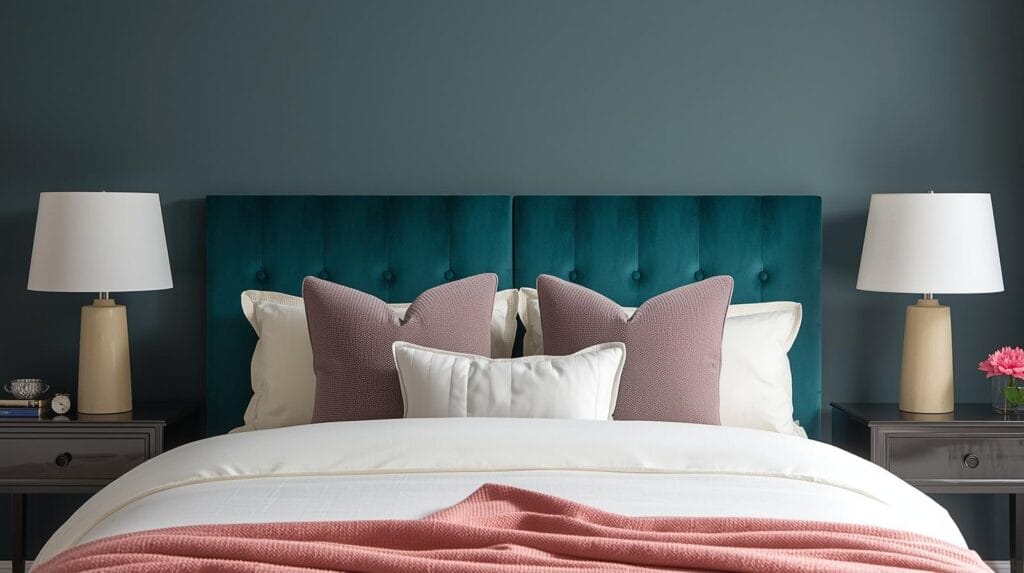
Painting walls demands a level of certainty not everyone possesses on a first pass. A jewel-toned headboard, generously scaled and upholstered in the right fabric, gives the room its saturated focal point without a drop of paint. The walls can stay a quiet plaster white or a warm limestone tone. The headboard does the heavy lifting.
Upholstery Choices That Age Gracefully
Velvet is the obvious choice and for good reason. It shifts color with the nap and softens the room acoustically. Performance velvet handles spills and resists fading better than cotton velvet. However, heavily textured wool or raw silk can be more interesting. A headboard in deep teal raw silk shows irregular slubs and variations that mass-produced velvet erases. Those imperfections make the piece feel collected rather than purchased. Avoid bonded leather or faux leather in jewel tones. They crack, peel, and look sad within three years.
Scale Decisions That Anchor the Room
A headboard that stretches wall to wall in a saturated color creates the effect of a half-painted room without the paint. It grounds the bed and eliminates the need for art above it. In a room with high ceilings, a headboard that reaches at least sixty inches tall prevents the bed from looking like a raft floating in open water. The fabric must have enough weight to hang taut. Lightweight cottons wrinkle and sag, undermining the luxury you worked to build.
9. Ceilings as the Fifth Wall in Saturated Spaces
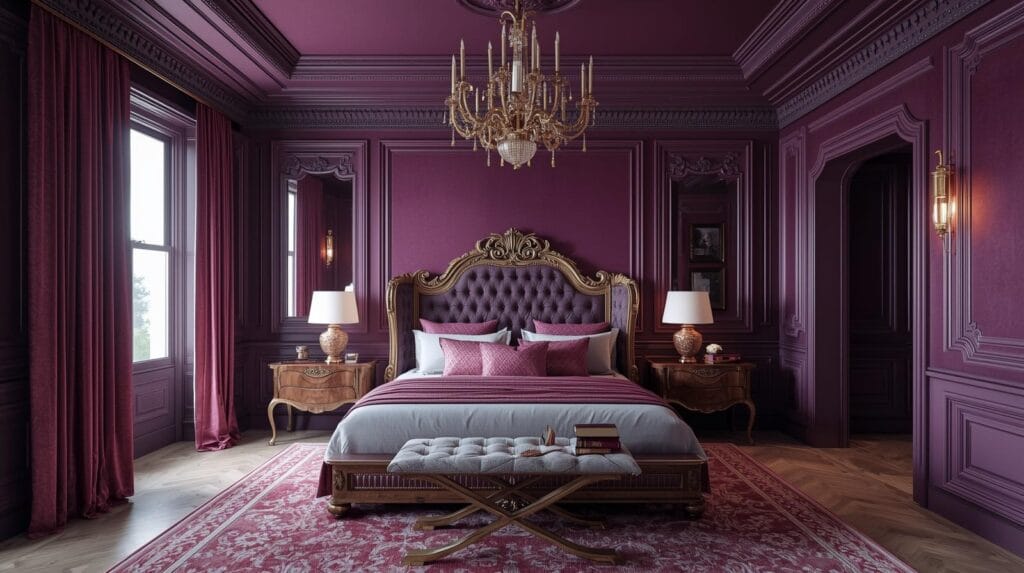
The ceiling painted a jewel tone changes the room’s geometry. A high ceiling comes down. A low ceiling, surprisingly, can feel higher if the wall color extends partially up and stops at a picture rail, with white above. But a fully painted jewel ceiling above light walls produces a canopy effect that feels protective and enveloping.
When a Painted Ceiling Fails
A dark ceiling in a room without adequate lighting suffocates. You need at least three separate light sources washing different parts of the room. A central fixture alone casts shadows downward and makes the ceiling feel lower. Recessed perimeter lighting, wall sconces aimed upward, or a pair of floor lamps with shades that throw light both up and down solve the problem. Without them, the ceiling becomes oppressive instead of cocooning.
Color Choices That Work Overhead
Sapphire and emerald work best overhead because cooler colors visually recede. Ruby or topaz on a ceiling can feel warm and enveloping in a dining room but unsettling in a bedroom. One exception is a very pale amethyst-gray on a bedroom ceiling, which glows faintly pink at sunrise and fades to a neutral shadow by midday. The effect is subtle enough to soothe without demanding attention.
10. Lighting Design That Serves the Palette
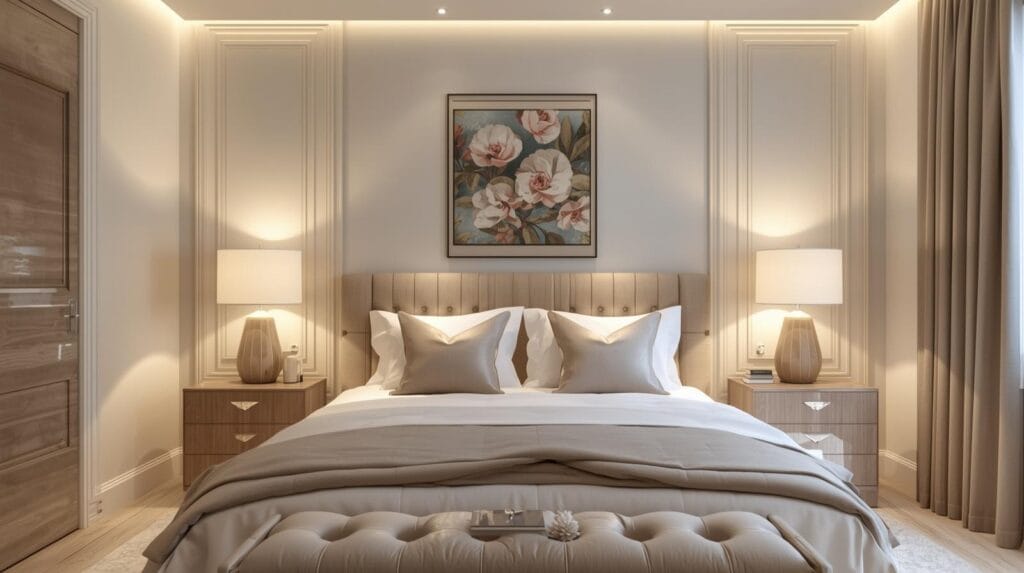
Jewel tones die under bad light. The investment in paint, textiles, and furniture means nothing if the bulbs wash everything out or cast sickly yellow pools. Lighting a saturated bedroom requires layers: ambient, task, and accent. Ambient light covers the room evenly. Task light serves reading. Accent light highlights a single surface, a piece of art, the texture on a wall, and creates depth.
Color Temperature That Reads Color Accurately
A bulb rated 2700K to 3000K renders jewel tones faithfully without skewing too yellow or too blue. Anything higher than 3000K pulls green toward hospital tones. Anything lower muddies blue and purple. Smart bulbs with tunable white ranges let you shift from energizing cool in the morning to candle-warm at night. The flexibility means your emerald wall reads true across the entire day rather than turning into a swamp at dusk.
Placement Over Quantity
Overhead lighting alone flattens every surface. A pair of low bedside lamps creates pools of light that leave the corners of the room in shadow. That shadow is the point. It gives the jewel tones somewhere to go, somewhere to deepen. Wall sconces at eye level cast light horizontally, picking up the nap of velvet and the grain of wood. A single picture light aimed at a textured piece of art above a dresser catches the peaks of impasto or the sheen of a framed textile. These small illuminations make the room feel inhabited and layered rather than staged.
Wrap Up
Jewel tones reward patience. The rooms that succeed understand that saturation is a tool, not a statement. A single emerald wall, a sapphire ceiling, a ruby headboard, each works because it respects the room’s light, its proportions, and the textures that soften hard color into something you want to wake up inside. The finishes matter as much as the hues. The lighting matters more than both. Start small, test your swatches at different times of day, and let the room teach you what it needs. A well-executed jewel tone bedroom does not shout for attention. It simply holds you there, quiet and deep, like water.
FAQs Section
What makes a bedroom color a jewel tone?
Jewel tones are deeply saturated colors inspired by precious gemstones, emerald green, sapphire blue, ruby red, amethyst purple, and topaz amber. Unlike pastels or muted earth tones, they carry high pigment density and tend to shift dramatically under different lighting conditions.
Do jewel tones make a small bedroom feel smaller?
Not automatically. Cool jewel tones like sapphire and deep teal visually recede, which can make walls feel farther apart. Warm tones like ruby advance toward the eye and work better in larger rooms or as accent surfaces. The finish of the paint also matters; an eggshell sheen reflects just enough light to keep a small space from closing in.
Which jewel tone is easiest to live with long-term?
Sapphire blue and grayed amethyst tend to be the most forgiving. They shift gracefully across different times of day, pair easily with wood and metal finishes, and rarely overwhelm the room. Emerald demands more attention to lighting and textile balance but rewards the effort with unmatched depth.
Can I mix multiple jewel tones in one bedroom?
Yes, with a strict hierarchy. One color must dominate roughly seventy percent of the visible surfaces. The secondary jewel tones appear in smaller, repeated doses through textiles and accessories. Without a clear anchor, the room loses cohesion and feels chaotic rather than curated.
Is a jewel tone bedroom hard to repaint later?
Saturated colors often require a tinted primer and multiple coats for full coverage. Repainting over them usually demands a high-quality primer to block the deep pigment. The process is not difficult, but it takes patience and an extra coat compared to painting over lighter shades.
Disclaimer:
The content shared by Fall Rugs is solely for research and informational purposes. Fall Rugs is not a professional interior design or home renovation consultancy, and the information provided should not be considered professional advice for home improvement or decor. All ideas and suggestions are based on current trends and general knowledge in the home decor industry.