

TL;DR
Hiding a kitchen television inside cabinetwork succeeds or fails on three things the mechanism you pick, how the face panel matches surrounding doors, and cable routing planned before drywall goes up.
The most livable solution for a luxury kitchen is usually a motorized flip‑down mount inside an upper cabinet with a false front that reads as ordinary millwork. This article walks seven real integration strategies, ranked by invisibility and practical daily use.
Introduction
A television in the kitchen always felt like a compromise. You wanted the morning news while making coffee, but the black rectangle destroyed the sightline of hand‑finished cabinetry.
The industry spent a decade trying to solve that tension with trim kits and recessed alcoves, and most of them still announced the screen’s presence loudly. What changed is the quiet arrival of cabinet‑integrated concealment that treats the television as a temporary visitor, not a permanent resident.
Once the screen retracts, swings away, or hides behind a matched door, nothing reads as electronics. I have watched clients run their hand over a stile and ask where the TV went. That moment is the benchmark for a job done right. This article maps out seven methods that deliver that reaction, drawn from installations where the millwork came first and the technology bent to meet it.
1. Motorized Flip‑Down Mount Concealed in Upper Cabinetry
What the Mechanism Actually Looks Like on Site
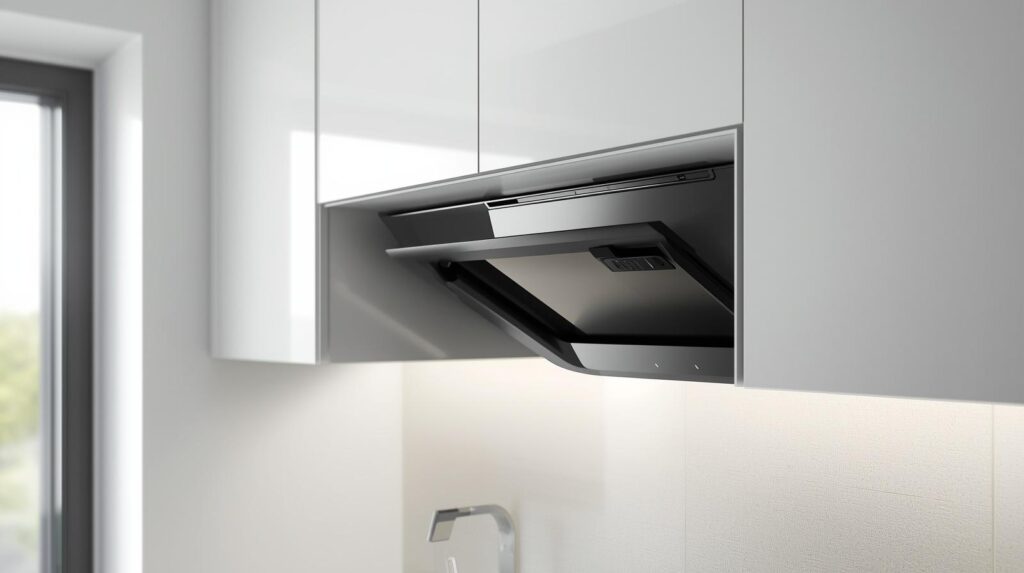
A motorized flip‑down system lives in a reinforced upper cabinet, typically a 42‑inch wall box with a false bottom that swings open on a geared hinge. When activated, the entire panel rotates ninety degrees downward, and the screen descends behind it on a linear actuator. From a seated or standing position you see only the television face.
The cabinet carcass needs blocking inside the side panels that can hold a dynamic load well beyond static shelving weight. A 55‑inch screen exerts meaningful leverage at full extension. I learned early on that mounting the actuator rail to ¾‑inch plywood alone guarantees sag within eighteen months. Builders who understand this add a steel cross‑brace between the two cabinet sides and bolt the rail to that plate, not the cabinet walls.
The thing nobody tells you during specification is that the cabinet interior must be empty. Shelves, plates, glassware, all of it has to leave because the screen occupies the entire volume when retracted. If you do want storage, you need a double‑stack approach where the lower third houses the mechanism and the upper portion stays open for adjustable shelves, separated by a fixed horizontal divider that gets screwed into the face frame. That divider also functions as a dust shield for the motor and cabling.
Power, Ventilation, and Control That Does Not Annoy You
Heat is the silent killer of these installs. A flat panel running inside a closed cabinet with no airflow will bake its power supply in a year or two. Vent the top of the cabinet through a slotted toe kick return or a crown molding gap, and add a temperature‑triggered USB fan pair that runs only when the internal thermostat trips. It is a thirty‑dollar addition that saves a board repair.
For control, hardwired RF remotes work reliably through wood doors where infrared fails. Better still, integrate the actuator into a home automation processor and trigger it with a single “Kitchen On” scene that lowers the screen, powers the set, and dims the pendants. Avoid apps that require you to unlock a phone with flour on your hands. Physical keypads mounted at light switch height remain the gold standard for daily sanity.
2. Flush In‑Wall Recess With a Cabinet‑Matched Sliding Door
Building the Pocket Where the Television Lives
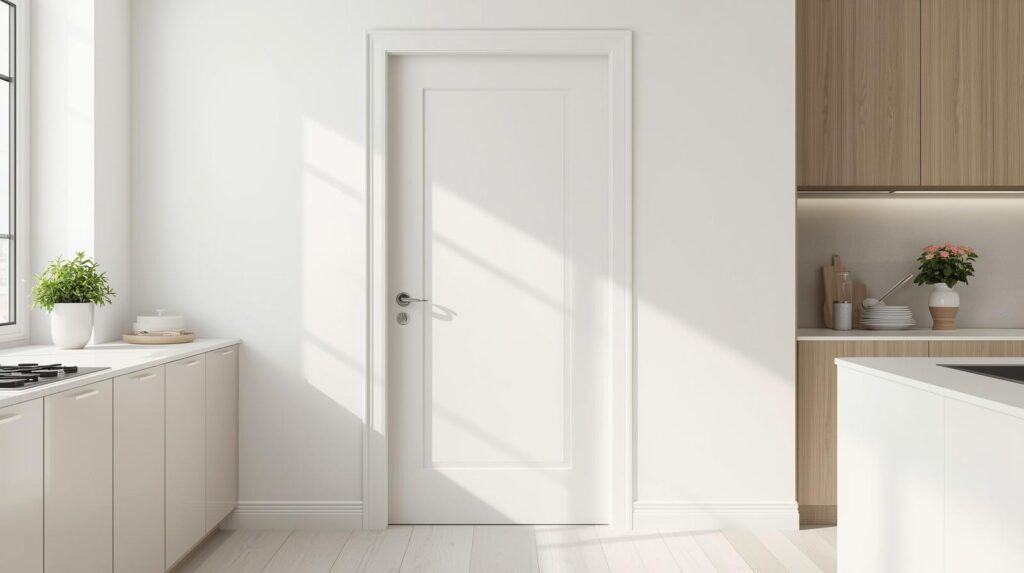
Sometimes the wall cavity itself is the cabinet. A recessed pocket set between two stud bays, finished with drywall returns and painted matte black on all interior surfaces, creates a zero‑depth look for the screen. The real trick is the door that covers it. A cabinetmaker builds a single slab door with the same profile, finish, and hardware as the perimeter cabinetry, hung on a bypass barn‑door track or a pocket sliding system that routes into a false column to one side. When closed, the viewer faces an uninterrupted wall of millwork.
The dimension errors happen at the rough‑framing stage. A 65‑inch television needs a wider pocket than most people assume because you need clearance for your hand to reach behind and grab the edge for manual override. Any tighter than three inches of side gap and you cannot service the mount without pulling the door track off the wall.
I spec a minimum recess width of the screen plus eight inches. The depth must account for the articulating mount’s folded thickness plus the screen depth, For those focusing on structural aesthetics, integrating modern archway designs can further elevate the kitchen’s architectural flow.. HDMI connectors that kink hard against drywall will fail intermittently. A right‑angle adapter saves the port.
Matching the Door to the Rest of the Kitchen
The door slab must come from the same run of lumber as the adjacent cabinets, ideally cut from the same sheet of veneer. Even a minor batch variation in stain absorption telegraphs the location of the screen immediately. The cabinet finisher needs to treat that door alongside the drawer fronts so aging and UV exposure stay identical over time.
One client insisted on a framed door with the same inset panel detail as her Shaker perimeter. When it slid across to reveal the screen, the reveal margins matched every other cabinet gap to within a thirty‑second of an inch. That is the level of craft where concealment stops being a gimmick and becomes architectural.
3. Television Disguised as a Cabinet Panel Insert
The Fixed‑Frame Approach That Tricks the Eye
This method does not try to hide the fact that something lives in that cabinet opening. Instead, it frames a thin‑profile OLED inside a door opening so the screen bezel reads as a recessed panel from six feet away. The door stiles and rails run continuously around the screen, effectively turning the TV into a glazed cabinet insert.
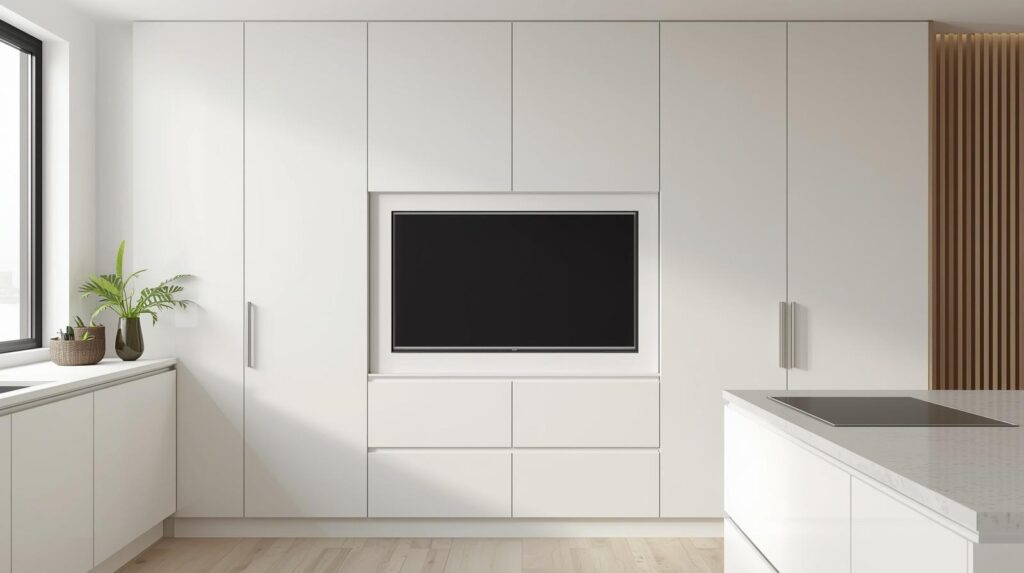
Works best with matte‑finish screens that reject kitchen glare and look less like polished glass. Samsung’s The Frame series exists precisely for this, but you can achieve the same effect with any ultra‑thin set and a custom bezel kit cut by a local frame shop.
The installation demands a recessed back box behind the door frame, which pushes the cabinet depth to at least eight inches. You lose usable storage, but the reward is a piece of millwork that nobody identifies as a television until it lights up.
I have seen guests lean against the screen while talking, thinking it is a frosted glass cabinet front. That is the level of deception possible when the frame matches the kitchen profile and the screen stays in Art Mode displaying a still image with a matte overlay. If you love this hidden art aesthetic and want to apply it to other spaces, you can also explore modern art ideas for your sleeping quarters to create a cohesive look throughout the home.
Managing the Cable and Power Constraints
Powering a screen inside a framed cabinet panel means the outlet must live behind the set, inside the back box, with enough clearance that the plug does not push the television proud of the door. A recessed clock outlet buys you that inch.
Run a single slim HDMI and optical audio cable through a grommet into an adjacent base cabinet where the source gear and soundbar amplifier sit. Do not attempt to stuff a streaming box behind the screen; the heat buildup in an enclosed back box shortens component life sharply. Use an outboard rack in the island or a butler’s pantry, controlled by an IR repeater wire snaked through the wall cavity.
4. Under‑Cabinet Television Mount With a Hinged Fold‑Up Screen
The Flip‑Up Solution for Tight Island‑Viewing Sightlines
A screen mounted under an upper cabinet, on a hinge that lets it fold flat against the bottom of the wall cabinet when not in use, solves the visibility problem for cooks who want eye‑level viewing from the island.
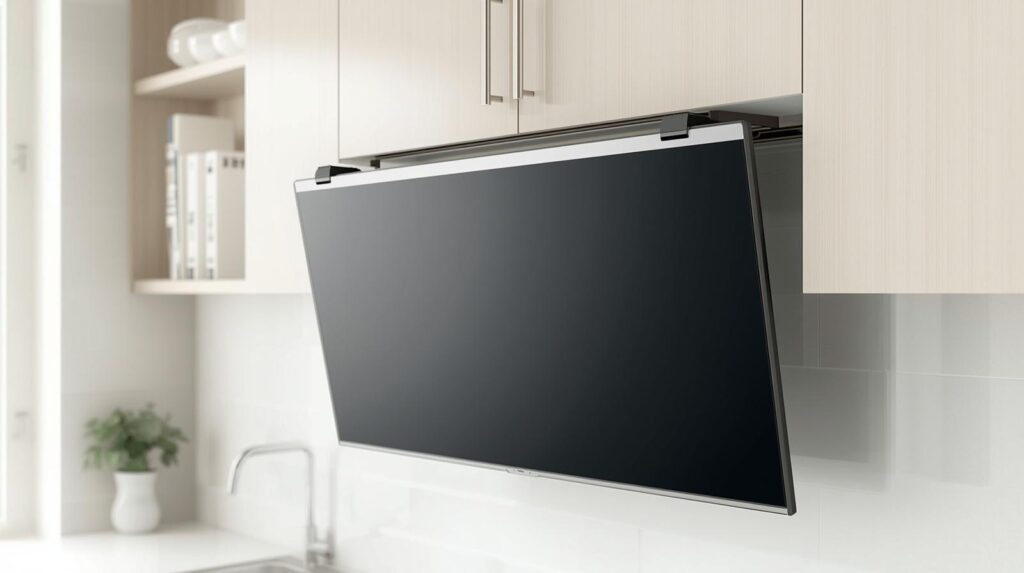
When you need it, the screen pivots down to a near‑vertical angle. When you do not, it parks completely out of the cooking zone and splatter radius. The hinge hardware comes in spring‑loaded manual versions and 12‑volt motorized arms that respond to a contact sensor when you press the leading edge.
This design lives or dies on the cabinet reinforcement. Screwing a fold‑down mount into the ½‑inch bottom panel of a standard wall cabinet is reckless. A full ¾‑inch plywood sub‑bottom, screwed and glued to the cabinet carcass, distributes the cantilevered load.
The hinge must be rated for at least three times the screen weight because the dynamic stress of folding and unfolding is nothing like a static wall mount. I have replaced cheap hinges that sheared their internal stop pins after a few hundred cycles. Spend on a marine‑grade stainless hinge if you cook with steam and oil often.
Screen Size, Sound, and the Splatter Factor
The size sweet spot for an under‑cabinet fold‑down is 24 to 32 inches. Anything larger overpowers the cabinet visually and blocks too much of the backsplash when deployed.
Built-in speakers on small kitchen sets are uniformly terrible, so pair this setup with a slim soundbar mounted to the face of the upper cabinet or a set of in‑ceiling speakers driven by an amplifier tucked in a pantry. Position the screen so that when folded down, its bottom edge clears the tallest stockpot you own. One client discovered that her 12‑quart pasta pot hit the corner of the screen mid‑boil. We moved the entire cabinet assembly up two inches. The backsplash tile replacement cost more than the mount.
5. Pocket Door Cabinet Column That Swallows the Screen Entirely
Hiding a Large Television Inside a Tall Pantry Pull‑Out
The pocket door column works like a tall pantry cabinet with a retracting door. Instead of shelves, the interior holds a vertical articulating mount. You pull the door open, slide it into a side pocket built into the cabinet carcass, and then pull the screen forward on a heavy‑duty drawer slide and articulating arm until it faces the room.
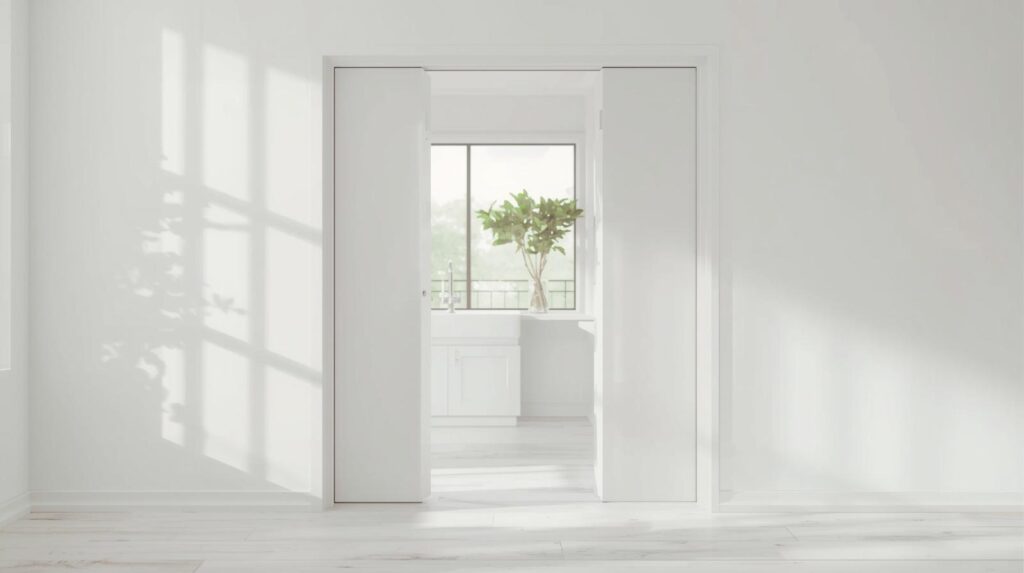
Closing up involves reversing the sequence, and what remains is a cabinet column that looks identical to a broom closet or tall pantry unit.
Carpenters need to build a true pocket inside the cabinet box, which means the interior width must accommodate the door slab sliding fully sideways into a recessed track. This consumes interior volume fast. The cabinet ends up deeper than a standard wall cabinet, usually 24 to 30 inches.
That additional depth can serve as shallow storage on the back side if you install fixed shelves behind the screen’s parked position, accessible only when the screen is deployed. It is a niche use case but works beautifully in open‑plan kitchens where the television must face a sofa zone in the adjoining living area. The articulation allows the screen to swing nearly ninety degrees. If you prefer a completely non-electronic approach for that extra space, incorporating some kitchen bookshelf ideas can turn the unused depth into a beautiful cookbook display.
Why the Track and Slide Quality Dictates Everything
If the pocket door binds, the whole concealment scheme frustrates daily. Spec soft‑close, full‑extension ball‑bearing slides rated for 200 pounds. The door slab alone, built from ¾‑inch paint‑grade MDF or solid walnut, weighs more than expected. Undermount slides that hide beneath the door require a perfectly square cabinet box with no racking.
Any twist in the cabinet frame transfers directly into a door gap that widens top to bottom. On one install, the cabinetmaker shimmed the base of the column by an eighth of an inch to correct a floor slope. After that adjustment the door glided with one finger. Before the shim, it stuck halfway.
6. Motorized Art Panel That Rises to Cover the Screen
The Vertical Lift Concealment That Reads as Decorative Millwork
Instead of moving the television, move the cover. A motorized panel on a vertical linear lift rises from a slot in the countertop or from behind a finished valence to block the screen completely.
When the television is off, a decorative panel stained wood, a stretched canvas, a metal print sits flush in front of it. When you press a button, the panel lowers into a hidden floor pocket or behind the base cabinet, revealing the screen mounted on the wall behind it.
The floor pocket requires cutting a slot in the cabinet base and, frequently, into the subfloor between joists. This is a renovation‑heavy option best suited to new builds or major remodels where the flooring trades are already on site.
The pocket needs a cleanable liner because crumbs and dust find their way down there inevitably. A vacuum slot at one end of the pocket makes maintenance possible without disassembling the mechanism. The lift actuator motor must be accessible from a removable toe kick panel for service.
Art Panel Selection and the Viewing Experience
The panel itself becomes a focal point, so its scale matters. For a 55‑inch screen, the covering panel runs roughly 52 inches wide by 34 inches tall. A single slab of book‑matched walnut veneer in that size costs real money and looks incredible. For more inspiration on choosing large-scale focal pieces, checking out bedroom wall decor trends can offer great cross-over concepts for texturing blank walls. Canvas pieces need to be gallery‑wrapped on a lightweight aluminum frame so the lift motor is not over‑worked.
The speed of the lift matters less than the noise level; a noisy mechanism announces the television’s location every time it cycles. Belt‑drive lifts are quieter than screw‑drive, though they need tensioning at installation and a recheck after the first hundred cycles. Budget
2,500to
2,500to5,000 for the lift hardware alone, not including the panel fabrication.
7. Mirror Television Hidden Inside a Cabinet Door Face
When the Screen Doubles as a Functional Mirror
A mirror television uses a partially silvered glass front that reflects the room when the screen is off and becomes transparent when the display backlight shines through. Mounted inside a cabinet door frame, it looks exactly like a mirrored cabinet front. The illusion works best in kitchens where mirrored or high‑gloss panels already appear in the design language, so the mirror TV does not announce itself as the odd element.
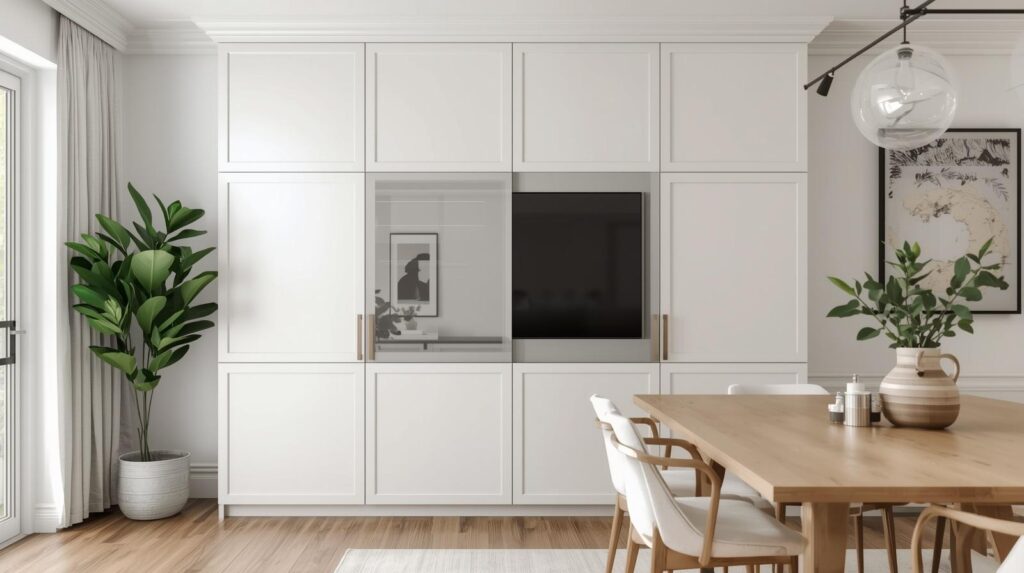
The installation requires a cabinet door built to hold the mirror television securely within a rabbeted frame, with a cable passthrough that allows the door to open and close without pinching wires.
A European hinge with an integrated cable management arm handles this cleanly. The catch is weight. A mirror TV weighs two to three times what a standard panel of the same size weighs because of the glass thickness required for the reflective coating. The cabinet door hinges must be rated for the load, and the door frame stiles need cross‑dowel joinery rather than pocket screws to prevent sagging over time.
Choosing Rooms and Sightlines That Favour the Illusion
Mirror televisions reflect overhead lighting, which can wash out the picture if a pendant or recessed can points directly at the screen surface. Position the cabinet door at a slight downward angle relative to the nearest light source or use dimmable fixtures that reduce glare during viewing.
The reflective coating also reduces peak brightness compared to a standard screen, so the kitchen benefits from some daylight control during daytime viewing. In a kitchen with a wall of windows, expect a mirror TV to look best after dusk.
One homeowner routed her morning news to an iPad on the island and saved the mirror screen for evening cooking sessions when the light was soft and the reflected view of the dining room actually added to the atmosphere.
The Unseen Infrastructure That All Integrations Share
Every method described above shares a common set of behind‑the‑wall requirements. Ignore them and the most expensive cabinetwork will frustrate you within weeks. Run dedicated 20‑amp circuits to the television location so the screen does not share a line with the espresso machine that trips the breaker. Pull at least two shielded HDMI cables, one Cat6 for data, and a spare conduit.
The spare matters more than the primary run because formats change and cables fail. I have watched a client’s immaculate kitchen television install become unusable because a single HDMI cable embedded in plaster developed a handshake fault and there was no pull string. A one‑inch conduit with a gentle bend radius to a nearby accessible cabinet saves that nightmare.
Think about audio early. In‑wall and in‑ceiling speakers with a remote amplifier deliver sound that a thin television cannot match, and they disappear visually. Wire for a center channel above the screen location even if you install nothing on day one; adding it later without opening walls is almost impossible.
The amplifier can live in a ventilated cabinet with an IR flasher and a streaming box, controlled by a universal remote programmed for the kitchen’s specific activity sequence. A well‑tuned audio system makes a modest screen feel cinematic and a huge screen feel properly supported.
Wrap Up
A kitchen television that disappears was an aspirational fantasy a decade ago. It is now a solved problem for anyone willing to plan the millwork and the mechanism together. The cabinet leads, the technology follows, and the result is a room that works as hard for a quiet Tuesday breakfast as it does for a dinner party.
Pick one of these seven approaches based on your cabinet layout and sightline geometry, reinforce the mounting points beyond minimum spec, and run a spare conduit. If a guest cannot find the screen until you turn it on, you got the details right.
FAQs
Can a kitchen television be fully hidden without any visible signs of electronics?
Yes, with a motorized lift inside upper cabinetry or a cabinet‑matched sliding door that covers a recessed wall pocket, the screen can disappear entirely when not in use, leaving only millwork visible.
What is the most reliable mechanism for hiding a kitchen TV daily?
A motorized flip‑down mount built into a reinforced upper cabinet with a false bottom panel is the most dependable, especially when paired with a hardwired RF remote rather than a phone app.
Does hiding a television inside a cabinet cause overheating?
It can if ventilation is ignored. Adding a slotted vent at the top of the cabinet and a small temperature‑triggered fan keeps internal temperatures safe for the screen and power supply.
Disclaimer:
The content shared by Fall Rugs is solely for research and informational purposes. Fall Rugs is not a professional interior design or home renovation consultancy, and the information provided should not be considered professional advice for home improvement or decor. All ideas and suggestions are based on current trends and general knowledge in the home decor industry.