
TL;DR
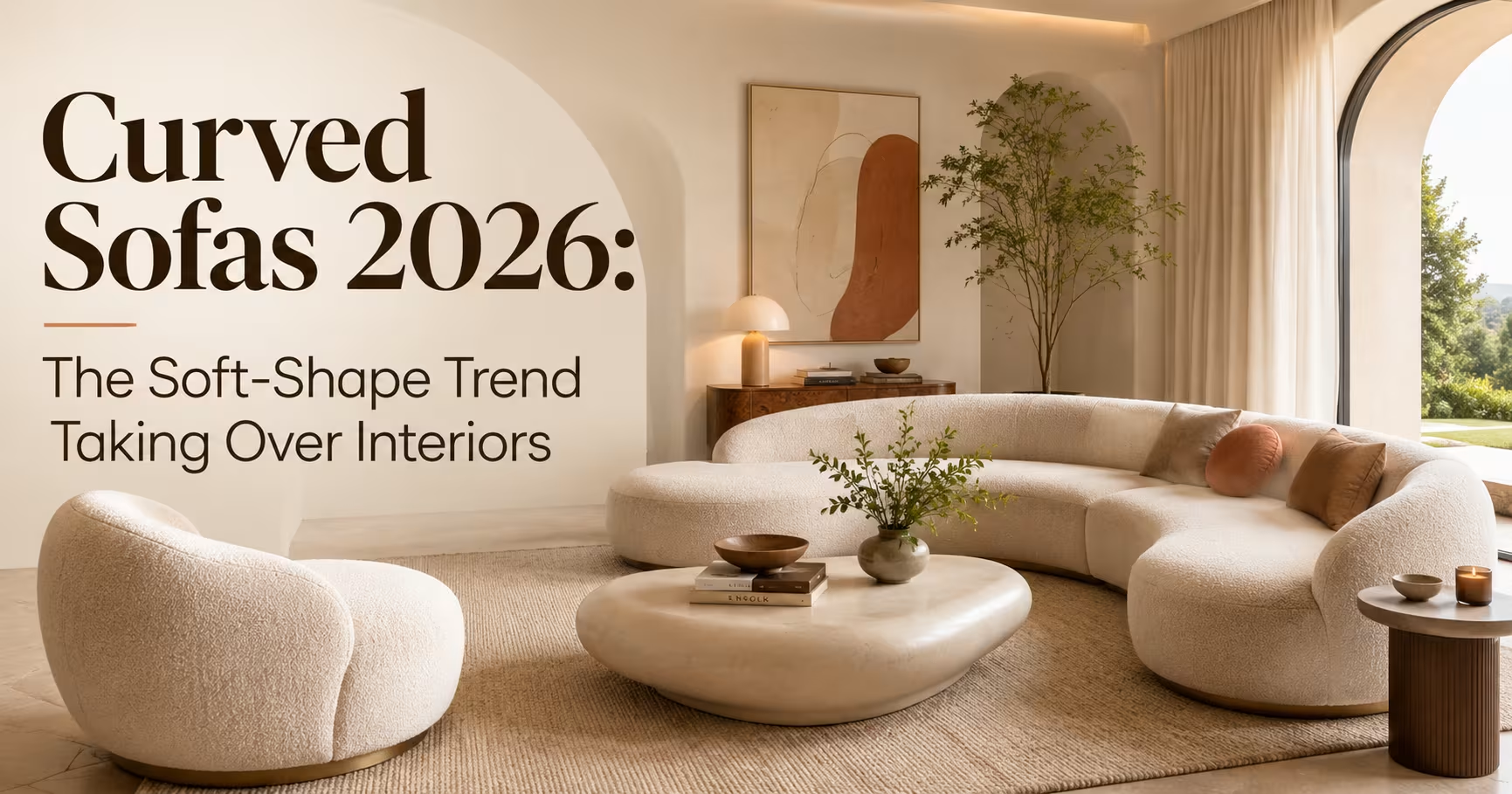
Curved sofas have moved well past trend status into a genuine design shift, driven by a cultural appetite for warmth, tactile comfort, and rooms that feel deliberately composed. The best versions marry sculptural form with real-world livability, and 2026’s market offers more variety than any previous year. Choosing one means understanding proportion, fabric, and how the piece will anchor a space rather than dominate it.
Introduction
What does a sofa communicate before anyone sits on it? That question sounds abstract until you place a sharp-edged sectional in a room and notice how it immediately divides the space into zones rather than gathering people into it. The growing dominance of curved sofas in 2026 interiors is not coincidental; it reflects a broader recalibration of what domestic spaces are supposed to feel like. This piece works through the design logic behind the curve, the practical realities of living with one, and the specific configurations earning the most attention from architects and interior designers this year.
The Design Logic Behind the Curve
Furniture designers have always known that a circle creates intimacy while a rectangle creates order. The resurgence of curved and semi-circular sofas is partly a response to the hyper-functional, grid-obsessed interiors that dominated the 2010s, where clean lines signaled discipline and restraint. That era produced beautiful rooms, but rooms that sometimes felt more like showrooms than places to actually inhabit.
The curve does something different. It turns a seating arrangement inward, so people face each other rather than a shared focal point like a television. Architects who specialize in high-density residential projects in cities like London and New York have noted that curved sofas allow them to create social nodes within open-plan apartments without building any walls. The sofa itself becomes the room-within-a-room.
There is also a purely visual argument. A rounded silhouette reads as complete, almost sculptural, which means it holds its own against statement rugs, gallery walls, and the kind of layered, object-rich interiors that define contemporary maximalism. A straight sectional often needs surrounding furniture to feel finished; a curved sofa frequently needs very little.
How Proportion Changes Everything
The biggest mistake people make with curved sofas is scaling them wrong. A semi-circular piece with a diameter under 220 centimeters can feel like a loveseat pressed into service for a full living room, and the awkwardness shows immediately. Conversely, a deep-bodied crescent sofa in a compact room becomes the room, swallowing every other piece.
The rule most experienced decorators follow is to let the sofa occupy roughly 60 percent of the room’s usable width, leaving circulation space on both flanks. In a room measuring four meters wide, that typically means a curved sofa spanning 240 to 260 centimeters at its widest arc, with the curve pulling inward by 40 to 60 centimeters. These proportions feel generous without becoming oppressive.
The Conversation Pit Revival
The conversation pit, a sunken seating area built into the floor and popular in mid-century American residential design, is experiencing a serious architectural comeback, and it is directly connected to the curved sofa trend. The pit format almost requires curved or circular seating; straight benches placed in a square recess look like a waiting room.
Contemporary designers are interpreting this through flush-to-floor modular curved units, which achieve a similar psychological enclosure without requiring structural alteration. Designers in Scandinavian markets have been particularly active in this space, producing low-profile curved systems that sit only 30 to 35 centimeters off the ground, creating that same sense of being gathered and held by the room rather than perched on furniture.
Materials and Textures Defining 2026 Curved Sofas
Boucle fabric became the defining upholstery of the early 2020s, and while it remains in heavy rotation on curved sofas, 2026 has introduced more competition. Velvet is back, particularly in clay, tobacco, and muted olive colorways that feel organic rather than opulent. Linen-cotton blends are gaining ground for their casual texture that reads as effortlessly sophisticated without demanding careful maintenance.
Bouclé’s continued popularity on curved forms makes sensory sense. The looped, nubby texture softens a silhouette that is already soft, creating a double register of warmth. When a piece like the well-regarded Faye sofa from Italian manufacturer Arflex is upholstered in cream bouclé, the result reads almost like a cloud suspended on legs, which is precisely the aesthetic many clients are requesting.
Leather remains relevant but in a different way than before. Full-grain leathers in caramel and cognac tones on curved frames create an interesting tension between the organic shape and the more traditionally structured material. Several Brazilian furniture studios have built a strong international following by working in this exact combination, producing pieces that feel simultaneously of-the-moment and timeless.
Frame Materials and Structural Integrity
A curved sofa frame is structurally more complex to produce than a rectangular one, and that complexity has real quality implications. Frames built from kiln-dried hardwood jointed at corners hold their shape over years of use; frames relying heavily on MDF or particleboard in the curved sections tend to crack or warp within three to five years, particularly in climates with significant humidity variation.
The best manufacturers in this category, whether Italian heritage houses or newer studios operating in Portugal and Poland, use steam-bent solid wood to achieve curves without compromising the grain integrity of the material. When evaluating a curved sofa’s quality, asking specifically about frame construction is not pedantic; it is the single most important question that determines whether a piece lasts a decade or starts wobbling within two years.
How Modular Curved Systems Changed the Market
The single-piece curved sofa is beautiful but inflexible. Moving into a new apartment, reconfiguring a room after adding a child, or simply wanting to rearrange things occasionally becomes genuinely difficult when the sofa is a fixed arc of two meters. Modular curved systems solved this directly, and they have been responsible for much of the category’s commercial growth.
The modular format works through a series of standardized curved wedge sections, end pieces, and occasional chaise or corner extensions that can be combined in multiple configurations. Bolia’s Nova system and the Outline Sofa from Menu (now Audo Copenhagen) both operate on this principle, allowing buyers to build everything from a compact loveseat to a sweeping conversation-circle by simply adding or subtracting units.
What makes 2026’s generation of modular curved sofas different from earlier iterations is connection quality. Earlier systems often featured visible brackets or required careful alignment to avoid gaps between sections, which looked sloppy in practice. The newer generation uses concealed magnetic connections or interlocking foam profiles that hold sections flush without visible hardware, and the difference in finish quality is significant.
Placement Strategies That Actually Work
Sara and Tom Kessler, a couple who renovated a 1970s house in Bristol, England, documented the process of integrating a large-scale modular curved sofa into what had originally been a long, narrow sitting room. Their instinct was to float the sofa away from the wall entirely, positioning it perpendicular to the room’s main axis with the curve facing the window rather than the television. The television moved to a swiveling wall mount.
The result, according to their account, was that the room stopped feeling like a corridor with furniture pushed against the walls and started feeling like a destination in itself. The sofa’s curve created a defined sitting zone within the larger room, and because it faced the window rather than a screen, the room defaulted to conversation rather than passive viewing. It is exactly the kind of second-order effect that curved sofas produce when placed with intention rather than habit.
Color and Styling in Sophisticated 2026 Interiors
Neutral curved sofas dominated the early part of this decade, and while they remain the commercial majority, 2026 has produced a genuine appetite for color in curved forms. Deep terracotta, slate blue, and forest green are all performing strongly, particularly when combined with natural-material flooring like travertine, raw oak, or jute rugs that keep the overall palette grounded.
The styling logic with a curved sofa is different from a sectional because the piece is already visually complex by virtue of its shape. Adding too many throw pillows clusters the silhouette and defeats the sculptural purpose. Most interior designers working at the higher end of the residential market are styling curved sofas with two to three large, simple cushions in complementary textures rather than the maximalist piling that works on a longer, straighter sofa.
Pendant lighting positioned above or near the sofa changes the reading dramatically. A sculptural rattan or hand-blown glass pendant hung at low height over the center of a curved sofa creates an overhead anchor that makes the seating arrangement feel like a deliberate vignette rather than furniture that happens to be positioned in a room.
When a Curved Sofa Is Not the Right Choice
Curved sofas genuinely do not suit every space or lifestyle. Very formal sitting rooms arranged around a fireplace as the central axis often work better with pairs of sofas facing each other; a single curved piece in that configuration can feel like it is turning its back on the fireplace, which reads as architecturally odd.
Households with multiple young children frequently find that the curved form limits seating capacity relative to a full L-shaped or U-shaped sectional. A 270-centimeter curved sofa might seat four adults comfortably; a sectional of similar footprint might accommodate six or seven. That practical math matters.
And in very small rooms under 15 square meters, a curved sofa often creates movement problems. The arc that defines the piece also projects into circulation space, and in a tight room that can mean constantly navigating around the sofa’s outer edge to reach bookshelves, a coffee table, or a door.
Wrap Up
The curved sofa’s position in 2026 interior design is not a passing moment but a structural shift toward spaces that prioritize warmth, social gathering, and visible intentionality. The best pieces in this category balance sculptural confidence with practical durability, offering frame construction that survives decades of real use without sacrificing the softness that makes the form so compelling.
Whether working with a fixed arc or a modular system, the choice of proportion, material, and placement determines whether the piece transforms a room or simply occupies it.
FAQs
Are curved sofas practical for everyday use?
Yes, provided the frame is solid hardwood and the upholstery fabric suits the household’s actual lifestyle; bouclé is beautiful but less forgiving than performance velvet or treated linen in high-traffic homes.
What size room do I need for a curved sofa?
A room of at least 18 to 20 square meters gives a standard curved sofa enough space to read as a design statement without creating circulation problems; smaller rooms can work with compact semi-circular loveseat configurations.
Do curved sofas hold their resale value?
Quality pieces from established manufacturers like Arflex, Bolia, or Audo Copenhagen tend to retain value well because they are built to last; budget versions with particleboard frames depreciate quickly and are rarely worth reselling.
Disclaimer
This content shared by Fall Rugs is solely for research and informational purposes. Fall Rugs is not a professional interior design or home renovation consultancy, and the information provided should not be considered professional advice for home improvement or decor. All ideas and suggestions are based on current trends and general knowledge in the home decor industry.