

TL;DR
A foyer is an architectural entrance space that connects a building’s exterior door to its interior rooms. Historically designed as a security and climate buffer, the modern residential foyer serves as a functional transition zone that sets the aesthetic tone for the entire home. It acts as a dedicated area for welcoming guests, removing outerwear, and organizing daily essentials before entering primary living spaces.
Introduction
Does the entrance of a house dictate how people feel about the entire property? Architects and real estate professionals consistently find that the initial ten seconds inside a front door establish a permanent psychological baseline for visitors. This critical transition area is known as a foyer, a term that carries significant weight in both classic architecture and modern property valuation. Readers will learn the precise definition of this spatial entity, its historical evolution from public buildings to private residences, and practical ways to optimize its functional layout.
Defining the Modern Foyer and Its Core Purpose
A foyer is a distinct architectural room or entryway located at the front of a house or building, positioned between the outer door and the main interior living areas. The word itself comes from the French language, originally referring to a hearth or the central heating hub in public theaters where actors and audience members gathered during intermissions. Over time, residential architects adopted the term to describe the formal greeting space in private homes. In contemporary floor plans, the foyer acts as a crucial airlock that prevents outdoor debris, wind, and temperature fluctuations from directly entering core living rooms.
Property developers distinguish a foyer from a standard hallway by its scale, shape, and specific placement. While a hallway is a narrow passage meant primarily for circulation between rooms, a foyer is generally wider, often square or rectangular, and explicitly designed to facilitate stopping, greeting, and removing coats or shoes. In two-story properties constructed by production builders like Toll Brothers or KB Home, the foyer frequently features a vaulted ceiling or an open staircase, which creates an immediate sense of vertical volume.
The primary utility of this space centers on logistics and hospitality. It provides a neutral zone where delivery workers, service personnel, or casual acquaintances can stand comfortably without accessing the private quarters of the family. From a construction standpoint, the flooring material in this zone requires high-durability specifications, such as natural slate, porcelain tile, or engineered oak, to withstand moisture and foot traffic.
Key Differences Between Foyers, Mudrooms, and Entryways
Homeowners frequently confuse the terms foyer, vestibule, entryway, and mudroom because all four concepts relate to entering a house. However, each space serves a fundamentally different demographic, aesthetic function, and architectural placement within a property layout. An entryway is an umbrella term for any point of access, whereas a foyer is specifically the formal front entrance intended for guests and residents alike.
A vestibule is a much smaller, distinct outer chamber that typically exists in older historic homes, such as brownstones in Boston or Victorian terraces in London. The vestibule serves a strict climate-control function, featuring an outer door and an inner door to lock out cold winter air. In contrast, a mudroom is a utilitarian, casual entrance usually located at the side or rear of a house, frequently connected to a garage or laundry room. Mudrooms feature heavy-duty storage, built-in cubbies, and moisture-resistant benches specifically for family members to deposit wet boots, sports gear, and dirty jackets after daily outdoor activities.
- A foyer emphasizes formal aesthetics, hospitality, and welcoming guests at the primary front door of the property.
- A mudroom prioritizes maximum storage capacity, family organization, and heavy utility near secondary entry points.
- A vestibule acts as a compact, structural weather shield with dual-door enclosures common in northern climates.
- An entryway represents the general zone of arrival, which may lack the defined walls or architectural boundaries of a true foyer.
Essential Elements for a Functional Foyer Design
Designing a foyer requires a careful balance between visual styling and daily practical needs. Interior design professionals from firms like Pottery Barn and West Elm emphasize that every successful foyer requires a focal point, a surface for temporary storage, and appropriate illumination. Without these core components, the area quickly becomes cluttered with discarded keys, loose mail, and scattered shoes, creating visual chaos at the front door.
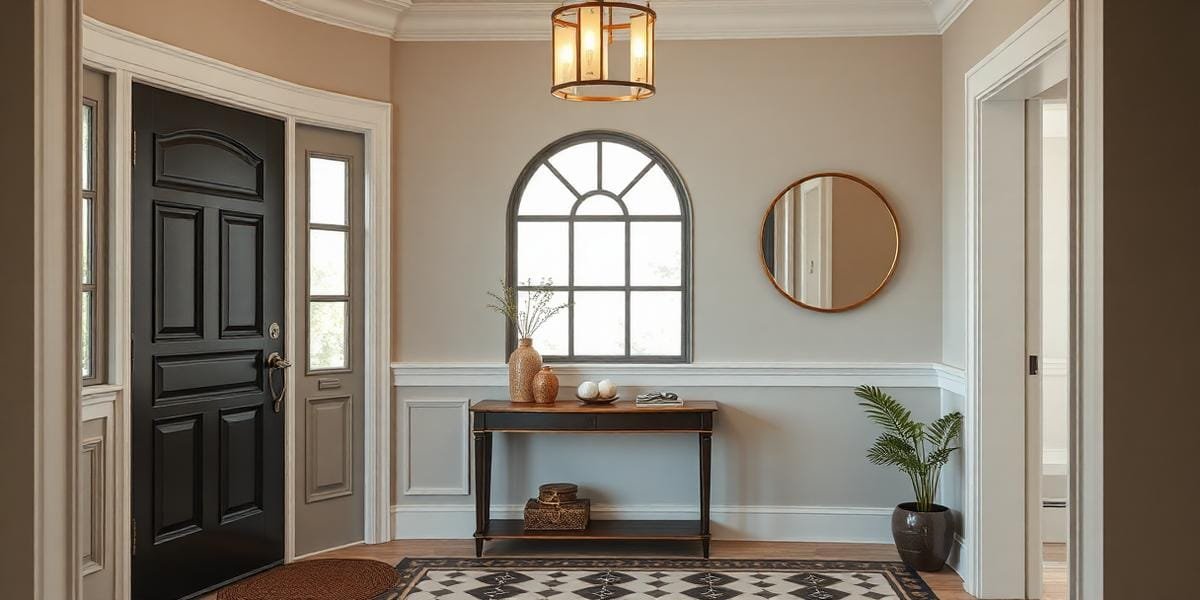
A console table is the standard furniture piece utilized in medium to large foyers, providing a shallow surface that does not block the walking path. Beneath or atop this table, designers position organizational tools such as ceramic trays for keys, woven baskets for umbrellas, and small decorative bowls. Seating is another critical attribute; a low bench or a pair of upholstered stools allows guests to sit comfortably while putting on or removing footwear.
Lighting plays a dual role in foyer performance, acting as both a safety requirement and a stylistic statement. Because foyers often lack large windows, builders install overhead fixtures like low-profile chandeliers or flush-mount LED discs to ensure the floor is clearly visible at night. Wall mirrors are frequently mounted above the console table to bounce natural light from the front door glass throughout the space, while allowing residents a quick appearance check before departing.
Real Estate Value and Staging Lessons From the Field
In the residential housing market, a well-defined foyer pays measurable dividends during open houses and private showings. National real estate agencies note that properties with a dedicated, beautifully staged foyer sell faster than homes where the front door opens directly into a living room or kitchen. When a buyer walks inside, a distinct foyer offers a moment of emotional pause, making the home feel larger and more organized than its actual square footage might suggest.
A common mistake observed in suburban developments built during the early 2000s is the over-cluttering of the front entrance with bulky storage units. In a recent property liquidation in Atlanta, Georgia, an agent named Sarah Miller encountered a house that languished on the market for 60 days because the front entrance felt cramped and dark due to an oversized armoire. By removing the heavy piece and replacing it with a sleek metal console table from IKEA, a neutral Ruggable runner rug, and a large round mirror, the space opened up visually, and the home secured a buyer within one week.
The financial return on foyer presentation stems from the concept of perceived quality. When buyers see premium materials like solid brass hardware, clean baseboards, and scratch-free hardwood floors right at the threshold, they automatically assume the rest of the structure has been meticulously maintained. Conversely, scuffed paint, loose jackets hanging on wall hooks, and poor lighting signal hidden maintenance problems to a trained eye.
Architectural Adaptations for Homes Without a Dedicated Foyer
Not every architectural style includes a built-in foyer, as seen in mid-century modern ranches, open-concept urban lofts, and compact bungalows. In these configurations, the front door frequently opens directly into the main seating area, exposing the entire living space to outdoor air and immediate viewing. Homeowners can successfully construct a simulated foyer using deliberate furniture placement, flooring changes, and visual dividers without building expensive structural walls.
One highly effective technique involves positioning the back of a living room sofa three to four feet away from the front door, facing inward toward the room. The back of the sofa acts as a physical boundary, creating a natural walkway behind it that functions exactly like a traditional foyer wall. Placing a long, slim console table directly against the back of that sofa provides the necessary surface area for keys, mail, and lamps.
Alternatively, rugs can establish spatial boundaries through texture and color contrasts. By placing a heavy-duty, low-pile jute or sisal rug in a distinct rectangle right inside the door frame, a visual landing pad is created that tells the brain where the outdoor zone ends and the indoor living room begins. Painting the immediate front door wall a slightly different shade or adding vertical wooden slats can also establish a zone of transition within a completely open floor plan.
Wrap Up
The foyer remains a vital component of residential architecture that bridges the gap between public life and private sanctuary. Understanding its true meaning allows homeowners to maximize its utility as a weather buffer, an organizational asset, and a design showcase. By focusing on durable materials, intelligent lighting, and clear boundaries, this entry space can elevate the daily experience of entering a home while protecting its resale value over time.
FAQs Section
What is the difference between a foyer and a lobby?
A foyer is a private greeting space located at the entrance of a residential home or theater apartment, whereas a lobby is a large, public reception room found at the entrance of commercial buildings, hotels, or corporate offices. Lobbies are built to accommodate large crowds and often contain service desks, public seating, and elevators.
How big should a standard residential foyer be?
A standard residential foyer typically measures between 20 to 50 square feet in a modest single-family home, though luxury properties can feature entryways that exceed 100 square feet. The minimal functional width for a foyer path is roughly 3.5 to 4 feet, which allows two adults to walk past each other comfortably.
Can you have a foyer in a small apartment?
Yes, a small apartment can feature a foyer if there is a distinct alcove or short hallway separating the front door from the primary living space. Even without physical walls, apartment renters can create a faux foyer by using a small wall-mounted floating shelf, a mirror, and a compact area rug.
Disclaimer
This content shared by Fall Rugs is solely for research and informational purposes. Fall Rugs is not a professional interior design or home renovation consultancy, and the information provided should not be considered professional advice for home improvement or decor. All ideas and suggestions are based on current trends and general knowledge in the home decor industry.