
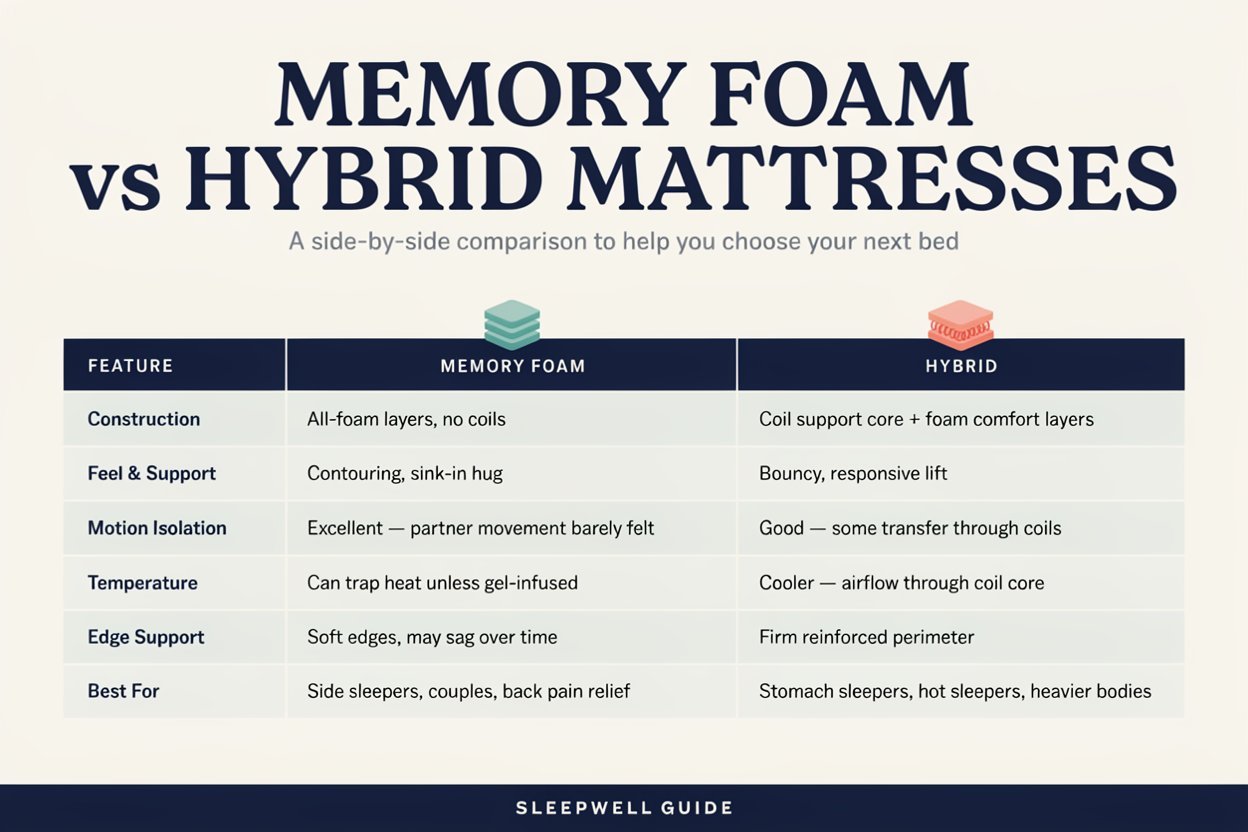
Here is how memory foam and hybrid mattresses compare across key performance categories, with traditional innerspring included as a baseline:
| Feature | Memory Foam | Hybrid | Traditional Innerspring |
| Core Structure | Solid high-density polyfoam | Pocketed steel coils | Connected steel coil grid |
| Comfort Layers | Viscoelastic foam layers | 2 to 4 inches of foam or latex over coils | Thin fiber pad or quilted foam top |
| Pressure Relief | Exceptional; deep sinkage and body hug | Moderate to high; cushions joints without deep sink | Low; firm pushback with minimal contouring |
| Cooling & Airflow | Tends to trap body heat (unless gel-infused) | High airflow through open coil system | Excellent airflow; stays naturally cool |
| Motion Isolation | Outstanding; deadens almost all movement | High; pocketed coils absorb movement well | Low; motion transfers across the whole bed |
| Edge Support | Weak; soft perimeter tends to compress | Strong; reinforced perimeter coils | Moderate to strong steel border |
| Ease of Movement | Low; slow response can feel “stuck” | High; springy bounce makes turning easy | Very high; immediate pushback |
| Average Lifespan | 6 to 8 years | 7 to 10 years | 5 to 7 years |
| Best For | Side sleepers, joint pain, light sleepers | Hot sleepers, combination sleepers, couples | Budget buyers, stomach sleepers wanting a firm feel |
The fundamental decision comes down to hugging pressure relief versus breathable support. All-foam memory mattresses excel at contouring around shoulders and hips while deadening motion transfer between partners. Hybrids use individually pocketed coils beneath their foam top layers, providing stronger edge support, easier position changes, and significantly better temperature regulation.