
TL;DR
An L-shape sofa divides space, anchors seating, and doubles as a room-planning tool all at once. Getting the size and orientation right matters far more than the fabric or color. Measure your floor plan before you buy, not after.
Introduction
What makes a piece of furniture genuinely useful rather than just expensive? For most living rooms, the answer sits in the corner. The L-shape sofa has become the dominant seating format across urban apartments, suburban family rooms, and open-plan homes because it solves a problem most other sofas cannot: it fills awkward space without wasting it. This piece breaks down how these sectionals actually work, what goes wrong when people buy them without enough information, and how to get the decision right the first time.
Why the L-Shape Configuration Works Differently Than Other Sofas
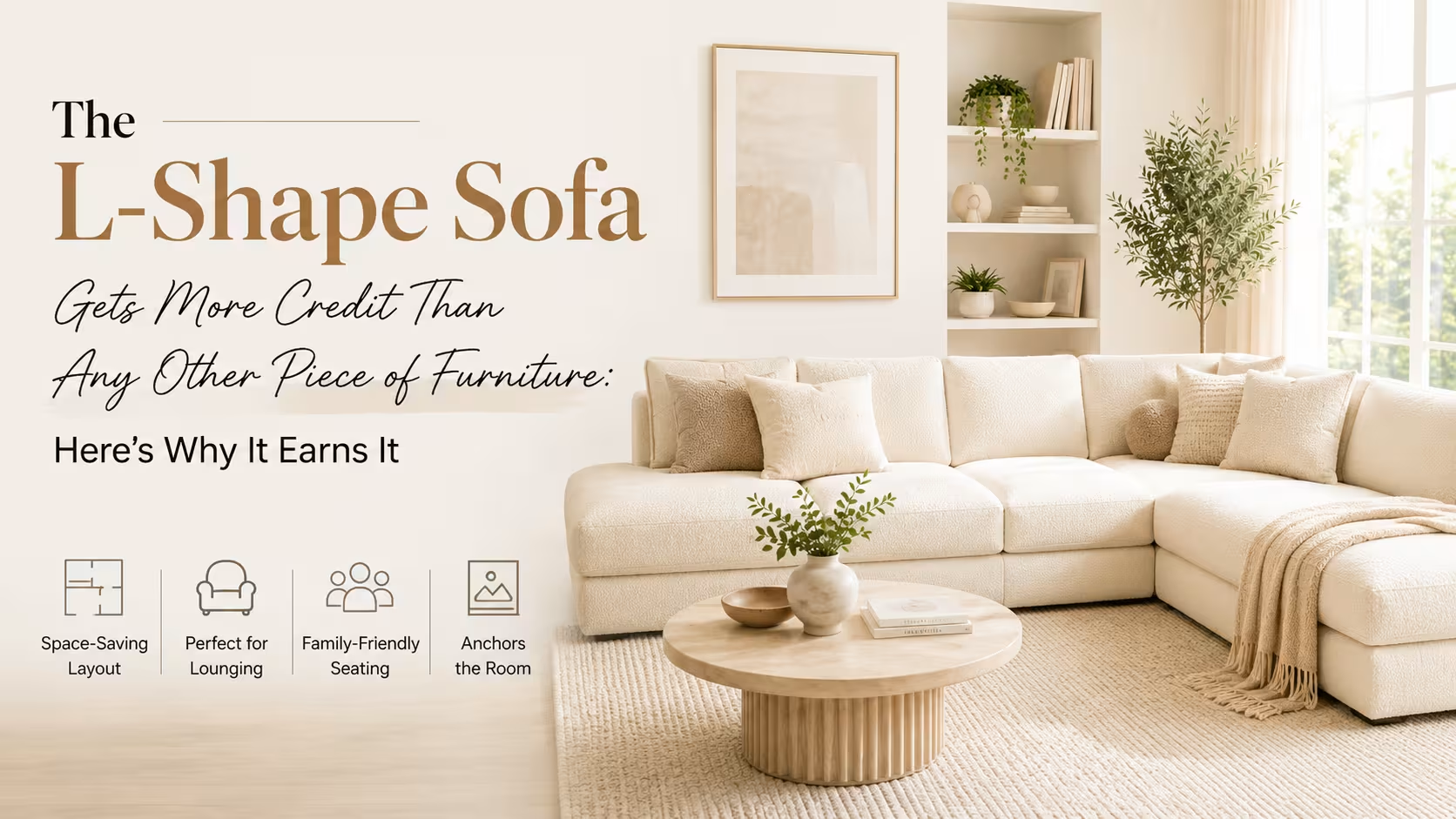
A standard three-seater sofa floats in a room. It needs a coffee table in front, accent chairs on either side, and a rug underneath to feel complete. An L-shape sofa creates its own spatial logic. The longer arm runs along one wall, the shorter arm extends perpendicular, and together they define a seating zone that needs very little else to feel finished. That self-contained quality is why interior designers reach for sectionals when a room lacks natural structure.
The corner piece itself, the section where the two arms meet, is often underestimated. It is the most-used seat in the entire sofa, not the least. Families tend to anchor there during movie nights. Children claim it instinctively. In practice, the corner converts an L-shape sectional from a seating product into a gathering product, which is a meaningful functional difference.
This matters most in open-plan homes where a kitchen, dining area, and sitting space all share one continuous floor. Without walls to define zones, furniture has to do that work. A corner sectional sofa placed strategically signals “this is the living area” with the same clarity that a partition wall would, while keeping sightlines open.
Measuring for an L-Shape Sofa Before You Fall in Love With One
The most consistent mistake buyers make is measuring the sofa instead of the room. A sectional listed as 280 cm on the long side and 165 cm on the short side does not tell you whether it fits until you map those numbers onto your actual floor plan with tape or painter’s tape markings.
Start with the longest wall where the sofa will sit. Allow at least 30 to 45 cm of clearance between the back of the sofa and the wall if you plan to place it away from the wall, or confirm the sofa’s depth if it will sit flush against it. The short arm extending into the room should leave at least 90 cm of walking clearance to any opposing furniture or wall. Less than that creates a corridor, not a sitting room.
The Chaise End Versus the Equal-Arm Debate
Some L-shape sofas are true sectionals with two similarly proportioned arms forming an L. Others are chaise-end sofas, where one side extends into a long, low lounger rather than a full sofa arm. These two formats behave differently in a room. The chaise-end version works well in smaller spaces because the low-profile lounger takes up floor area without crowding the sightline. The equal-arm sectional suits larger rooms where you want two distinct seating directions, for example, one arm facing a TV and the other angled toward a fireplace or view.
Modular Versus Fixed-Frame Sectionals
A fixed-frame L-shape sofa arrives as two or three pieces that bolt together. It is sturdy and usually better upholstered at the seams, but it cannot change configuration if you move. A modular sectional consists of individual units, typically a corner piece, single seats, and end arms, that can be reconfigured entirely. Riya Mehta, a renter in a Mumbai apartment, bought a fixed-frame sectional before realizing she would be moving within eighteen months. The sofa did not fit her next flat’s door or floor plan. A modular version would have adapted. This is a common and entirely avoidable situation.
Fabric, Fill, and Frame: The Three Materials That Determine Longevity
Upholstery fabric is what most buyers focus on first and what degrades fastest if chosen poorly. Performance fabrics woven with polyester or solution-dyed acrylic resist staining, pilling, and UV fading significantly better than natural linen or untreated cotton. Velvet reads beautifully in photographs and showrooms but shows seating imprints and pet hair in daily use. Leather and high-grade leatherette age well if maintained and are genuinely easier to wipe clean, making them the practical choice for households with young children.
The fill inside the cushions determines how the sofa feels after two years, not how it feels in the store. High-resilience foam wrapped in a layer of fiber or down gives an initial softness that does not fully compress over time. Pure foam without fiber wrapping can feel firm but tends to hold its shape longer under heavy use. Memory foam cushions feel luxurious but trap heat and recover slowly, which bothers many people after extended sitting.
Frame Construction and Why It Outlasts Everything Else
A hardwood frame, typically kiln-dried beech or oak, resists warping and cracking over the life of the sofa. Softwood and particleboard frames cost less upfront but flex under sustained weight, loosening joints within a few years. The simplest test in a showroom: lift one corner of the sofa slightly. A well-built frame feels rigid and returns to the floor without any creaking. Any movement at the joints or sound under light stress is a signal to look elsewhere.
Springs in the seat base matter too. Eight-way hand-tied coil springs represent the older, more labor-intensive construction that furniture makers still advertise as a quality marker. Sinuous springs or S-springs are less expensive and perform acceptably in mid-range sofas, but they produce more of the “hammock effect” over time, where the center of a cushion sags while the edges remain firm.
Positioning an L-Shape Sofa in Different Room Layouts
Living rooms come in a small number of recurring shapes: square, rectangular, L-shaped rooms themselves, and open-plan configurations. Each calls for a slightly different approach to sectional placement. In a square room, placing the sofa in a corner of the room with both arms running along the walls maximizes central floor space and creates a theater-style seating arrangement that works well for screen-facing setups.
In a rectangular room, the long arm of the sectional typically runs parallel to the longest wall, with the short arm extending toward the center. This draws the eye down the length of the room and prevents the sofa from cutting the space in half. A rug placed underneath, extending at least 45 cm beyond the sofa’s front edge, ties the furniture zone together visually.
Open-Plan Spaces and the Room-Divider Function
Open-plan living is where the L-shaped couch becomes particularly useful as a spatial tool. Placing a sofa with the back of the short arm facing the dining area creates a soft boundary between zones without blocking light or sightlines. James and Carla Osei renovated a Lagos townhouse into a combined kitchen-dining-living space. Their architect suggested using the back of the sectional’s short arm as the visual divider. The result was two clearly distinct zones in one room with no wall required. The sofa’s upholstery color was chosen to complement both sides, which made the transition feel intentional rather than improvised.
Floating the Sofa vs. Pushing It Against the Wall
A common assumption is that sofas belong against walls. With standard two-seaters and three-seaters, this makes sense because they need the wall to anchor them visually. With an L-shape sectional, floating the sofa slightly away from the wall, by as little as 10 to 15 cm, can make a room feel significantly more designed. It introduces depth and allows for lamp placement or narrow console tables behind the sofa. In smaller rooms, this may not be feasible, but in medium to large spaces, it is worth considering before defaulting to the flush-wall position.
Styling the Sofa Once It Is in Place
Cushions are the fastest way to change the feel of a sectional without replacing it, but more is not always better. Three to five cushions in varying sizes and textures read as intentional. More than seven typically reads as cluttered and makes the sofa harder to actually use. A common approach is two larger cushions in a solid or textured fabric at either end, two medium cushions in a pattern or contrasting color, and one smaller accent cushion tucked into the corner seat.
The coffee table relationship matters enormously. A large rectangular table placed in front of the long arm creates a natural conversation zone. A round or oval table softens the geometry of an already angular sofa and prevents the arrangement from feeling overly formal. The table should sit close enough to be usable from the sofa, ideally within 35 to 45 cm of the front edge, without feeling like an obstacle.
Rugs beneath sectionals should be sized so that at least the front legs of the sofa rest on the rug. A rug that is too small floats disconnected in the center of the room and visually shrinks the space. For most medium L-shape sofas, a rug of 200 by 290 cm or larger works as a starting point.
Wrap Up
An L-shape sofa earns its place in almost any living room when it is chosen with floor dimensions in mind, built on a solid frame with good-quality fill, and positioned to actually define rather than clutter the space. The corner seat, the fill material, and the distance from adjacent walls are the three decisions that matter most and receive the least attention in showrooms. Get those right and most other choices, color, fabric texture, leg style, become secondary.
FAQs
What size L-shape sofa works for a small living room?
For compact rooms under 15 square meters, look for an L-shape sectional with a long arm no wider than 220 cm and a short arm or chaise no deeper than 150 cm, and measure clearances before ordering.
Which direction should the chaise face on an L-shape sofa?
The chaise should extend toward the room’s natural exit path or toward the wall that receives least traffic; in practice, choose whichever side keeps 90 cm or more of clear walking space between the sofa and the nearest opposing furniture.
Is a modular or fixed L-shape sofa better for renters?
Modular sectionals are better for renters because individual pieces can be reconfigured to fit different floor plans, and they are easier to transport through narrow doorways and stairwells than fixed-frame sectionals.
Disclaimer
This content shared by Fall Rugs is solely for research and informational purposes. Fall Rugs is not a professional interior design or home renovation consultancy, and the information provided should not be considered professional advice for home improvement or decor. All ideas and suggestions are based on current trends and general knowledge in the home decor industry.