
TL;DR
Ten specific wild plants produce white blossoms that quickly take over turfgrass and garden beds. Proper identification allows you to choose targeted mechanical removal or specific organic controls. Early intervention prevents these aggressive species from choking out desirable turf and stealing vital soil nutrients.
Introduction
Why are white blossoms suddenly taking over your turf grass? Property owners often mistake these invaders for harmless wildflowers until their root systems crowd out expensive Kentucky bluegrass or perennial beds. This guide helps you identify ten frequent backyard intruders, unpacks their survival strategies, and gives you direct methods to reclaim your turf. You will learn exactly how to spot them by leaf shape, soil preference, and seasonal growth patterns.
1. White Clover (Trifolium repens)
White Clover stands as a classic perennial survivor that thrives in under-fertilized lawns throughout North America. It spreads through creeping stems called stolons that root directly into the soil as they expand horizontally. The plant features distinctive three-lobed leaves, each displaying a faint white V-shaped mark across the leaflets. During summer months, it produces spherical flower heads composed of dozens of tiny white tubular florets that attract bees.
This plant regularly invades areas where nitrogen levels have dropped significantly. Because it fixes its own nitrogen from the air, it easily outcompetes struggling turfgrass in poor soils. Homeowners using John Deere mowers often notice patches surviving low blade heights because the leaves grow close to the ground.
Eradication requires targeted effort. Hand-pulling works for small patches, provided you extract the entire root system using a hand trowel. For larger lawns, adjusting your fertilizer schedule to favor turfgrass density will naturally crowd out this competitor over two seasons.
2. Common Chickweed (Stellaria media)
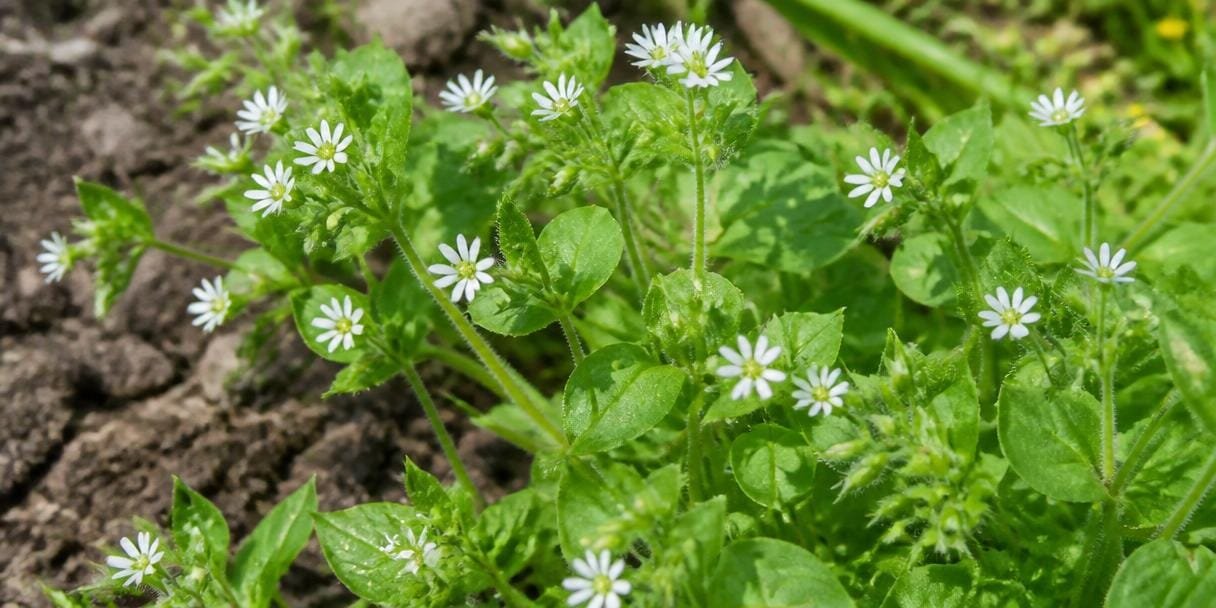
Common Chickweed prefers cool, moist conditions and dense shade, making it a frequent sight in early spring. This annual weed develops multi-branched, trailing stems covered in a single line of fine hairs. The leaves are oval with pointed tips, growing in opposite pairs along the delicate stems. Its star-like blossoms consist of five white petals, but each petal is deeply cleft, giving the illusion of ten distinct petals.
The main issue with this species involves its massive seed production capability. A single chickweed plant can deposit up to thirty thousand seeds into the surrounding soil during a single growing season. These seeds remain viable in the dirt for up to ten years, waiting for cool autumn temperatures to germinate.
Moisture management reduces chickweed presence. Avoid over-watering shaded zones under trees or near residential foundations where soil stays damp. A Fiskars stand-up weeding tool helps pull the shallow fibrous roots without disturbing the surrounding turf.
3. Daisy Fleabane (Erigeron annuus)
Daisy Fleabane grows as an upright annual or biennial plant that easily reaches heights of three feet in neglected landscape beds. It features coarse, hairy stems and alternate, lance-shaped leaves with tooth-like edges. The composite flower heads resemble miniature daisies, featuring a bright yellow central disc surrounded by forty to one hundred narrow white ray petals.
This weed establishes itself rapidly in disturbed soils, along fence lines, and inside newly cleared garden beds. It creates aesthetic problems and robs surrounding ornamental plants of valuable moisture during hot July weather. Wind carries the lightweight, fluffy seeds over long distances, spreading the infestation across entire neighborhoods.
Manual extraction works best when the soil is damp. Grab the base of the central stalk near the soil line and pull straight upward to extract the taproot completely. Regular mowing before the yellow centers turn to seed prevents the next generation from taking hold.
4. Garlic Mustard (Alliaria petiolata)
Garlic Mustard represents a severe biennial threat to wooded property borders and shaded lawn edges. First-year plants form low-growing rosettes of kidney-shaped leaves with scalloped edges. In the second year, the plant shoots up a flowering stalk with triangular, sharply toothed leaves that release a distinct garlic scent when crushed. Small white flowers with four petals arranged in a cross appear at the top of the stem in May.
This invasive plant releases toxic chemicals through its root system into the surrounding soil. This process inhibits the growth of beneficial mycorrhizal fungi, which native trees and shrubs require to absorb nutrients. Property values can drop when this aggressive plant suffocates desirable landscape plants.
Complete removal requires pulling the plant before it drops seeds. Use a Corona weeding trowel to dig beneath the root crown, ensuring the entire S-shaped taproot comes out of the earth. Bag the pulled plants and discard them in the trash rather than composting them, as the seeds can survive standard compost pile temperatures.
5. Field Bindweed (Convolvulus arvensis)
Field Bindweed behaves as a persistent perennial vine that twists counter-clockwise around fences, ornamental shrubs, and tool sheds. The leaves possess an arrowhead shape with pointed basal lobes. The blossoms look like small white or pale pink trumpets, measuring roughly one inch across and opening only on sunny mornings.
The primary risk of bindweed lies in its extensive, deep root system. Roots can penetrate up to twenty feet into the ground, storing immense energy reserves that allow the plant to survive prolonged droughts. Shovels or tillers often break the roots into tiny fragments, and each fragment can regenerate into a completely new vine.
Control requires persistent vigilance over multiple seasons. Repeatedly cutting the vines to the ground level every two weeks exhausts the root reserves over time. Applying a thick layer of cardboard covered by four inches of wood mulch helps suffocate emerging shoots in garden beds.
6. Queen Anne’s Lace (Daucus carota)
Queen Anne’s Lace functions as a biennial plant that populates sunny fields, roadsides, and large residential lawns. First-year growth looks identical to cultivated carrot tops, featuring finely dissected, fern-like green leaves. In its second year, the plant sends up a hollow, hairy stem terminating in a flat, lace-like cluster of hundreds of tiny white flowers. Often, a single dark purple flower sits exactly in the center of the white umbrella.
This wild carrot relative poses a minor health risk to sensitive skin. Contact with the hairy stems combined with sunlight exposure can cause mild skin irritation or photodermatitis in some individuals. The stiff, dried flower stalks also create an untidy appearance throughout the winter months.
Mowing large fields twice a year prevents the plants from completing their life cycle. For localized yard infestations, a standard garden fork can loosen the soil around the thick, deep taproot, making manual extraction much easier.
7. Shepherd’s Purse (Capsella bursa-pastoris)
Shepherd’s Purse is a common winter annual that establishes itself during the cool autumn months and blooms early the following spring. The plant forms a basal rosette of deeply lobed leaves resembling dandelion foliage. It then produces erect flowering stems that bear tiny, four-petaled white flowers at the tips, followed quickly by distinctive heart-shaped seed pods that resemble old-fashioned leather pouches.
The rapid life cycle of this plant allows it to exploit bare spots in thin lawns before summer grasses wake from dormancy. It draws heavily on shallow soil moisture, leaving the surrounding turfgrass vulnerable to heat stress later in the year.
Maintaining a thick lawn profile prevents shepherd’s purse seeds from receiving the sunlight they need to germinate. Overseeding bare patches with high-quality tall fescue or perennial ryegrass in September stops this weed from establishing its autumn rosettes.
8. Hairy Bittercress (Cardamine hirsuta)
Hairy Bittercress thrives as a small annual weed that loves damp soils, container plants, and heavily irrigated turf zones. It grows as a compact rosette of circular leaflets arranged in pairs along a central stem. Small, inconspicuous white flowers appear early in spring, quickly transitioning into long, narrow, vertical seed capsules called siliques.
The defining characteristic of this weed is its explosive seed dispersal mechanism. When the seed pods mature, the slightest touch causes them to burst open violently, launching seeds up to three feet away from the parent plant. This behavior allows the plant to spread rapidly across patio pavers and greenhouse benches.
Hand weeding must occur before the seed pods turn brown and stiffen. Pulling the plants while they are still in the flowering stage prevents the explosive dispersal from contaminating nearby garden soil. Adjusting automatic irrigation systems to reduce excess surface moisture also discourages new germination.
9. Mouse-Ear Chickweed (Cerastium fontanum)
Mouse-Ear Chickweed grows as a low, spreading perennial that forms dense, mat-like patches across lawns and golf courses. The small, oblong leaves are covered in dense, fuzzy grey-green hairs that resemble the ears of a small rodent. It produces small white flowers with five deeply notched petals that open wide in full sunlight.
The fuzzy texture of the leaves makes this plant highly resistant to some topical organic sprays, as the hairs prevent liquids from reaching the leaf surface. The dense mats choke out lawn grasses by blocking sunlight and capturing surface moisture before it reaches grass roots.
A manual thatch rake can tear up the shallow, creeping stems from the lawn surface. For large infestations, raising the mowing height of your Ames lawn mower helps the grass shade out the low-growing chickweed mats.
10. Mayweed Chamomile (Anthemis cotula)
Mayweed Chamomile is a bushy annual weed that emits a strong, unpleasant odor when stepped on or crushed. It features finely divided, thread-like leaves that look soft but feel coarse to the touch. The flowers feature a distinct cone-shaped yellow center surrounded by ten to fifteen white ray petals, blooming from June through October.
This plant regularly invades high-traffic areas, compacted soils, and barnyards where other plants struggle to survive. The irritating sap can cause blisters on livestock and skin rashes on humans who handle the plant without protection.
Alleviating soil compaction is the most effective long-term defense against this weed. Utilizing a core aerator in the autumn opens up the soil profile, allowing desirable grasses to establish deep roots that outcompete the shallow-rooted chamomile seedlings.
Wrap Up
Managing white-flowering weeds requires accurate identification and an understanding of their specific growth habits. Shifting your focus toward building a thick, healthy lawn through proper aeration, correct mowing heights, and balanced soil nutrition provides the best defense. Consistent physical removal before these plants drop their seeds will steadily reduce their numbers over successive seasons.
FAQs Section
How do I stop white clover from taking over my grass?
Increasing the nitrogen levels in your lawn fertilizer helps turfgrass outgrow and crowd out white clover naturally. You can also manually pull small patches using a weeding tool, ensuring you extract the creeping horizontal stems completely.
Are weeds with white flowers toxic to pets?
Some white-flowering weeds like garlic mustard or mayweed chamomile contain chemical compounds that can cause digestive issues or skin irritation in dogs and cats. It is best to remove these plants from backyard areas where pets frequently play.
Why does hairy bittercress spread so quickly across my patio?
Hairy bittercress utilizes an explosive seed pod system that launches seeds several feet through the air when touched. This mechanism allows the seeds to lodge into patio cracks, gravel pathways, and nearby garden pots very efficiently.
Disclaimer
This content shared by Fall Rugs is solely for research and informational purposes. Fall Rugs is not a professional interior design or home renovation consultancy, and the information provided should not be considered professional advice for home improvement or decor. All ideas and suggestions are based on current trends and general knowledge in the home decor industry.