
TL;DR
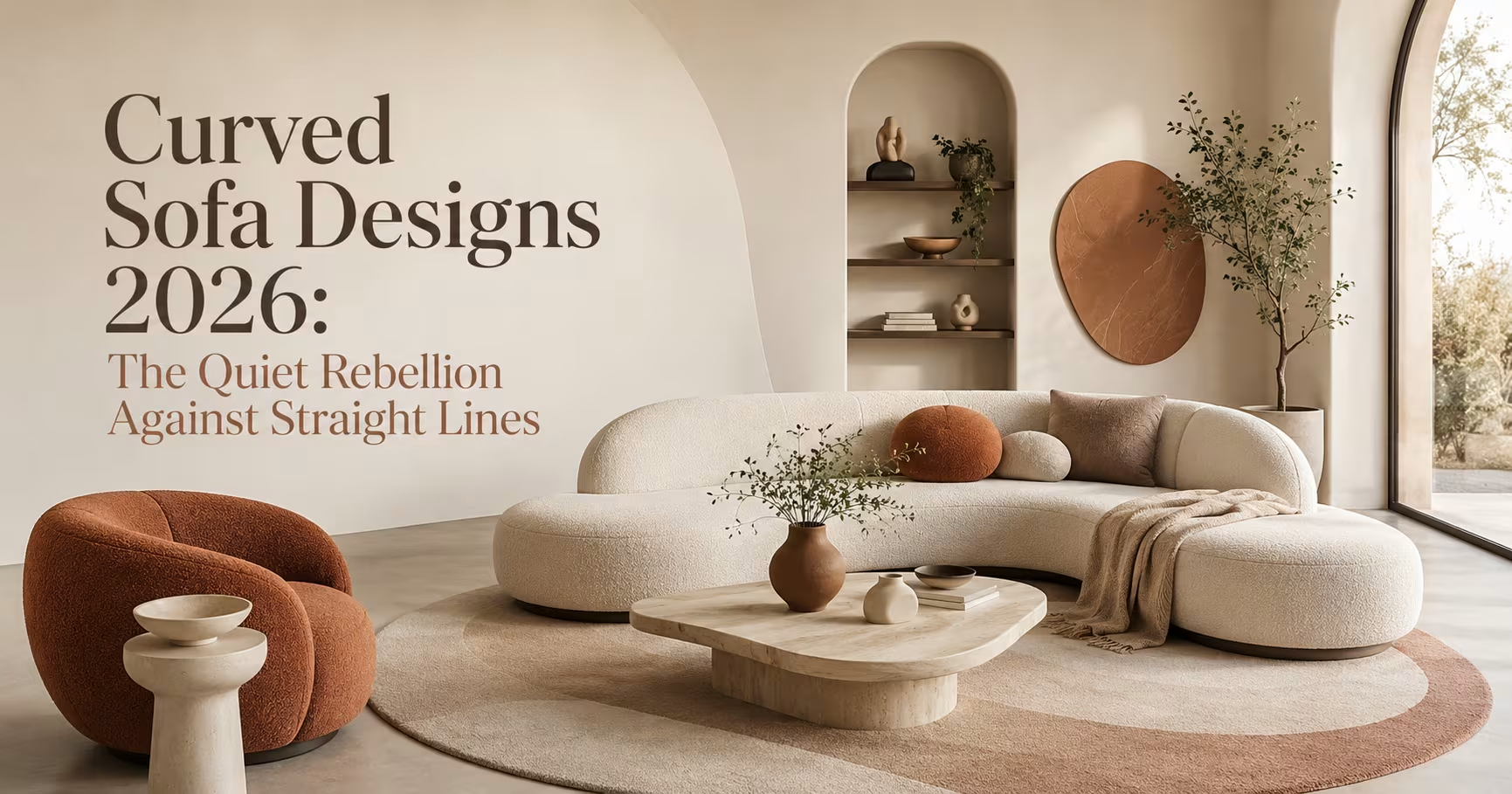
Curved sofas in 2026 solve concrete spatial problems, not just aesthetic ones. The best designs pull from Japanese metabolism architecture, 1970s Italian radicalism, and biophilic principles without feeling retro. Success depends entirely on room geometry, traffic flow, and fabric weight; get those wrong and the piece works against the space.
Introduction
Nobody walks into a room and feels their shoulders drop because the sofa forms a perfect right angle. A gentle arc, though, does something physiological. Curved sofa designs for 2026 have stopped chasing the Instagram-friendly crescent and started answering harder questions about how bodies actually gather, how light moves through open plans, and why certain rooms repel people despite looking flawless on camera. This year’s designs represent a maturing of the organic furniture movement, shedding its novelty phase and earning placement in homes where function rules.
Why Straight Lines Lost Their Grip on Living Rooms
The rectilinear sofa dominated postwar interiors for a reason. It stacked efficiently in warehouses, fit against flat walls, and mirrored the boxy architecture of suburban expansion. Open-plan living rewrote those rules. When walls came down, furniture had to do the work of defining zones, and a long straight sectional often acted less like a boundary and more like a barricade.
Curved silhouettes carve space differently. A crescent sofa placed opposite a dining table creates an implied corridor without building a physical wall. Architects noticed this first. Firms like SANAA and John Pawson have used curved seating in residential projects for decades, but the shapes rarely trickled into consumer manufacturing because the production costs were punishing. That changed when CNC cutting and cold-cure foam became accessible to mid-tier factories. Suddenly a sweeping arc didn’t require hand-built hardwood frames and a second mortgage.
The psychological shift matters too. People spent years staring at their own walls during lockdowns. Straight edges and sharp corners started reading as aggressive. A sofa with a soft return feels more like a retreat, and buyers now register that distinction instantly, even if they can’t articulate why.
The Mario Bellini Reissue Phenomenon
Bellini’s Camaleonda and Tentazione pieces never disappeared from design discourse, but their influence on 2026 production lines is staggering. The interlocking modular system he pioneered let owners reconfigure arcs, waves, and islands without buying new frames. Current manufacturers have borrowed the logic and stripped the cost. You see it in brands like Ligne Roset and even IKEA’s higher-tier experiments. The key takeaway from Bellini isn’t the rounded edge; it’s the permission to treat a sofa as a landscape rather than a fixture.
Metabolism Architecture and the Sofa as Topography
Japanese metabolism from the 1960s proposed buildings that grew and adapted like organisms. The same thinking now informs curved sofa design, particularly in modular systems that let arcs expand as families grow. Brands such as Arflex and Edra build pieces that avoid a fixed perimeter. A curved sectional might start as a two-seater crescent and later accept additional segments that shift the geometry from a quarter-circle to a flowing S-shape. Homeowners who plan to stay in a property for a decade find this logic persuasive because the furniture adapts rather than gets discarded.
The Geometry of Comfort in Curved Sectionals
Not every curve embraces. Some arcs push people away, forcing occupants to twist their necks or perch awkwardly on the outer radius. The most livable curved sectionals in 2026 follow a simple rule: the inner radius matches the natural reach of a seated adult. Designers working at Minotti and Living Divani measure this at roughly 110 to 130 centimeters. Tighter curves look sculptural but read as decorative objects rather than seating. They belong in hotel lobbies, not family rooms where someone wants to curl up with a book.
Seat depth along the curve creates another friction point. On a straight sofa, depth stays consistent. On a crescent, the outer edge offers more room than the inner compression zone. Smart manufacturers now grade the foam density along the arc, firmer at the tight side and softer where bodies sprawl. Without this compensation, the sofa feels lopsided after twenty minutes. Buyers rarely test for this in showrooms because the sensation takes time to register, so reviews from owners who have lived with the piece for six months become unusually valuable.
Backrest height also needs recalibration on curves. A uniform backrest on a serpentine sofa can make the inner seats feel overbearing and the outer seats feel exposed. The better 2026 designs taper the backrest subtly, dropping it where the curve opens toward the room and raising it where the arc hugs the sitter. It’s a small detail that separates pieces engineered for living from pieces engineered for photographs.
Fabric Weight and the Drape Problem
Upholstering a curve demands fabric that behaves predictably under tension. Lightweight linens and slubby cottons bunch at the inner radius and pull taut on the outer sweep, creating visible distortion within months. Performance velvets and densely woven bouclés have become the default for curved designs this year. They stretch enough to wrap compound curves without sagging, and their texture hides the minor creasing that straight sofas never reveal. Mohair blends solve the problem beautifully but push the price into custom territory, so manufacturers like B&B Italia offer proprietary synthetic blends that mimic the hand-feel at half the cost.
Crescent Sofas and the Traffic Flow Equation
Rooms don’t exist in a catalog spread. People walk through them carrying laundry, chasing toddlers, and navigating toward balconies. A crescent sofa placed badly becomes an obstacle course. Stylists working on 2026 interiors treat the sofa as a hub with a minimum clearance of 90 centimeters on all sides. Where the arc bulges into the room, that clearance needs to increase, especially if the path leads to a doorway or staircase.
The crescent shape shines brightest in square rooms where furniture placement feels static. A straight sofa against a wall leaves the center empty and awkward. Floating a curved piece in the middle of the same room redistributes the volume and creates two distinct zones: a conversation pit on one side of the arc and a walkway or secondary seating area on the other. Loose ottomans and floor cushions reinforce the division without adding visual weight.
L-shaped rooms pose a different challenge. A crescent sofa oriented toward the long axis can exaggerate the tunnel effect. Rotating it 30 degrees off-axis, anchoring it with a rug cut to follow the sofa’s sweep, breaks the bowling-alley proportion and makes the room feel wider. This trick originated in yacht interiors, where every centimeter of perceived width counts, and it migrated to compact urban apartments where floor space is similarly precious.
The Round Coffee Table Conversation
Pairing a curved sofa with a round coffee table sounds obvious, almost lazy. Stylists in 2026 have shifted toward organic, amoeba-shaped tables or nested geometric pieces that echo the arc without mimicking it exactly. A perfectly round table centered inside a crescent can feel like a bullseye, locking the arrangement into a single focal point that kills the flow the curve was meant to create. Offsetting the table slightly, or using two smaller tables at different heights, keeps the eye moving and lets the sofa’s shape breathe.
Biophilic Shapes and the Nature Borrowing That Works
Biophilic design has become a buzzword diluted enough to mean almost nothing. In the specific context of curved sofas, the connection holds water. The arcs showing up in 2026 don’t copy kidney beans or amorphous blobs; they reference the parabolic curves found in seed pods, river bends, and the spiral growth patterns of succulents. These shapes register as familiar even when the observer has never studied botany. The brain processes them faster and with less cognitive friction than it processes sharp angles.
Patricia Urquiola’s work for Moroso exemplifies this. Her curved seating doesn’t shout for attention. It borrows proportions from pebbles and weathered stone, objects shaped by water rather than by a designer’s ego. The resulting pieces look inevitable, as if the room grew around them. That quality separates the biophilic curve from the novelty curve. One ages into its surroundings; the other becomes a dated conversation piece within three years.
Living with biophilic curves also affects how people arrange complementary furniture. Owners of these sofas tend to add more natural materials organically; unpolished stone side tables, jute rugs, ceramic lamps with irregular glazes. The sofa sets a material standard that synthetic finishes can’t comfortably meet, and the room either rises to that standard or feels disjointed.
Avoiding the Theme-Park Organic Trap
Too many curved pieces in one room tip from serene to cartoonish. A crescent sofa paired with a round rug, circular pendant light, and arched mirror becomes a study in circles rather than a functional living space. The best 2026 interiors use the curved sofa as a singular gesture and ground it with rectilinear elements. A sharp-edged console table behind the sofa’s straight back, a square-framed artwork above it, or a linear floor lamp alongside creates the tension that makes the curve register. Without contrast, softness reads as shapelessness.
Modular Curved Systems and the Long-Game Investment
Fully upholstered curved sofas with fixed frames commit the owner to one room configuration for the furniture’s lifetime. Modular systems that ship in segments change that calculation. Companies like Cozey and Burrow have entered the curved modular space with aggressive pricing, while established Italian makers like Flexform offer high-end versions with joints engineered to disappear once assembled.
The practical advantage surfaces during moves. A fixed crescent sofa might not fit through the doorway of a new apartment. A segmented version breaks down and reassembles. Owners who have moved twice with the same modular curved sofa report that the connectors need retightening after reassembly, and felt pads between segments reduce squeaking on hardwood floors. These details rarely appear in marketing materials but dominate owner forums.
Modular also allows for asymmetrical configurations that fixed curves don’t support. A homeowner might configure an S-shaped layout that wraps around two seating zones, or attach a chaise segment to one end of a crescent for a reading nook that doesn’t interrupt the room’s main sight line. The flexibility does come with a visual tradeoff. Segment seams interrupt the continuous sweep that makes a fixed curved sofa so seductive in photographs. People who prioritize photography-ready interiors over adaptability choose fixed frames.
Reconfiguration Fatigue and the One-Configuration Reality
Marketing for modular sofas emphasizes endless arrangements. Owner behavior tells a different story. Most people find a configuration that works and never change it, which means they paid a premium for connectors and seam detailing they don’t use. Smart buyers in 2026 test one configuration exhaustively in the showroom, commit to it, and only buy modular if they anticipate a move within five years. The money saved on a simpler fixed frame often covers a better grade of upholstery.
A Real-Life Scenario: The Open-Plan Rescue
Clara and Dev moved into a 1970s condo in Portland with a single 45-square-meter living space that served as entryway, lounge, and dining area. Their previous straight sectional, a three-meter gray beast, sat against the longest wall and forced every activity into a narrow strip between the sofa and the kitchen island. Traffic cut diagonally through conversations. The room felt like a hallway with furniture.
They replaced the sectional with a crescent sofa from Gubi’s Moon collection, a two-and-a-half-meter piece with a gentle outward arc. Instead of pushing it against the wall, they floated it facing the windows, creating a natural walkway behind it that connected the front door to the kitchen without crossing the seating zone. The arc opened toward the dining area, so someone on the sofa could talk to someone at the table without craning around a sofa arm. The clearance behind the piece measured just over a meter, tight by the book, but the curve made the passage feel wider than it was.
The mistake they almost made, and only avoided because Clara tested it with masking tape on the floor, was orienting the crescent toward the TV wall. That layout would have directed the sofa’s back at the entryway, creating the same blocked sight line they were trying to fix. The tape-on-floor exercise cost twenty minutes and saved two years of irritation.
A Real-Life Scenario: The Overfurnished Loft
Marcus rented a converted warehouse unit in Berlin with soaring ceilings and a single long wall of industrial windows. He bought a serpentine sofa from Edra that undulated like a dune across the center of the space. It photographed beautifully. The problem emerged during his first dinner party. The sofa’s outermost curve projected into the path between the kitchen and the dining table, and guests had to detour around it while carrying plates. Someone tripped on the rug edge, wine went into the bouclé, and Marcus spent the next morning with a rented upholstery cleaner.
The fix required rotating the entire arrangement 90 degrees so the sofa’s long axis ran parallel to the window wall instead of perpendicular. The curve no longer blocked traffic. The piece lost some of its sculptural drama, but Marcus discovered the room felt larger because the sofa no longer interrupted the view toward the windows. The lesson was that curved sofas amplify the consequences of bad placement more than rectangular ones do. A straight sofa against a wall can get away with being in the wrong spot. A floating curve cannot.
Wrap Up
Curved sofa designs in 2026 earn their place by solving problems that straight furniture creates in open, multifunctional rooms. The best examples pull their proportions from architecture and nature, use fabrics that hold compound curves without distortion, and get placed with more attention to traffic flow than to how they’ll photograph. Modularity adds real-world flexibility but introduces seams and connection points that some owners regret paying for. A crescent sofa treated as a room’s structural element, rather than its decorative afterthought, does more than soften a corner. It changes how people move through and settle into a space.
FAQs
Are curved sofas harder to fit through doorways than straight sofas?
Curved sofas with fixed frames can be wider at their deepest point than a comparable straight sofa, so measuring doorways, hallways, and elevator interiors before ordering is non-negotiable. Modular curved sofas solve this problem by shipping in segments that assemble inside the room.
Do curved sofas work in small living rooms or only in large open spaces?
A smaller crescent with a gentle radius works well in compact rooms by pulling seating away from walls and freeing up circulation space behind it. The key is choosing a piece with a seat depth under 100 centimeters so the sofa does not consume a disproportionate share of the floor area.
Which upholstery fabrics hold up best on curved frames?
Performance velvets, tightly woven bouclés, and high-quality microfiber blends handle compound curves without excessive bunching or sagging. Linen, thin cotton, and loosely woven wools tend to distort at the inner radius and show wear unevenly over time.
Disclaimer
This content shared by Fall Rugs is solely for research and informational purposes. Fall Rugs is not a professional interior design or home renovation consultancy, and the information provided should not be considered professional advice for home improvement or decor. All ideas and suggestions are based on current trends and general knowledge in the home decor industry.