

TL;DR
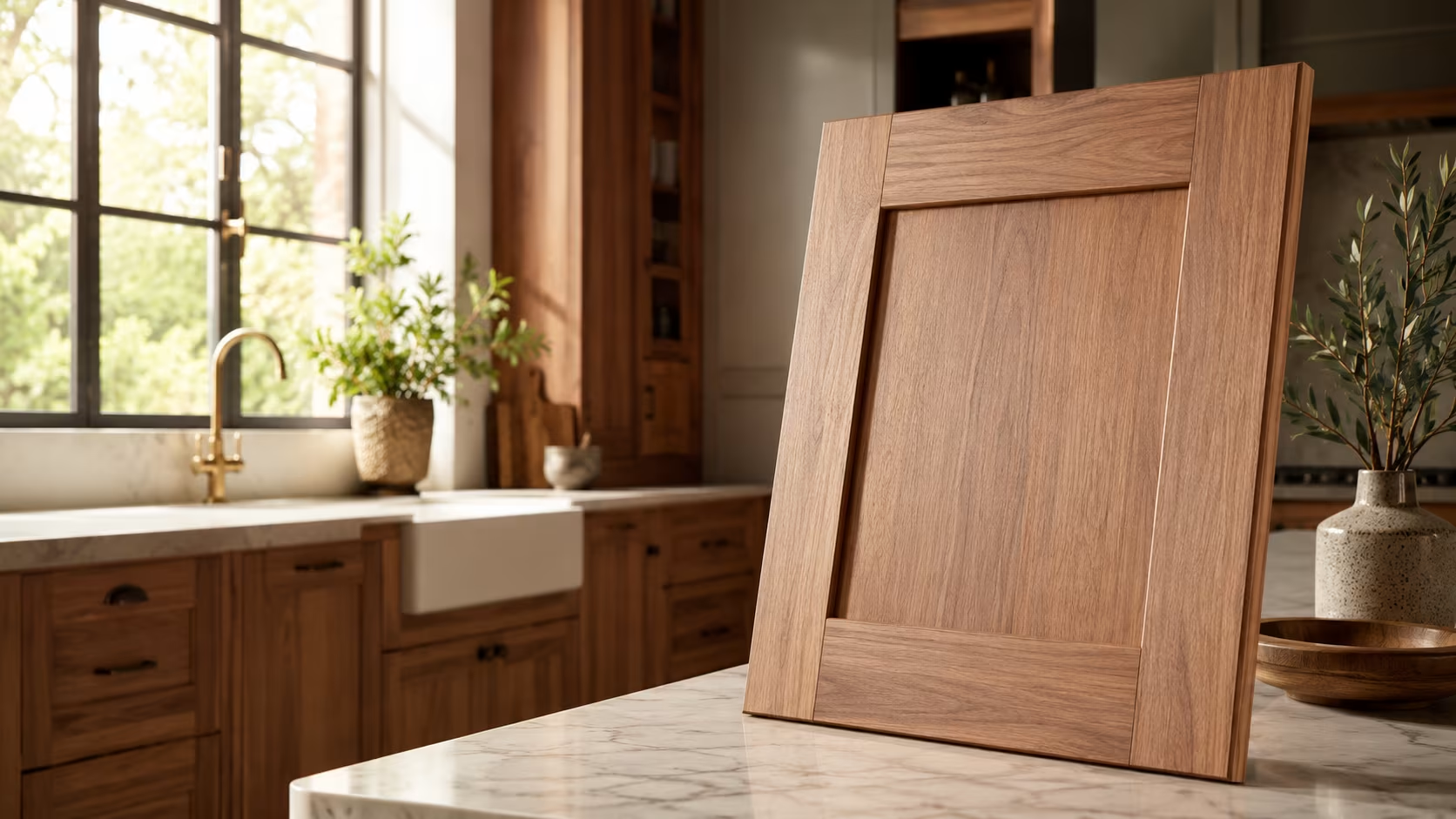
Stiles are the vertical frame members of a cabinet door; rails run horizontal. Together they create a floating panel structure that manages wood’s seasonal movement while defining the door’s architectural character. Material choices, joinery methods, and proportion rules have shifted noticeably through 2026, driven by wider planks, quieter grain, and demand for visible craftsmanship over veneer uniformity.
Introduction
A cabinet door looks simple until you build one. Then every millimeter matters. The parts have old names because the problem they solve is older than power tools: solid wood expands and contracts across its width, and if you trap it in a rigid frame, it will crack something.
Stiles and rails solve that equation without glue failure, without warping, and without hiding the wood’s natural movement behind engineered shortcuts. This article traces how that quiet partnership works, why proportion conventions are breaking in 2026, and what the material choices actually cost long after installation day.
The Anatomy That Changed Kitchens
What a Stile Actually Does
A stile is the vertical side member running the full height of a cabinet door or frame. In standard frame-and-panel construction, the stile receives the rail’s tenon into its mortise, creating a joint that resists racking forces every time someone opens the door. Stile width has become a design signature in recent years. Through the early 2020s, the default for Shaker-style doors hovered around two and a quarter inches.
By mid-2026, custom shops across the Midwest and Northeast are cutting stiles at three inches and wider, particularly on floor-to-ceiling pantry units where the door needs visual mass to avoid looking like a hallway coat closet. Benjamin Moore’s color of the year selections have repeatedly landed on deep blues and muted plums that read differently on a narrow stile versus a broad one; the wider face holds saturation better and gives the eye a stronger vertical line.
When I first apprenticed in a small Cincinnati cabinet shop, the lead finisher had a saying I still think about every time I set up a cope-and-stick bit: “The stile is the handshake between the door and the room.” If the stile proportion is off, nothing else in the kitchen feels settled. Too narrow and the door looks nervous. Too wide without adjusting the rail accordingly and the whole assembly reads as top-heavy. There is no universal formula, but a working rule among experienced cabinetmakers ties stile width to door height: for doors under thirty inches, keep stiles between two and two and a half inches; above forty-two inches, push toward three inches or risk a spindly look.
What a Rail Brings to the Frame
Rails span horizontally between stiles, typically matching the stile width for visual consistency. Their structural job is to hold the panel’s short edges while resisting the tendency of wide doors to sag toward the latch side. The bottom rail deserves special attention because it collects more hand contact, more moisture from mopping, and more visual weight than the top rail.
Many well-built cabinet doors use a bottom rail that is slightly wider than the top rail, often by half an inch to a full inch. This asymmetry predates modern kitchen design. Nineteenth-century built-in cabinetry in New England homes frequently shows a heavier bottom rail, partly for proportion and partly because mortise-and-tenon joinery survives better when the lower joint has extra glue surface to fight gravity and humidity swings.
Ruggable introduced washable rugs that changed how people think about kitchen floor moisture, but that moisture still rises. I have inspected doors in homes less than three years old where the bottom rail swelled noticeably because the end grain absorbed water wicked up from stone floors cleaned with steam mops.
A wider bottom rail paired with a catalyzed conversion varnish, specifically post-catalyzed lacquer from brands like Gemini or Milesi, offers meaningfully better resistance than standard pre-cat finishes applied in thinner coats. The rail material choice matters here more than the stile because horizontal grain orientation exposes more end grain pores to ambient moisture, and rail end grain faces downward.
The Frame-and-Panel Logic Most People Miss
Wood Movement Is Not a Flaw
Solid wood panels shrink and swell across their width with seasonal humidity changes. A typical kitchen in Chicago might see interior relative humidity swing from twenty percent in January to sixty-five percent in July, even with HVAC running. That translates to a solid maple panel moving roughly an eighth of an inch across a twelve-inch width.
If you glue that panel rigidly into a frame, the panel will split or the frame joints will separate. The frame-and-panel system solves this by floating the panel inside grooves cut into the stiles and rails. The groove depth, usually three-eighths to half an inch, provides expansion room, and small rubber or silicone space balls placed in the groove prevent the panel from rattling while still allowing movement.
I learned the hard way, on a built-in bookcase commission in 2019, that skipping space balls and relying on finish to hold a loose panel produces an annoying chatter every time the furnace kicks on in February. The client noticed. I had to remove the face frames, disassemble three doors, and insert the balls after the fact. Now I keep a bag of quarter-inch clear silicone balls from an Ohio-based supplier in my fastener drawer at all times, and I never deliver a solid-wood door without them.
Why Pocket-Hole Frames Are Not the Same
Pocket-hole joinery for face frames has its place in paint-grade cabinetry built to a budget. Home centers and ready-to-assemble brands like IKEA’s higher-end Sektion cabinet frames often use dowel construction or confirmat screws rather than traditional mortise-and-tenon joinery for the box, but the door construction tells a different story.
True frame-and-panel doors rely on cope-and-stick joinery, where the rail end is profiled (coped) to match the stile’s profile (the stick cut), creating a mechanical lock that strengthens with glue. A pocket-hole door frame can fail in racking over time because the screw acts as a pivot point. I have replaced pocket-hole shaker doors in rental property kitchens where the bottom rail twisted away from the stile after repeated exposure to dishwasher steam venting directly below the counter.
Semihandmade, the California-based company known for aftermarket IKEA-compatible doors, uses five-piece construction with solid wood frames and medium-density fiberboard center panels for painted finishes. Their approach acknowledges what paint-grade cabinetmakers have known for decades: a stable MDF panel eliminates wood movement concerns while the solid wood frame provides the structural integrity and feel that a fully engineered door lacks. The compromise is weight and the inability to refinish a painted MDF panel, but for a white shaker kitchen in a dry climate, it is a pragmatic trade-off.
Proportion Rules That Shifted in 2026
The Return of Wider Stiles
Minimalist slab doors dominated the 2010s. IKEA’s flat-front Veddinge and Voxtorp lines captured the aesthetic, and European frameless construction made slab doors easy to manufacture. By 2023, the pendulum started swinging back toward framed doors with visible proportions, and 2026 has accelerated that shift.
Designer firms in cities like Portland, Oregon, and Austin, Texas, are specifying stiles at three and a quarter inches for rift-sawn white oak doors on full-overlay cabinets. The wider stile showcases the wood’s medullary ray figure in a way narrow stiles simply cannot. Quarter-sawn and rift-sawn white oak both show pronounced ray fleck, but rift-sawn has a straighter grain line that reads as more contemporary. When a stile is too narrow, that figure gets lost, and the client pays a premium for material nobody sees.
Pottery Barn and West Elm have both introduced wider-framed cabinet collections in their 2025 and 2026 catalogs, moving away from the slim-shaker proportions that defined their earlier solid-wood offerings. The marketing language emphasizes “substantial framing” and “architectural presence,” but the underlying motivation is probably simpler: wider stiles use more wood, which signals higher quality in a showroom, and they allow the manufacturer to use narrower panels, which reduces the risk of panel warp in transit and in service.
Rail-to-Stile Ratios That Actually Work
A standard ratio of one-to-one between stile and rail width looks balanced on most doors under thirty-six inches tall. On taller doors, a slightly heavier bottom rail corrects an optical illusion where the door appears to narrow toward the floor. The rule of thumb in many custom shops calls for a bottom rail that is twenty to thirty percent wider than the stile, with the top rail matching the stile or even slightly narrower.
I built a hutch last spring with forty-eight-inch doors on the lower cabinets, using two-and-three-quarter-inch stiles, a two-and-a-half-inch top rail, and a three-and-a-quarter-inch bottom rail. The client’s interior designer initially questioned the asymmetry, but once installed, she admitted the doors looked “grounded” in a way symmetrical doors had not in her previous projects.
The Beaded Inset style, heavily associated with high-end makers like Plain English and deVOL, uses narrow stiles by necessity because the door sits inside the cabinet face rather than overlaying it. Typical beaded inset stiles run between one and three-quarters and two and a quarter inches. The bead detail, a small quirk cut along the inner edge of the frame opening, draws the eye inward and makes narrow stiles feel intentional rather than skimpy. DeVOL’s Shaker peg rail and cabinetry, manufactured in Leicestershire, England, has popularized the look globally, and by 2026, several North American custom shops in cities like Nashville and Charleston offer a version using locally sourced hardwoods.
Material Choices Driving Decisions
Maple, Oak, Cherry, and the Species That Faded
Hard maple dominated American cabinet interiors for thirty years because it machines cleanly, takes paint well, and costs less than cherry or walnut. For visible stiles and rails in stained or clear-finished doors, the 2026 market has tilted hard toward white oak. The shift is not subtle. Suppliers like Wurth Baer and Richelieu reported sustained demand for white oak veneer and solid stock through the first quarter of 2026, while maple orders softened.
Red oak, historically a budget alternative, has lost ground because its pronounced grain pattern reads as dated in a market that prefers the calmer figure of white oak. Cherry continues to sell in the Mid-Atlantic and New England markets where traditional full-inset cabinetry in dark stain remains a regional preference, but it has become a niche product nationally.
Hickory made a brief appearance in 2024 and early 2025 as designers experimented with rustic-modern aesthetics, but the extreme hardness that makes hickory appealing for flooring makes it punishing on cope-and-stick tooling. Router bit life drops noticeably when running hickory rails through a shaper all day. Small cabinet shops learned this quickly and steered clients toward white oak or ash instead. Ash, which emerald ash borer devastation made abundant and affordable in the Midwest for several years, is becoming scarcer as standing dead timber gets harvested, and its price is rising accordingly. By late 2026, ash has nearly returned to parity with select-grade white oak in many markets.
MDF, Plywood, and the Hidden Core Debate
Paint-grade cabinet doors increasingly use an MDF center panel captured within solid wood stiles and rails. This hybrid approach eliminates panel cracking in dry winter climates and provides a perfectly flat substrate for sprayed conversion varnish. The downside is weight. An MDF panel in a thirty-inch-wide door adds noticeable heft to the hinge load, and Blum soft-close hinges rated for full-overlay doors can struggle if the hinge cup spacing does not account for the extra panel mass. I spec three hinges on any painted door over twenty-four inches wide with an MDF panel, where two might suffice for a solid wood panel of the same dimensions. The extra hinge costs roughly eight dollars at wholesale, a negligible insurance against sag.
Plywood as a panel material occupies a middle ground. Baltic birch plywood with a thick face veneer, typically sourced from Russia until supply disruptions reshaped the market in 2022, now comes increasingly from Finnish mills. The quality remains high, and the plywood’s dimensional stability approaches MDF while offering screw-holding ability that MDF lacks.
Some cabinetmakers use plywood panels even in stained doors by edge-banding the panel groove with a solid wood lip, hiding the plywood core entirely. I consider this technique honest work, not deception, because the structural benefit is real and the appearance under finish is indistinguishable from solid wood.
Joinery, Tooling, and the Cope-and-Stick Standard
Router Bits That Define the Edge
Cope-and-stick router bit sets have been the standard for small and mid-sized cabinet shops since the 1980s, when high-speed steel gave way to carbide-tipped tooling that holds an edge through hundreds of doors. The stick cut profiles the inner edge of the stile, while the matching cope cut shapes the rail end to fit perfectly into that profile.
Freud, Whiteside, and Amana remain the dominant bit manufacturers in North American shops, with Whiteside’s premium carbide earning loyalty among professionals who run thousands of linear feet per month. The bit set costs between one hundred twenty and two hundred fifty dollars for a matched pair, and a well-maintained carbide set can produce several thousand doors before resharpening.
One mistake I see repeatedly in hobbyist forums and small shop social media is running cope cuts on a router table without a backer board, leading to tear-out on the rail’s exit side. Tear-out on a rail end means the joint line will show a gap that no amount of glue or clamping pressure can close. The fix is simple but initially counterintuitive: clamp a sacrificial block behind the rail during the cope pass so the bit exits cleanly into scrap material rather than blowing out the workpiece grain. It adds seconds per cycle and saves hours of repair work.
Mortise-and-Tenon in an Age of CNC
Dedicated mortising machines and horizontal boring equipment still live in high-production shops, but the rise of affordable CNC routers has changed how mortises get cut. A shop with a ShopBot or Axiom CNC can batch-cut mortises in stiles while the machine also drills shelf-pin holes and hardware pockets.
The precision is excellent, and the labor savings are real. The trade-off is that CNC-cut mortises have square corners, while a traditional hollow-chisel mortiser produces slightly rounded ends that match a routed tenon shoulder. The square corner collects excess glue that must be cleared before assembly, and if the tenon fit is too tight, hydraulic pressure from trapped glue can split the stile during clamping. A simple remedy involves rounding the tenon shoulders with a chisel after the cope cut, a five-second operation that prevents callbacks.
Larger factories producing for brands like KraftMaid and MasterBrand use fully automated tenoners and profile sanders that eliminate these manual steps entirely. The industrial machines produce joinery that fits consistently and sands cleanly, but the door profiles tend toward conservative shaker and slab designs because complex profiles slow the production line. The creative freedom in 2026 millwork lives in custom shops that blend CNC efficiency with hand-fitted joinery.
Finishing Methods That Respect the Frame
Conversion Varnish and Why It Dominates
Post-catalyzed conversion varnish became the default clearcoat for American cabinet shops because it cures chemically rather than through solvent evaporation alone. The result is a film that resists water, household cleaners, and the oils from cooking better than traditional lacquer. Milesi and ICA are Italian brands widely distributed in North America, and their two-component systems produce a finish that can survive a decade of kitchen abuse without yellowing or peeling. The application requires serious ventilation and spray equipment; this is not a wipe-on product for the weekend woodworker.
An often-overlooked finishing detail involves the groove that holds the floating panel. If the spray gun coats the groove interior heavily, the panel will stick during dry months and possibly crack the finish film when it finally shifts. Experienced finishers know to spray the assembled door with the panel already inserted but unglued, allowing a light dusting of finish into the groove rather than a flooded coat. The panel itself gets finished before assembly on all faces and edges to minimize moisture absorption differential.
Staining vs. Toning and the Grain-Flip Problem
Stain penetrates wood fiber unevenly, particularly on the end grain of rails where the exposed pores absorb more pigment than the face grain of stiles. This creates a visible color difference at the cope-and-stick joint that shouts “amateur” to anyone who knows what to look for. Toning, by contrast, applies color in the clearcoat layer rather than soaking into the wood. The tinted finish sits uniformly on all surfaces regardless of grain orientation, producing a consistent color across stile face, rail end grain, and profile edges. Sherwin-Williams and Gemini both sell pre-tinted conversion varnishes in popular colors, and many shops now tone rather than stain for any door with visible joinery.
I abandoned traditional oil-based stains for cabinet doors five years ago after a cherry kitchen went blotchy despite careful sanding and a pre-stain conditioner. The conditioner helped, but the stile-to-stile color variation across eight upper doors was enough to make me eat the cost of refinishing. Switched to a sprayed dye sealer followed by a tinted topcoat, and the color consistency improved so dramatically that I have not touched a can of wiping stain for frame-and-panel work since.
Real-World Scenarios That Test Construction
The Humid Summer Kitchen
Megan and David renovated a 1920s bungalow in Atlanta during the summer of 2025, installing custom inset cabinets with solid cherry door frames and cherry raised panels. The contractor finished the doors in February when the shop humidity hovered around thirty-five percent. By July, with no central air running during the final weeks of construction, interior humidity reached seventy percent, and the panels swelled until they pressed against the stile grooves hard enough to bow the doors outward. The problem was not the joinery or the wood species; it was assembly timing without accounting for the seasonal moisture differential. The fix involved removing the doors, taking a thirty-second of an inch off each panel edge on a table saw, and rehanging them after the HVAC system had been running for two weeks. The doors settled flat and stayed flat. The lesson stuck with me and with the contractor, who now runs a dehumidifier in his assembly room year-round and conditions panels to the home’s expected humidity range before final glue-up.
The Paint-Grade Remodel That Fought Back
A builder in Denver ordered forty-five MDF-panel doors with poplar stiles and rails for a whole-house remodel. Poplar machines beautifully and takes paint well, which makes it the default paint-grade hardwood in most American shops. The doors arrived on site in January, and the painting subcontractor sprayed them with a water-based primer before the house’s humidification system was active. The poplar frames absorbed moisture from the primer and swelled, but the MDF panels stayed dimensionally stable, creating a hairline gap at the panel groove that telegraphed through the finish as a thin crack line around every panel. The painter blamed the cabinetmaker; the cabinetmaker blamed the painter. The actual culprit was applying water-based primer to an unsealed door in a dry winter environment without allowing the wood to acclimate. A quick coat of solvent-based vinyl sealer before the water-based primer would have prevented the entire fiasco. I heard about this job from the lumber supplier who sold both parties the poplar and had to mediate the dispute.
What 2026 Means for the Next Generation of Cabinetry
Designers Are Asking for More Wood, Not Less
The trend toward painted cabinets has not disappeared, but it has split into two distinct camps. One still wants full-paint, often in muted greens, navy blues, or warm off-whites. The other wants natural wood with visible joinery, celebrating the stile and rail as architectural elements rather than structural necessities. This second camp drives demand for premium white oak, walnut, and even thermally modified ash that takes on a rich chocolate tone through a heat-and-steam process without chemical stain. Thermally modified wood has gained serious traction in the Pacific Northwest, where firms like Henrybuilt and Kerf Design use it for entire cabinet runs.
Hardware Integration and Soft-Close Expectations
Blum’s Clip-top BLUMOTION hinges now carry an expectation, not a premium feature. Cabinet doors without soft-close feel incomplete to a 2026 buyer, even in budget-conscious renovations. The hinge cup drilling location on the stile is standardized at thirty-five millimeters for European-style concealed hinges, but the reveal, or gap between door and adjacent door or face frame, varies by design. A full-overlay door in a frameless cabinet might show a three-millimeter reveal; an inset door might show a uniform two-millimeter gap all around. Getting reveals consistent across a kitchen full of doors requires precise stile width cutting and rail length cutting, plus disciplined hinge adjustment. Sloppy reveals announce rushed work, and they cannot be fixed with paint or hardware.
Wrap Up
Stiles and rails form a system that manages wood’s living nature while creating the visual structure of a cabinet door. The material shifts toward white oak, the wider stile proportions taking hold in 2026, and the hybrid panel approaches that balance stability with appearance all point toward a market that values visible craftsmanship. Good joinery, careful moisture management, and thoughtful finishing separate doors that last thirty years from doors that fail in three. A stile is more than a vertical board and a rail is more than a crosspiece, and when that truth gets lost, the doors show it first.
FAQs Section
What is the difference between a stile and a rail on a cabinet door?
The stile is the vertical side piece running the full height of the door, while the rail is the horizontal piece spanning between the stiles. Together they form the outer frame that holds the center panel.
Why do cabinet doors have a frame around the panel instead of being one solid piece of wood?
Solid wood expands and contracts across its grain with humidity changes. If a wide panel were glued into a rigid frame, the seasonal movement would crack either the panel or the joints. The frame-and-panel design floats the panel inside grooves so it can move freely while the frame stays stable.
What is the standard width for stiles and rails on Shaker cabinets?
Classic Shaker proportions use stiles and rails around two and a quarter to two and a half inches wide. In 2026, many designers are specifying wider stiles up to three inches or more, especially on tall doors, to create a more substantial architectural presence.
Disclaimer
This content shared by Fall Rugs is solely for research and informational purposes. Fall Rugs is not a professional interior design or home renovation consultancy, and the information provided should not be considered professional advice for home improvement or decor. All ideas and suggestions are based on current trends and general knowledge in the home decor industry.