

TL;DR
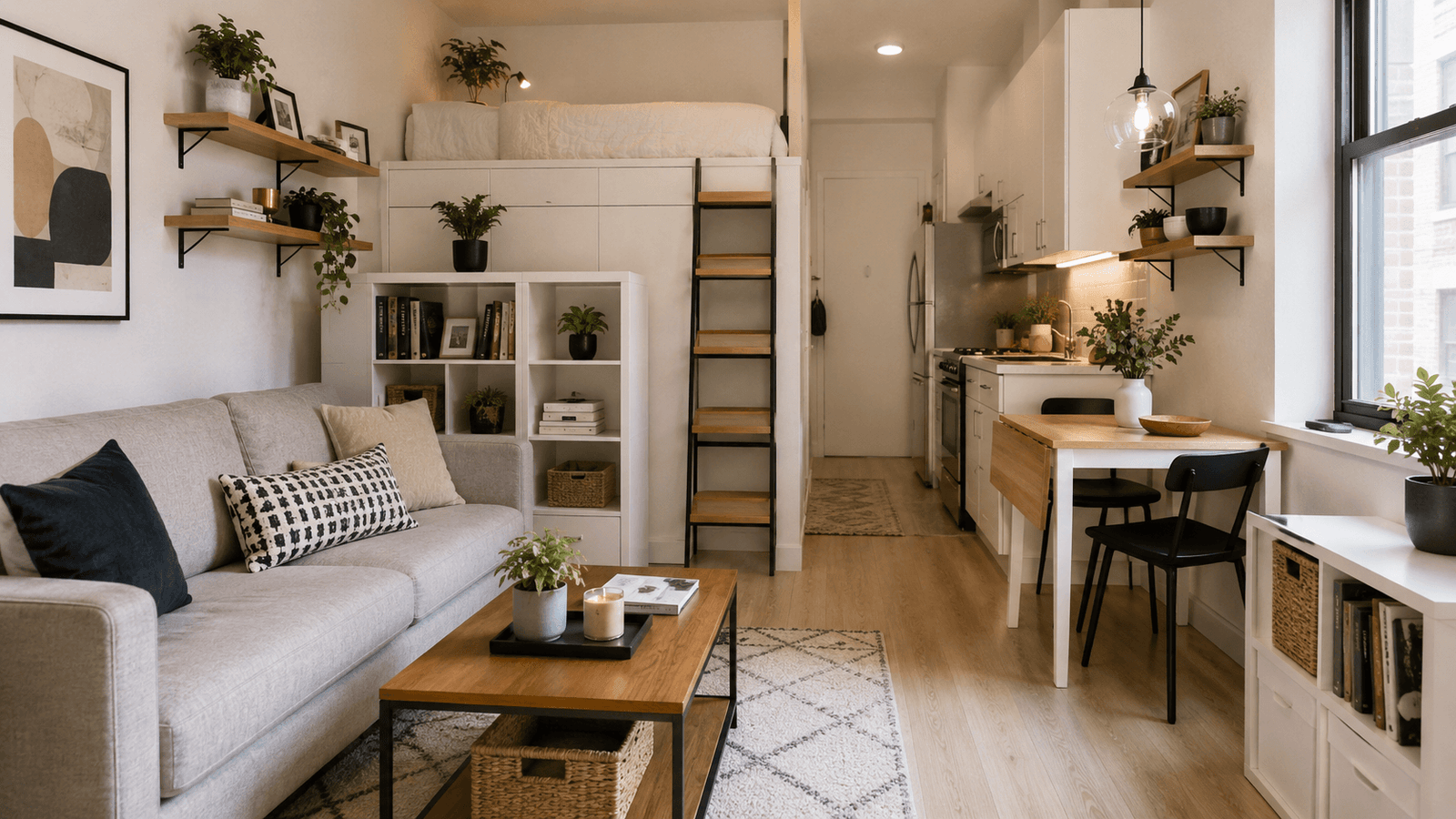
A small apartment feels larger when every object earns its place and doubles its function. Vertical storage, multifunctional furniture, and strategic use of mirrors and light are the three pillars of genuinely space-aware decorating. Getting this right does not require spending a lot of money.
Introduction
What makes a 400-square-foot apartment feel either suffocating or surprisingly livable? It is rarely the square footage itself. Interior designers who work with micro-apartments in cities like Tokyo, New York, and Paris will tell you the same thing: perception of space is shaped by decisions around light, scale, and object placement far more than by raw dimensions. Whether you rent a studio in Chicago or own a compact flat in London, the ten ideas ahead give you a working framework, not vague inspiration.
Why Most Small Apartment Decor Advice Fails
Most decorating guides treat small spaces as a problem to hide. That framing leads to choices that make things worse, not better. Cramming in “slim” furniture still creates clutter when there are too many pieces. Painting everything white reads as clinical, not spacious, when the lighting is poor.
The smarter position is to treat a small apartment as a design constraint that forces better decisions. Architects who specialize in compact housing, like those working on ADU (accessory dwelling unit) projects across California and the Pacific Northwest, consistently find that constraint produces more considered, livable results than unlimited floor area.
Real improvement comes from working with the architecture you have. That means reading your ceiling height, window placement, and traffic flow before buying a single piece of furniture. A layout mistake in a 600-square-foot space costs you proportionally more than the same mistake in a 2,000-square-foot home.
Furniture That Pulls Double Duty
The first and most impactful category is multifunctional furniture. A Murphy bed with integrated shelving, like the units offered by Resource Furniture or the more affordable Ori Cloud Bed system, converts a bedroom into a usable living room during the day. In a true studio apartment, this single swap can reclaim 50 to 60 square feet of floor area.
Nesting tables replace a standard coffee table with three surfaces you can spread out for guests and collapse back to one when the space needs to breathe. West Elm’s Terrace nesting tables and IKEA’s KRAGSTA set are two widely available options that work across budgets, the former around $350 and the latter under $80.
Ottomans with internal storage solve two problems at once. They function as seating, footrests, and coffee tables while hiding blankets, books, and remote controls. A designer named Emily Henderson popularized the “storage ottoman as living room anchor” approach on her blog, and it remains one of the most repeated practical tips in residential interior design circles for good reason.
Sofa Beds and Dining Tables That Fold
A wall-mounted fold-down dining table, sometimes called a Murphy table, gives a kitchen or living area a full dining surface without the permanent footprint. Pottery Barn sells a version called the Benchwright Drop-Leaf Table that folds flat against the wall. IKEA’s NORBERG is a comparable fold-down shelf that supports up to 220 pounds and costs under $30.
Sofa beds have improved dramatically since the uncomfortable pull-out models of the 1990s. Brands like Burrow and Article now make sleeper sofas with memory foam mattresses that do not require a guest to apologize in the morning.
Vertical Space Is the Most Underused Real Estate
Floor space is finite. Ceiling space is almost always wasted. In a standard apartment with 8-foot ceilings, there is roughly 18 to 24 inches of dead space above most furniture where shelving, cabinetry, or even hanging storage can live.
IKEA’s KALLAX and BILLY systems both extend to ceiling height with additional shelf units. Installing a second rod inside a standard closet, roughly 18 inches above the first, can nearly double hanging capacity at a hardware cost of under $15. Floating shelves along a hallway wall turn a transition space into a library without narrowing the walkway.
Interior designer Justina Blakeney, known for her Jungalow aesthetic, frequently demonstrates how vertical plant shelving creates the illusion of height in a room. The eye follows the line upward, which shifts the perceived ceiling. The same principle applies to tall bookshelves, vertical artwork arrangements, and floor-to-ceiling curtains hung close to the ceiling, not the window frame.
Hanging Storage in Kitchens and Bathrooms
A pot rack mounted to the ceiling above a kitchen island removes the need for lower cabinet storage while adding a professional kitchen aesthetic. In bathrooms smaller than 50 square feet, over-door organizers and suction-mounted shelving from brands like Umbra or mDesign can add 10 to 15 items of storage without drilling.
Mirrors, Light, and the Science of Visual Expansion
A large mirror positioned opposite a window reflects both natural light and the outdoor view, creating a convincing impression that the room continues beyond the wall. This is not a new trick. Versailles used it at grand scale in the Hall of Mirrors in 1684 for exactly this reason, though a West Elm arched floor mirror in a 350-square-foot Brooklyn studio achieves a comparable perceptual effect at a fraction of the cost.
Layered lighting replaces overhead-only setups that flatten a room and make it feel smaller. A combination of floor lamps, table lamps, and under-cabinet strips creates depth and separates zones in an open-plan space. Philips Hue bulbs and similar smart lighting systems let you dial down evening light to a warm 2700K tone, which makes walls visually recede and the space feel more intimate and less cramped.
Sheer curtains allow daylight to diffuse through while maintaining privacy, which keeps a room brighter throughout the day without additional lighting. Heavy blackout curtains pulled across a small window can cut ambient light by 70 to 80 percent, which is one of the fastest ways to make a small room feel like a closet.
Color Strategies That Actually Work
Light walls help, but the specific finish matters. A flat paint in a warm off-white like Benjamin Moore’s White Dove or Sherwin-Williams’ Alabaster reflects more evenly than a bright cool white, which can create harsh contrast with natural shadows. Painting a ceiling the same color as the walls, rather than white, removes the visual border between the two surfaces and makes the room feel taller.
An accent wall in a deep, saturated color works in small rooms when it is the wall furthest from the entry point. It creates a focal point that draws the eye across the room, increasing the perceived depth of the space.
Rugs, Zones, and the Open-Plan Problem
A studio apartment without zoning feels like one continuous mass of furniture. A well-placed rug defines a living area as distinct from a sleeping area or dining zone, giving each part of the room its own identity without building a wall.
Ruggable makes washable, flat-profile rugs that work particularly well in small apartments because they do not trap grit under furniture and they can be swapped seasonally. Their 5×8 size is the sweet spot for a studio living zone that does not overpower the floor plan.
The rug should be large enough that at least the front legs of all seating furniture sit on it. A common and costly mistake is buying a rug that is too small, which makes furniture float and the room look fragmented. For a standard apartment living setup with a sofa and two chairs, an 8×10 rug is usually the minimum workable size.
Room Dividers That Add Function
A bookshelf used as a room divider, like the IKEA KALLAX placed perpendicular to a wall, creates a visual boundary between a sleeping area and a living area without blocking light. This approach is common in New York City apartment styling, where open-plan 500-square-foot units are divided by interior designers into functional zones without losing the airy feel.
Sheer curtain panels hung from ceiling-mounted tracks offer another option. They can close off a sleeping area at night and open fully during the day. The track hardware from companies like KVARTAL (IKEA’s ceiling-mounted curtain system) costs around $40 and supports panels of almost any weight.
Decluttering as a Design Strategy
No furniture arrangement or paint color corrects a room that has too many objects in it. The single most documented finding from residential design research on small spaces is that visual clutter raises stress and reduces the perceived size of a room more than almost any other variable.
The KonMari method, developed by Marie Kondo and published in 2011, gave millions of people a repeatable framework for reducing possessions. The core idea, keeping only what serves a purpose or brings genuine satisfaction, is not just a lifestyle philosophy. It is a design principle with measurable spatial consequences.
Cassidy Holloway, a real estate stager who works primarily in San Francisco micro-units, has noted in industry profiles that removing 30 percent of a tenant’s belongings before a showing can make a unit appear 15 to 20 percent larger in photographs, even with no other changes. Storage choices should conceal rather than display wherever possible in small apartments, meaning closed cabinetry outperforms open shelving for most homeowners who are not committed to curation.
Wrap Up
Small apartment decorating done well is not about deprivation. It is about precision. Furniture that works harder, storage that climbs the walls, light that fills the room, and mirrors that expand it visually are four moves that collectively shift how a space is experienced day to day. Start with one wall, one corner, or one piece of furniture that is not earning its place, and work outward from there. The best small apartment interiors look intentional because they are.
FAQs
What is the best furniture for a small apartment?
Multifunctional furniture gives you the highest return in a small space. Murphy beds, storage ottomans, fold-down dining tables, and nesting tables all reduce footprint while keeping usability intact.
How do you make a small apartment look bigger?
Mirrors placed opposite windows, floor-to-ceiling curtains hung close to the ceiling, light wall colours with matte finishes, and layered artificial lighting all create a convincing sense of more space without structural changes.
What size rug should I use in a small apartment living room?
An 8×10 rug is usually the right minimum for a living room setup with a sofa and two chairs. A rug that is too small makes furniture appear to float and visually fragments the space rather than anchoring it.
Disclaimer
This content shared by Fall Rugs is solely for research and informational purposes. Fall Rugs is not a professional interior design or home renovation consultancy, and the information provided should not be considered professional advice for home improvement or decor. All ideas and suggestions are based on current trends and general knowledge in the home decor industry.