
TL;DR
The Japanese maple cultivar Acer palmatum ‘Takeyama’ offers an unusual vertical architecture that solves a specific spatial problem in small gardens and modern landscapes. Its narrow form, layered branching, and seasonal color transformation from crimson to deep burgundy make it a functional design tool, not merely a decorative tree. Success with this plant depends on understanding root zone protection, precise pruning at the correct time of year, and matching its rigid structure with companion plants that soften rather than compete.
Introduction
A garden without vertical punctuation loses the eye halfway through. That is a problem many homeowners in Kyoto, Portland, and Charleston have solved not with a fence or a pergola, but with a single well-placed Japanese maple. The ‘Takeyama’ selection pushes this architectural role further. It grows like a living exclamation point, yet its foliage stays delicate, almost lace-like.
People who plant it are usually solving for something specific: a narrow side yard that eats afternoon sun, a courtyard that needs height without sprawl, or a modernist facade that demands a plant with structural integrity. This article walks through what the tree actually does, how it behaves across seasons, and where it goes wrong when planted without forethought.
What ‘Takeyama’ Actually Is, Botanically and Practically
The Cultivar’s Lineage and Physical Signature
Acer palmatum ‘Takeyama’ belongs to the palmatum species of Japanese maples, a group that includes hundreds of named cultivars bred across Japan, Europe, and the Pacific Northwest over the past four centuries. Unlike the weeping dissectum types that cascade horizontally, ‘Takeyama’ holds a fastigiate, upright habit. Branches angle upward at roughly 30 to 45 degrees from the trunk, creating a silhouette that reads as columnar without becoming stiff. Mature specimens in the ground reach about 18 to 22 feet tall in North American growing conditions, with a spread of only 6 to 8 feet. Container-grown trees stay smaller, typically topping out at 10 to 12 feet over fifteen years.
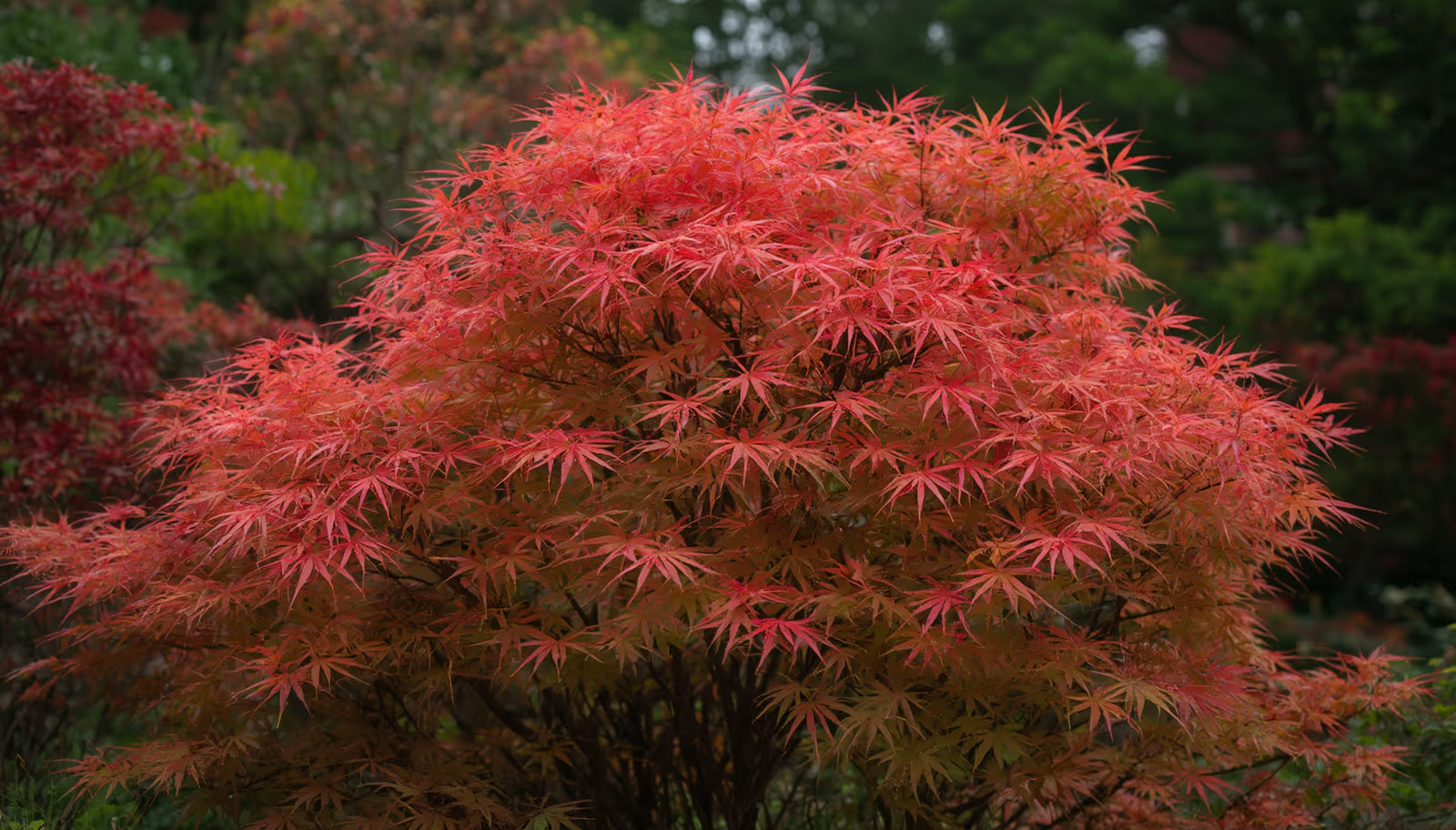
Leaf shape is the classic palmate form with five to seven deeply cut lobes. Spring emergence brings a saturated crimson-red that holds through early summer. By July in hot climates like Raleigh, North Carolina, the foliage can bronze or green slightly, a photoprotective response to ultraviolet exposure. Autumn returns the tree to its signature scarlet, often intensifying after a first light frost. The bark ages to a smooth grey-green, giving winter interest when the tree stands bare.
Why the Narrow Form Matters for Spatial Design
Most small gardens fail because the planting scheme ignores vertical real estate. A typical suburban lot in San Diego or Austin might be 40 feet wide with a side setback of 8 feet. That strip often becomes a mulch-filled dead zone. A ‘Takeyama’ placed in that corridor does three things simultaneously: it screens the neighboring two-story window without blocking the path, it draws the eye upward which makes the space feel larger, and it casts dappled rather than dense shade, preserving light for underplanting. Landscape architect Shinichi Nakajima, known for residential work in Kamakura, Japan, has described upright Japanese maples as “living columns” that replace hardscape elements with seasonal texture. That concept translates directly to Western garden design, where pergolas and trellises once dominated vertical thinking.
Site Selection and Planting: Mistakes That Cost Years
Light, Soil, and the Microclimate Equation
Japanese maples in general prefer morning sun and afternoon shade, but ‘Takeyama’ tolerates more direct light than many red-leaf cultivars. In Portland’s Willamette Valley, specimens in full sun hold decent summer color. In Atlanta’s humid heat, the same exposure bleaches leaves to a tired tan by August. The rule is geographic: north of the 40th parallel, full sun works; south of it, partial shade becomes non-negotiable. Wind is an under-discussed threat. Narrow-form trees catch less wind than broad-canopy types, but leaf scorch still appears when hot, dry air moves continuously across the foliage. A planting location near a south-facing brick wall amplifies both heat and reflected light, which pushes the tree past its tolerance in USDA zones 7b and warmer.
Soil pH between 5.5 and 6.5 suits the species. Heavy clay, common across the Midwest from Columbus to Kansas City, requires amendment. The standard advice to “add organic matter” is incomplete. What actually works is excavating a planting hole three times the root ball width but only as deep as the root ball height, backfilling with the native soil mixed at a 30 percent ratio with pine bark fines or composted leaf mold, and ensuring the root flare sits one inch above grade. Maples planted too deep develop girdling roots that slowly strangle the trunk over a decade. By the time the canopy thins, the damage is usually irreversible.
Drainage, Root Competition, and the Container Alternative
Soggy soil kills Japanese maples faster than drought. The roots of Acer palmatum are shallow and fibrous, concentrated in the top 12 to 18 inches of soil. In a poorly drained site, Phytophthora root rot colonizes within a single wet season. The tree may leaf out normally in spring, then collapse suddenly in June. A percolation test is the practical diagnostic: dig a 12-inch hole, fill it with water, and time the drainage. If water remains after 24 hours, either install subsurface drainage or consider a raised bed or container.
Container culture solves the drainage problem entirely while adding a mobility benefit. A ‘Takeyama’ in a 24-inch glazed ceramic pot from a brand like Seibert & Rice can live happily for eight to ten years before needing root pruning. The mix should be 60 percent high-quality potting soil, 20 percent perlite, and 20 percent composted bark. Terracotta pots in freezing climates crack; fiberglass or high-fired stoneware pots survive Zone 6 winters without failure.
Pruning as a Design Conversation, Not a Chore
Timing, Cuts, and the Structural Frame
Japanese maples bleed sap heavily when pruned in late winter or early spring. For ‘Takeyama’, the optimal pruning window runs from late June through early August in the Northern Hemisphere. By then, the first flush of growth has hardened off, and sap flow has slowed. The tree compartmentalizes summer cuts quickly, reducing the risk of fungal entry. Pruning in autumn, especially in damp Pacific Northwest conditions, invites Nectria canker to infect open wounds.
The pruning objective with a narrow-form cultivar is to enhance the layered, architectural silhouette. Start by removing any branch that grows inward toward the central leader. Then address crossing branches that rub and create bark wounds. The third pass targets downward-growing or horizontal branches that disrupt the upward gesture. Each cut should angle just outside the branch collar, leaving a small swelling that heals into a neat ring. A bypass pruner from a brand like Felco or Okatsune makes cleaner cuts than anvil-style tools, which crush cambium tissue.
A common mistake: over-thinning the interior. ‘Takeyama’ has a naturally open structure. Removing too many inner branches exposes the trunk to sunscald and leaves the tree looking stripped. The goal is transparency, not bareness. After pruning, you should still see small twigs and tertiary branches filling the interior volume. Those fine branches carry the leaf buds that produce next year’s color display.
Correcting Past Pruning Errors
Many ‘Takeyama’ specimens in older landscapes bear the scars of poor pruning. Stub cuts, where a branch was severed halfway between node and trunk, do not heal. Instead, they die back and create entry points for decay organisms. A tree with multiple stubs needs rehabilitation, not a quick fix. The corrective process spans three growing seasons. Year one, remove dead stubs back to healthy wood. Year two, address structural flaws. Year three, do light refinement. Spreading the work prevents the stress response known as watersprouting, where the tree pushes dozens of vertical shoots from dormant buds along the trunk. Watersprouts grow fast and weak, ruining the tree’s form and redirecting energy from the canopy.
Seasonal Care Rhythms That Build Vigor
Watering Through the Establishment Window
The first two summers define a ‘Takeyama’s long-term health. Newly planted trees need consistent soil moisture without saturation. In sandy soils like those found near Cape Cod or Long Island, that means two deep waterings per week during dry spells. In clay soils, one weekly deep soak suffices. Drip irrigation on a timer eliminates the guesswork. A 2-gallon-per-hour emitter placed 12 inches from the trunk, run for 90 minutes, delivers roughly 3 gallons, which penetrates to the full root depth. Overhead sprinklers wet the foliage and promote bacterial leaf spot; avoid them.
Mulch is a soil moisture insurance policy. A 2-inch layer of shredded hardwood or pine straw spread from 3 inches away from the trunk to the dripline keeps root temperatures stable and reduces evaporation. Volcanic rock mulch, popular in xeriscape designs in Denver and Albuquerque, reflects too much heat for Japanese maples and should be avoided around them.
Fertilizing Without the Flush of Weak Growth
Heavy nitrogen fertilization pushes Japanese maples to produce long, internodal shoots that lack cold hardiness and color intensity. A ‘Takeyama’ fed with a high-nitrogen lawn fertilizer will grow fast, look greenish-red, and die back at the tips each winter. The better approach uses a low-analysis organic fertilizer, something with an NPK ratio around 4-3-2, applied once in early spring after the last frost. Brands like Espoma and Dr. Earth produce formulations marketed for trees and shrubs that fit this profile. For container plants, a half-strength dose of fish emulsion every four weeks during the growing season provides steady nutrition without the surge-and-crash pattern.
Potassium plays an under-appreciated role in anthocyanin production, the pigment responsible for red leaf color. Trees growing in potassium-poor soils, common in the sandy Southeast, show duller autumn displays. A light application of sulphate of potash in late summer, roughly 2 ounces per inch of trunk diameter spread around the root zone, intensifies fall color within a single season.
Pairing ‘Takeyama’ With Plants That Understand Their Role
Underplanting for Contrast Without Competition
The vertical structure of ‘Takeyama’ creates a defined understory zone that receives filtered light from mid-morning onward. Plants that thrive in this niche share certain traits: shallow roots that do not compete aggressively, a preference for humus-rich soil, and foliage textures that contrast with maple leaves. Hakonechloa macra ‘Aureola’, the golden Japanese forest grass, works as a low groundcover that brightens the shaded ground plane. Its arching habit softens the maple’s rigidity. In zones where winter temperatures drop below -10°F, Hosta ‘June’ offers blue-green leaves with gold centers that echo the maple’s autumn tones without mimicking them.
A design principle worth stating explicitly: avoid planting another red-foliage plant directly beneath ‘Takeyama’. Burgundy Heuchera cultivars or red-leaf Japanese barberries create a monotonous color block that flattens the composition. The eye needs a break from red. Green foliage, silver foliage like Brunnera ‘Jack Frost’, or the lime-green spring growth of Dryopteris erythrosora ‘Brilliance’ provide the necessary visual rest.
Structural Companions for Winter Skeleton Views
From December through March in cold climates, ‘Takeyama’ stands bare. Its branching structure becomes the primary visual asset. Evergreen plants placed nearby should respect rather than obscure that skeleton. A single specimen of Pinus mugo ‘Slowmound’, a dwarf mugo pine that matures at 3 feet tall and wide, anchors the base without climbing into the maple’s frame. In larger landscapes, a grouping of three Chamaecyparis obtusa ‘Nana Gracilis’ creates a dark green backdrop that makes the maple’s grey bark and fine twigs visually pop under low winter light.
A landscape designer in Asheville, North Carolina named Claire Latané, known for her work with native-plant and Japanese-garden hybrids, often pairs upright maples with the native sedge Carex pensylvanica. The sedge spreads slowly into a soft mat, stays green through Appalachian winters, and requires no summer irrigation once established. That kind of low-maintenance relationship between tree and underplanting defines a garden that ages gracefully rather than demanding constant intervention.
Regional Performance Differences Worth Knowing
Pacific Northwest Versus the Northeast
In the maritime climate of Seattle and Vancouver, ‘Takeyama’ enjoys mild summers and reliable winter chill. The tree holds its foliage into late November most years, and spring leaf-out occurs in mid-March without frost damage. The primary regional challenge is fungal disease. Verticillium wilt, a soil-borne pathogen, affects Japanese maples in the Pacific Northwest more than anywhere else in North America. Symptoms appear as sudden wilting of individual branches, often on one side of the tree. There is no chemical cure. The only defense is planting in pathogen-free soil and avoiding sites where Verticillium-susceptible crops like potatoes or tomatoes previously grew.
In the Northeast, from Boston through the Hudson Valley, winter temperature swings pose a different threat. A warm spell in February followed by a hard freeze can crack bark on the southwest side of young trunks. Wrapping the trunk with kraft paper tree wrap in November and removing it in April prevents sunscald and frost cracking. Snow load on the narrow branches is less of an issue than it is for spreading-form maples, but a heavy wet snow can still snap the leader. Gentle shaking after a storm removes the load before it freezes into a solid mass.
The Southern and Interior West Challenge
Gardeners in USDA Zone 7b and warmer, including those in Charlotte, Nashville, and Dallas, face a heat-accumulation problem. Nighttime temperatures above 75°F for extended periods disrupt the tree’s respiration cycle. Leaves may show marginal scorch even with adequate soil moisture. The workaround is strategic siting: a location that receives direct sun only until 11 a.m., then open shade for the remainder of the day. East-facing foundation plantings often meet this criterion. Reflected heat from concrete or asphalt worsens stress; a planting bed at least 6 feet from a driveway or sidewalk edge reduces the heat load measurably.
In the interior West, including Boise, Salt Lake City, and parts of Colorado’s Front Range, the combination of intense solar radiation, low humidity, and alkaline soils makes growing Japanese maples difficult. Some enthusiasts succeed by growing ‘Takeyama’ in containers where soil pH can be controlled. The local water supply adds another variable. Municipal water in these regions often has a pH above 7.8 and high dissolved mineral content. Using rainwater catchment for irrigation, or acidifying tap water with a small amount of vinegar or citric acid, helps maintain the acidic root environment the species requires.
Propagation and the Nursery Trade Reality
Why Grafting Dominates Commercial Production
‘Takeyama’ does not grow true from seed. Like nearly all named Japanese maple cultivars, it propagates vegetatively through grafting. Commercial nurseries in Oregon’s Willamette Valley and in Tennessee’s nursery belt graft scion wood onto Acer palmatum seedling rootstock in late winter, using a side-veneer graft technique that achieves 80 to 90 percent success rates in skilled hands. The graft union remains visible at the base of the trunk for the tree’s entire life. That small diagonal scar sometimes causes confusion among new gardeners, who mistake it for damage.
The price of a ‘Takeyama’ reflects the labor and time involved. A grafted tree grown for three years in a 5-gallon container sells for between $120 and $180 at independent garden centers in 2025. Mail-order specialists such as MrMaple.com, based in North Carolina, and Conifer Kingdom in Oregon ship well-rooted specimens in smaller containers for less, usually $65 to $95 plus shipping. Big-box retailers rarely carry this cultivar; it is considered a specialty plant outside the mainstream nursery distribution channels.
Scouting for Quality at the Point of Purchase
A healthy ‘Takeyama’ at the nursery shows uniform leaf color without brown margins. The graft union is clean, without swelling or oozing sap. The root system, visible if you slide the container off for inspection, fills the pot without spiraling around the bottom third. Circling roots indicate a tree that sat in the container too long; those roots will continue to circle after planting rather than spreading outward, creating a structurally unstable tree. A tree with a single dominant central leader is preferable to one that was pruned into a multi-stemmed form, unless the latter is specifically desired for a certain design effect. The natural architecture of the cultivar favors the single-leader form.
Wrap Up
Acer palmatum ‘Takeyama’ solves a real design problem with botanical precision. It occupies vertical space efficiently, shifts its color palette across the calendar, and demands less pruning intervention than broad-form maples once the structural framework is set. The tree will fail when planted in heavy shade, waterlogged soil, or baking reflected heat. But given morning sun, consistent moisture, and a well-drained root run, it performs without fuss for decades. The best gardens pair it with quiet companions that respect its form rather than competing for attention. A mature specimen, bare and architectural in January or blazing crimson in November, repays the initial effort many times over.
FAQs
How fast does Acer palmatum ‘Takeyama’ grow per year?
Under good conditions with adequate water and partial sun, expect 8 to 14 inches of vertical growth annually. Growth slows after the tree reaches about 12 feet, and container-grown specimens grow more slowly than those planted in the ground.
Can ‘Takeyama’ Japanese maple survive in full shade?
It can survive but will not thrive. Leaf color shifts from red to a dull greenish-bronze, internode spacing elongates, and the tight columnar habit loosens into a more open, leggy form. Filtered light or morning sun produces the best balance of color and structure.
Is Acer palmatum ‘Takeyama’ deer resistant?
No Japanese maple is truly deer resistant. Hungry deer browse the tender new growth, especially in spring. In areas with high deer pressure, such as parts of New Jersey and Pennsylvania suburbs, protective caging or repellent sprays applied every three weeks during the growing season are necessary.
Disclaimer
This content shared by Fall Rugs is solely for research and informational purposes. Fall Rugs is not a professional interior design or home renovation consultancy, and the information provided should not be considered professional advice for home improvement or decor. All ideas and suggestions are based on current trends and general knowledge in the home decor industry.